

Saved Bookmarks
| 1. |
Mass m_(1) hits & sticks with m_(2) while sliding horizontally with velocity v along the common line of centres of the three equal masses (m_(1)=m_(2)=m_(3)=m). Initially masses m_(2) and m_(3) are stationary and the spring is unstretched. Find (a) the velocities of m_(1),m_(2) and m_(3) immediately after impact. (b) the maximum kinetic energy of m_(3). (c) the minimum kinetic energy of m_(2). (d) the maximum compression of the spring. |
Answer» 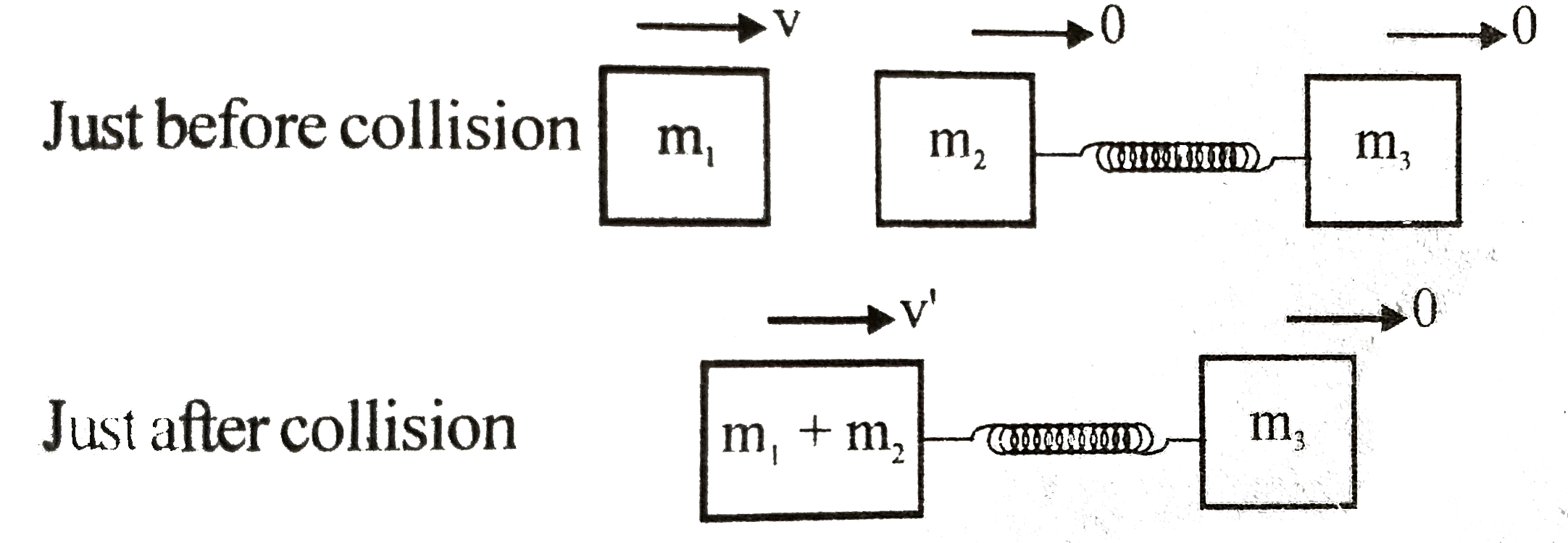 (a) We can use conservation of momentum as spring force is not an impulsive force. `rArrmv+0=(2m)V'rArr=(v)/(2)` `rArrv_(m_(1))=(v)/(2),v_(m_(2))=(v)/(2),v_(m_(3))=0` (b) Looking from CM FROME of refernce `v_(CM)=((2m)v'+m(0))/(2m+m)=(2)/(3)v'=(v)/(3)` 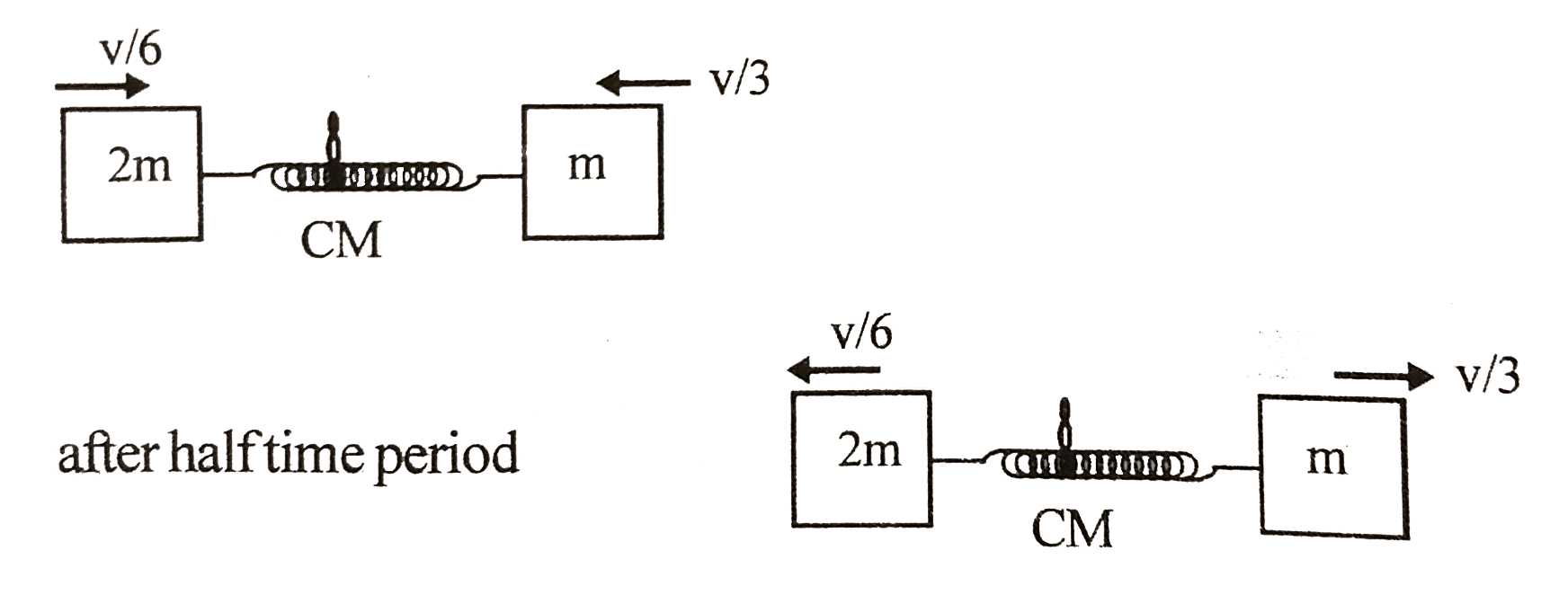 (Both the blocks will execute SHM of same time period in CM frome of reference) `rArr(v_(m_(3)))_(max)=(v)/(3)+v_(CM)=(v)/(3)+(v)/(3)=(2v)/(3)` `rArr(KE_(m_(3)))_(max)=(1)/(2)m(v_(3))_(max)^(2)=(1)/(2)m((2v)/(3))^(2)=(2mv^(2))/(9)` (c) `(v_(m_(2)))_(min)=(v)/(3)-(v)/(6)=(v)/(6)` `rArr(KE_(m_(2)))_(min)=(1)/(2)m(v_(2))_(min)^(2)=(1)/(2)m((v)/(6))^(2)=(MV^(2))/(72)` (d) At the time of maximum compression, both blacks will be at rest in CM frame of reference `rArr(1)/(2)kx_(max)^(2)=(1)/(2)(2m)((v)/(6))^(2)+(1)/(2)m((v)/(3))^(2)` `rArr(1)/(2)Kx_(max)^(2)=(1)/(12)mv^(2)` `rArrx_(max)=vsqrt((m)/(6k))` |
|