

Saved Bookmarks
| 1. |
A 14.5 kg mass, fastened to the end of a steel wire of unstretched length 1.0 m, is whirled in a vertical circle with an angular velocity of 2 rev/s at the bottom of the circle. The crosssectional area of the wire is 0.065 cm. Calculate the elongation of the wire when the mass is at the lowest point of its path. [Y_("Steel") =2 xx 10 ^(11) N,m ^(-2)] |
|
Answer» Solution :Centripetal force in circular motion , `F = (mv ^(2))/(r ) ""omega = 2pi f=2pi xx 2 ` `= mr omega ^(2) [ because v = r omega ]""=4pi rads^(-1)` When it is at te lowest position of the vertical circle total force, F= weight + centripetal force `= mg + mr omegga ^(2) = m [g + r omega ^(2)]` `=14.5 [9.8 + 1 xx (4 xx 3.14 ) ^(2) ] [because r =l =1 m]` `=14.5 [9.8 +(12.56) ^(2) ]=14.5 xx 167.55 = 2492.5` Young.s modulus `Y = ("Stress")/("Strain") = ((F )/(A))/((Delta l )/(l ))` `therefore Deltal = (Fl )/(AY) = (2429.5 xx 1 )/(65xx10^(-7) xx 2 xx 10 ^(11))` `therefore Delta l = 18.688 xx 10 ^(-4) m` `therefore Delta l = 1.87 xx 10 ^(-3) 10 ^(-3) m = 1.87 mm` 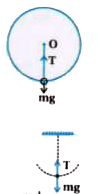 Second Method: `l = 1m` `m = 14.5 KG` `omega = 2 ("Rotation")/(s) = 2 xx 2 pi (rad)/(s) = 4pi (rad)/(s)` `A = 0.065 cm ^(2) = 0.065 xx 10 ^(-4) m ^(2)`  When the body is at the lowest position of the circle, then the centripetal force, `(mv ^(2))/( l ) = T - mg ` `therefore T = mg + (mv ^(2))/( l )` `therefore T = mg + (ml ^(2) omega ^(2))/( l)` `therefore T = mg + mlomega ^(2) = 14.5 xx 9.8 + 14.5 xx 1 xzx (4pi ) ^(2) = 2433.9 N` Now `Y = (sigma )/(sum)=( F //A)/( (Delta L )/(l ))` `Y= (FL )/( A Delta l ) = (Tl )/( A Delta l )` `therefore Delta l =(Tl )/(AY) = ( 2433.0 xx 1 )/( ( 0.065 xx 10 ^(-4)) xx 2xx 10 ^(11))` `therefore Delta l = 1.87 xx 10 ^(-3) m = 1.87 mm` |
|