

Saved Bookmarks
| 1. |
(a) A steel wire of mass u per unit length with a circular cross section has a radius of 0.1 cm. The wire is of length 10 m when measured lying horizontal and hangs from a hook on the wall. A mass of 25 kg is hung from the free end of the wire. Assuming the wire to be uniform an lateral strains lt lt longitudinal strains find the extension in the length of the wire. The density of steel is 7860 kgm ^(-3) and Young's modulus =2 xx 10 ^(11) Nm ^(-2) (b) If the yield strength of steel is 2.5 xx 10 ^(8) Nm ^(-2), what is the maximum weight that can be hung at the lower end of the wire ? |
Answer» Solution :(a) Consider an element dx at a distance x from the load `(x =0) . If T (x) and T ( x + dx)` are tensions on the two cross sections a distance dx apart then, 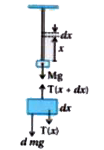 `therefore T(x+dx) -T(x) = gdm = mu g dx ` (where DM = mass of wire dx and `mu =` is the mass per unit length `= (dm )/(dx))` `therefore dT = mu g dx [ because T (x + dx) - T (x) = dT]` Integration on both side, `therefore T(x) = mu g x + C` but at `x =0,` tension `T(0)=0 +C` `therefore Mg = C` where M is suspended mass `therefore T(x) = mu gx + Mg ""...(1)` If element dx, increases by length dr then strain `= (dr)/(dx)` YOUNG modulus `Y= ((T (x))/( A))/( (dr)/( dx)) (dr)/(dx) = (T (x))/( YA)` Integrating on both the sides, `int _(0) ^(r) (dr)/(dx) = (1)/(YA) int T` `therefore r=(1)/(YA) int _(0) ^(1) (mu g x + Mg ) dx` `= (1)/(YA) [ ( mu g x ^(2))/( 2 ) + Mgx ] _(0 ) ^(L) ` `= (1)/(YA) [ (mu g L ^(2))/( 2) + MgL]` Now `mu =(m)/(L) implies mu L = m`( let) `= (1)/(YA) [ (mgL )/(2) + MgL]` but m = area ` xx` length `xx` density `= AL rho` `r = (1)/(YA) [ ( A L rho xx gL )/(2) + MgL ]` `= (1)/(YA) [ (A ro g L ^(2))/( 2 ) + MgL ] ` `=(1)/( 2 xx 10 ^(11) xx pi (0.1 xx 10 ^(-2)) ^(2))` `[ ((pi xx (0.1) xx 10 ^(-2)) xx 7860 xx 10 xx (10) ^(2))/( 2)+ 25 xx 10 xx 10 ]` `therefore r = 15.92 xx10 ^(-7)` `((3.14 xx 786 xx 10 ^(-6) xx 10 ^(3))/( 2 ) + 2500)` `= 15.72 xx 10 ^(-7) (1.234+ 2500)` `=15.72 xx 10 ^(-2) xx 2501.234` `= 3.98196xx 10 ^(-3)` `therefore r ~~4 xx 10 ^(-3) m` (b) The maximum tension would be at `x = L` `T = mu g L + Mg [ because `Putting `x = L ` in eq. (1) ] `= mg + Mg [ because mu = (m)/( L ) implies m=mu L]` `T= (m +M) g""...(2)` and maximum tension force = stress `xx` area `=250 xx 10 ^(6) xx pi xx 10 ^(-6)` `= 250 pi N ""...(3)` `(m + M) g = 250 pi N` here, `m lt lt M , m `is neglected compare to M `Mg = 250 pi` `therefore M = (250 pi)/(g) = ( 250 xx 3.14 )/(10)` ` therefore M =78.5 kg` |
|