

Saved Bookmarks
| 1. |
A ball A of mass m is suspended by a thread of length r = 1.2 m. Another ball B of mass 2m is projected from the ground with velocity it u= 9 m//s such that at the highest point of its trajectory it collides head-on elastically with ball A. It is observed that during subsequent motion, tension in the thread at the highest point is equal to mg. The height of the point of suspension of ball A from the ground is |
|
Answer» `81/40m` 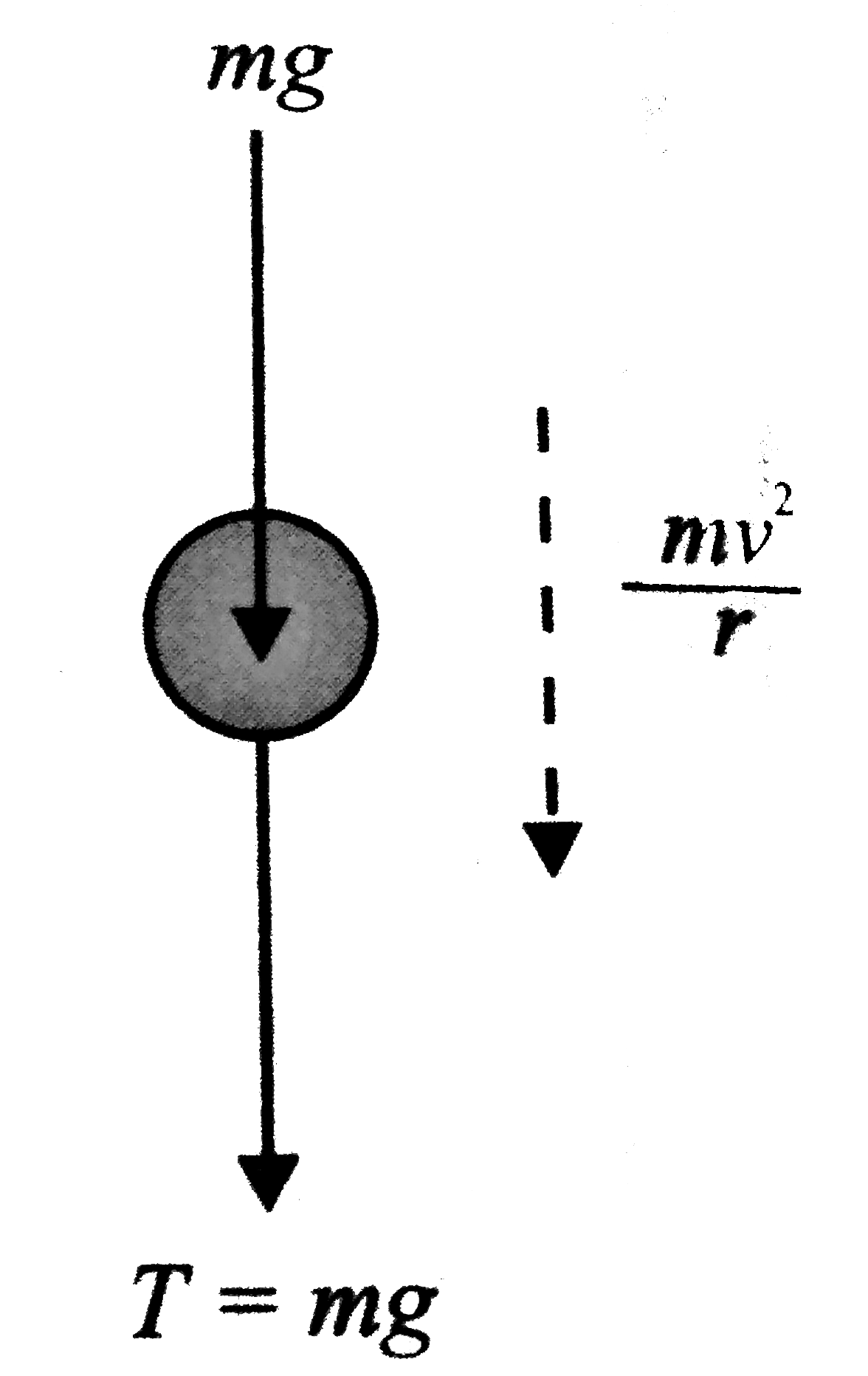 `mg+ T=(mv^(2))/r` where` T=mg` `implies v^(2)=2rg` `implies v=sqrt(2rg)=2sqrt(6)m//s` If the velocity of ball `A` just after the collisin is `v_(1)` then according to law of conservation of energy its `KE` at `A=(KE+PE)` at highest point `1/2mv_(1)^(2)=1/2mv^(2)+mg(2r)` `v_(1)=sqrt(6rg)` or `v_(1)=6sqrt(2)m//s` If angle of project of ball `B` is `theta`, then horizontal component of its velocity will be `9 costheta` and it remains constant. 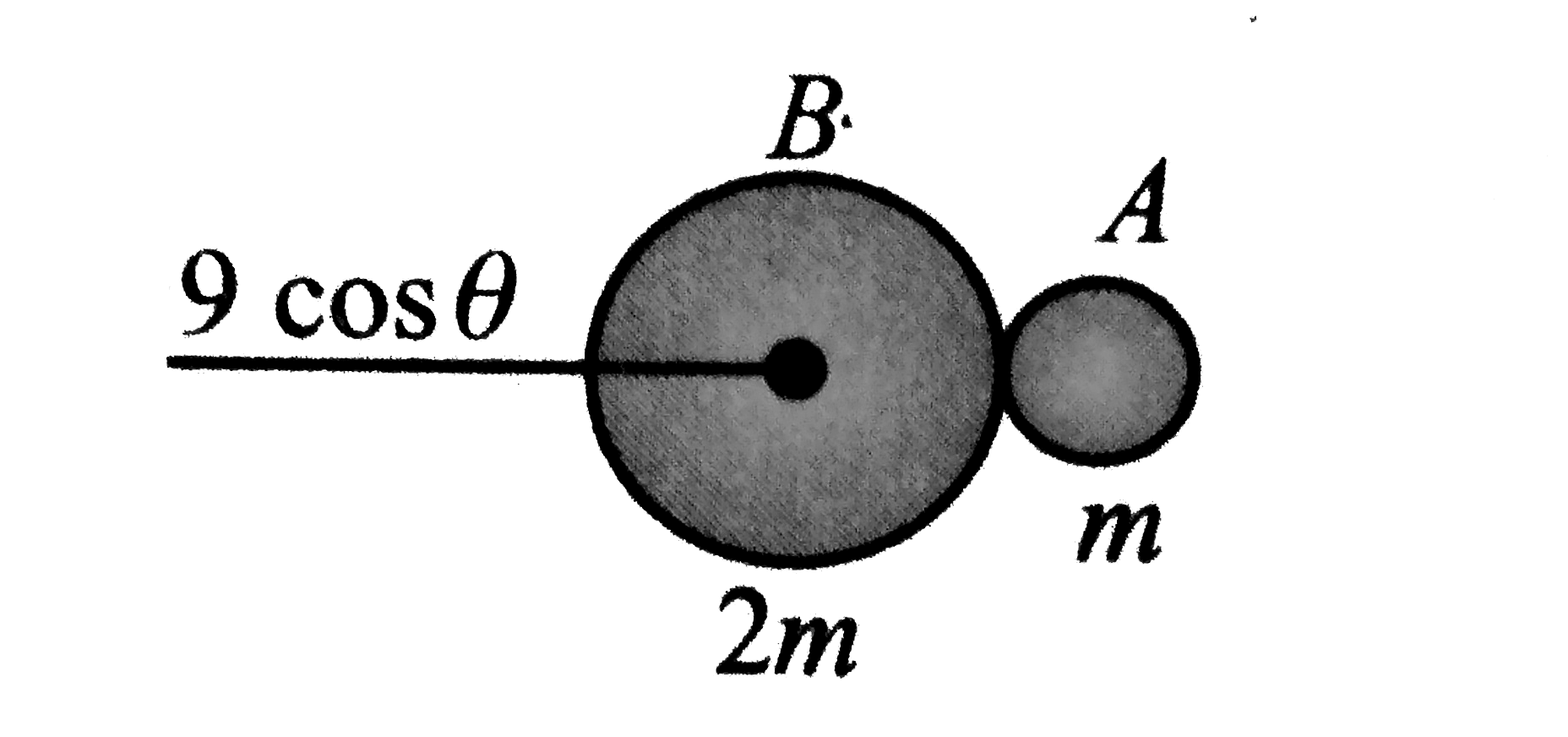 Now considering COLLISION of balls `B` and `A`, let velocitiesof balls `A` and `B`, just after the collision, be `v_(1)` and `v_(2)` respectively as shown in figure. Then according to the law of conservation of momentum `mv_(1)+2mv_(2)=2m(9costheta)` ...........i Since collision is ELASTIC, therefore `e=1` `(v_(1)-v_(2))/(9costheta)=1` or `v_(1)-v_(2)=9costheta` ........ii Solving eqn i and ii we get `costheta=1/(sqrt(2))` or `theta=45^(@)` `v_(2)=3/(sqrt(2))ms^(-1)` height of initial position of ball `A` (LOWEST position) is equal to maximum height ascened by the ball `B`. It is equal to `H=((9sintheta)^(2))/(2G)=81/40m` Height of point of suspension from the ground is `H=r=129/40m` |
|