

Saved Bookmarks
| 1. |
A ball is thrown straight up from the edge of the roof of a building .A second ball is dropped from the roof 1.00 s later. You may ignore air resistance. a. If the height of the buliding is 20.0 m, what must the initial speed be of the first batt if bothe are to hit the ground at the same time? Consider the same situation, but now let the initial speed v_(0) of the first ball be given and treat the height (h) of the building as an unknown. b. What must the height of the building be for both balls to reach the ground at the same time for each of the following values of v_(0): (ii) 9.5 m s^(-1_? c. If v_(0) is greater than some valus v_(max), a value of (h) does same time. Solve for v_(max). The value v_(min) also has a simple physicalinterpretation. What is it? |
|
Answer» Solution :For the purpose of doing all four farts with the least reperition of algebra, quantities will be dented symbolically. That is, let `y_(1)=H+v_(0)t-(1)/(2)g t^(1)` and `y_(2)=h-(1)/(2)g(t-t_(0))^(2)`. In this case, `t_(0)=1.00 s`. SETTING `y_(1)=y_(2)=0`, expanding the binomial `(t-t_(0))^(2)`, which can be solved for `t`, `t=((1)/(2)g t_(0)^(2))/(g t_(0)-v_(0)) =t_(0)/(2) (1)/((1-v_(0)/(g t_(0)))` Substiuting this into the expressinon for `y_(1)` and setting `y_(1)=0` and solving for `h` as a function of `v_(0)` yields after some algebra, `h=(1)/(2) g t_(0)^(2)((1)/(2)g t_(0)-v_(0))^(2)/(g t_(0)-v_(0))^(2)` a. Using the GIVEN value, `t_(0)=1.00 s` and `g=9.80 ms^(-2)`. `h=20.0 m=(4.9 m) ((4.9 ms^(-1)-v_(0))/(9.8 ms^(-2)-v_(0)))` This has two solutions, one of which is not physical [the first ball is still going up when the second is released, see part `C `]. The physical solution invlves taking the negative square root before solving for `v_(0)`, and yields `8.2 ms^(-1)` 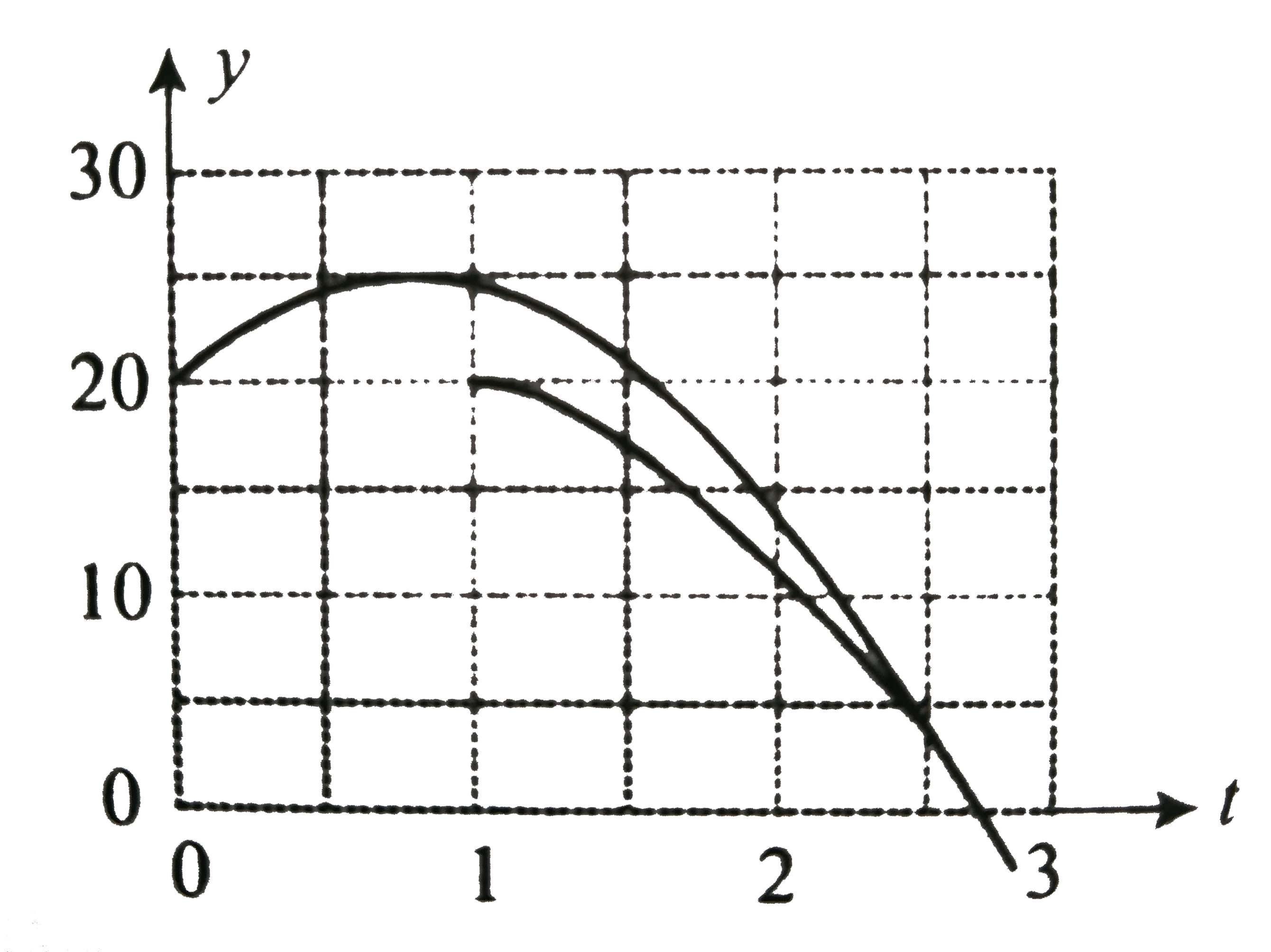 . . b. The above expression gives for (i) `0.411 m` and for (ii) `1.15 km`. C. As `v_(0)` approaches `9.8 ms^(-1)`, the height `h` becomes infinite corresponding to a relative VELOCITY at the second ball is throun that approaches zero, If `v_(0)le 9.8 ms^(-1)`, the first ball can never catch the second ball. d. As `v_(0)` approaches `4.9 ms^(-1)` the height approaches zero. This corresponds to the first ball being CLOSER and is released. If `v_(0) le 4.9 ms^(-1)`, the first ball will already have roof on the wau down nefore the second ball is released, and the second ball can catch up. |
|