

Saved Bookmarks
| 1. |
A ball of mass m hits a wedge of mass M vertically with speed u, which is placed, on a smooth horizontal surface. Find the maximum compression in the spring, if the collision is perfectly elastic and no friction any where. Spring constant of spring is K. |
Answer» 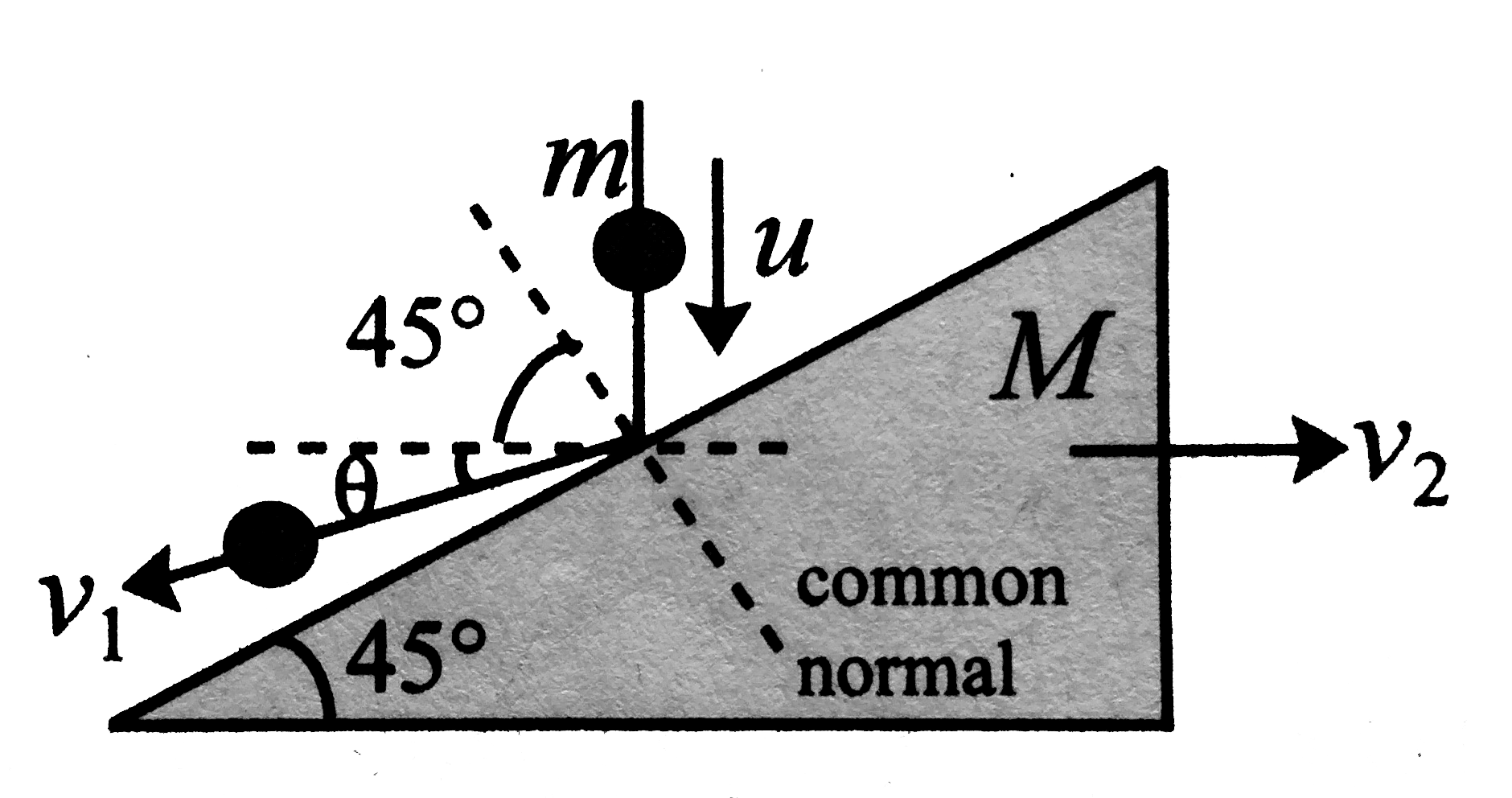 Aplying conservation of momentum in horizontal direction `mv_(1)costheta=Mv_(2)` ……….i From Newton's experimental LAW: `e=1=(v_(2)sin45^(@)-[-v_(1)cos(45+theta)])/(ucos45^(@))` `implies u=v_(2)+v_(1)costheta-v_(1)theta` ...........ii Velocity component of the ball along the surfasce of wedge will remain the same as during collision there is no force on the ball in this direction So `usin45^(@)=v_(1)cos(45-theta)impliesu=v_(1)costheta+v_(1)sintheta`...iii From i and ii and iii `v_(2)=(2"mu")/(m+2M)` To find maximum compression in the sprig, after collision apply conservation of energy for the SYSTEM of wedge and spring. `1/2 Mv_(2)^(2)=1/2Kx^(2)` `implies X=sqrt(M/x)v_(2)implies x((2"mu")/(m+2M))sqrt(M/K)` |
|