

Saved Bookmarks
| 1. |
A ball of mass m moving with constant horizontal velocity u strikes a stationary wedge of mass M on its inclined surface as shown in the figure. After collision, the ball starts moving up the inclined plane. The wedge is placed on frictionless horizontal surface. a. Calculate the velocity of wedge immediately after collision. b. Calculate the maximum height the ball can ascend on the wedge. |
|
Answer» `mu=Mv+m(V+v_0cosalpha)`….i 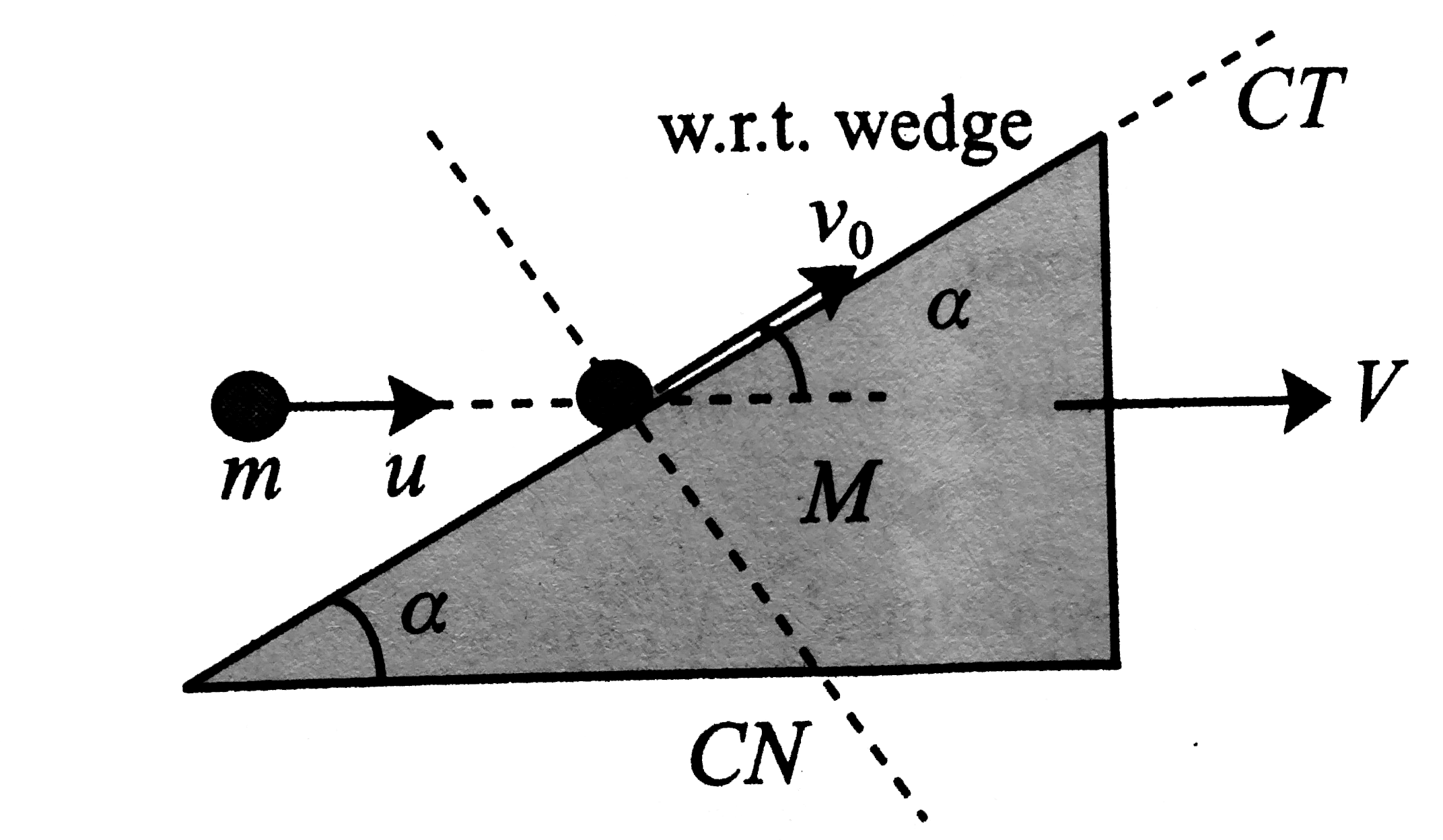 Velocity along CT remains, constant `ucosalpha=v_0+Vcosalpha`.......ii `vecv_b=(v_0cosalpha+V)HATI+(v_0sinalpha)hatj` From i and ii `"mu"=MV+mV+mcosalpha(ucosalpha-Vcosalpha)` `=(M+m)V+mucos^2alpha-mcos^2alpha` `implies V=("mu"sin^2alpha)/(M+msin^2alpha)` b. When the bal ASCENDS maximum HEIGHT, then ball will be at rest w.r.t. wedge and ther velocity will be same. Let their common velocity be `v'`. From conservationof momentum we cn FIND this common velocity as `'v'="mu"(M+m)`. From ii `v_(0)-(u-V)cosalpha`, put the value of `V` in this to get `v_(0)=(Mucosalpha)/(M+msin^(2)alpha)` Also, `v_(0)cosalpha+V=[(Mcos^(2)alpha+msin^(2)alpha)/(M+msin^(2)alpha)]u` To find maximum height From energy conservation `mgh+1/2(m+M)v^('2)` `=1/2MV^(2)+1/2m(v_(0)cosalpha+V)^(2)+1/2m(v_(0)sinalpha)^(2)` `2mgh+(m^(2)u^(2))/(M+m)=MV^(2)+m(v_(0)cosalpha+V)^(2)+m(v_(0)sinalpa)^(2)` `2mgh+(m^(2)u^(2))/(M+m)` `MM^(2) u^(2) sin^(4)alpha+m(Mcos^(2)alpha+msin^(2)alpha)^(2) u^(2)` `=(+mM^(2)u^(2)cos^(2)alphasin^(2)alpha)/((M+msin^(2)alpha)^(2))` Solve to get: `h=u^(2)/(2g) [(M^(2)cos^(2)alpha)/((M+m)(M+msin^(2)alpha))]` |
|