

Saved Bookmarks
| 1. |
A circular disc of mass 300 gm and radius 20 cm can roate freely about a vertical axis passing through its centre of O.A small inset of mass 100 gm is initially stationary) the insect starts walking from rest along the rim of the disc with such a time varying relative velocity that the disc rotates in the opposite direction with a constant angular acceleration = 2 pi rad//s^(2). After some time T, the insect is back at the point A. By what angle has the disc rotated till now , as seen by a stationary earth observer ? Also find the time T. |
Answer» 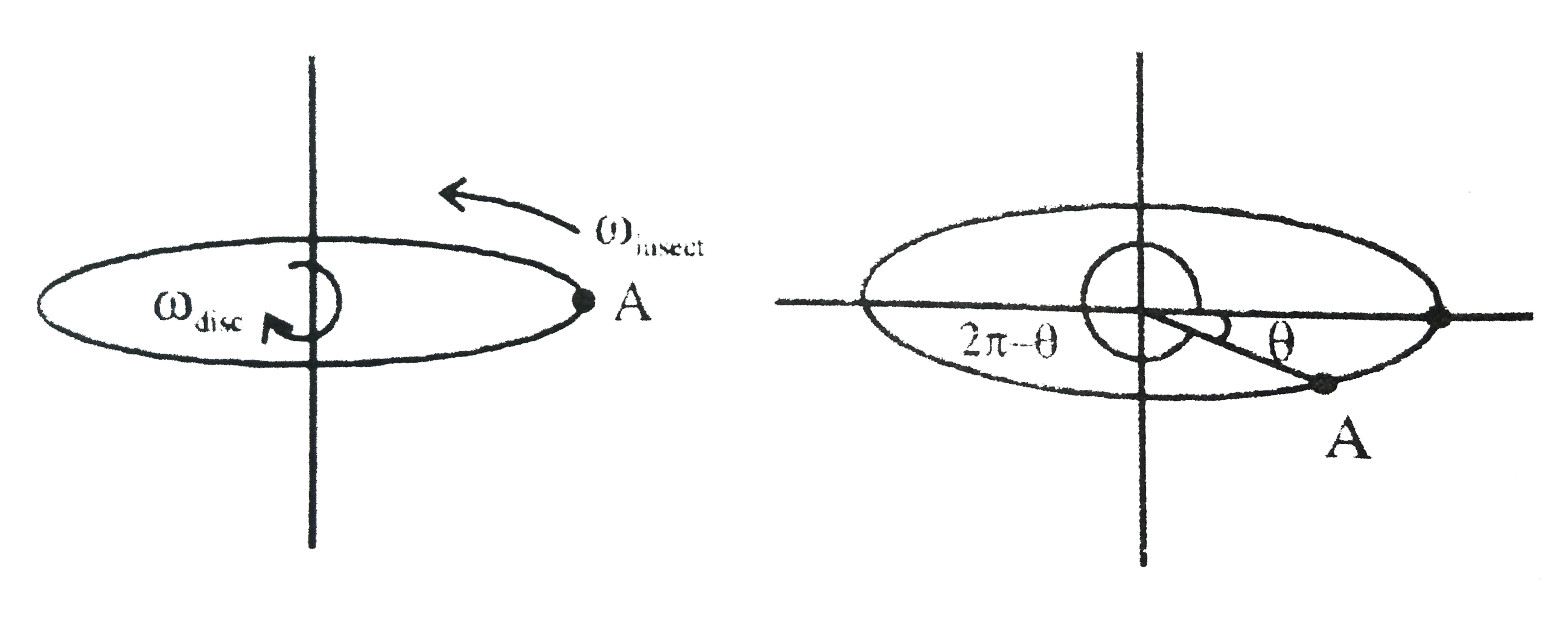 `I_("disc") omega_("disc") = I_("insect") omega_("insect") rArr I_("disc") alpha_("disc") = I_("insect") alpha_("insect")` `(1)/(2) xx(0.3) xx(0.2)^(2) xx 2 PI = (0.1) xx (2)^(2) xx alpha_("insect")` `alpha_("insect") = 3 pi RAD//sec^(2)` Angular covered by disc `= THETA`, so angle covered by insect `= 2 pi - theta` For disc `theta = (1)/(2) alpha_(disc) T^(2)` `theta = (1)/(2) xx 2 pi T^(2) rArr T^(2) = theta//pi` For insect `2 pi - theta = (1)/(2) alpha_(insect) T^(2)` From equation (1) and (2) `2PI - theta = (1)/(2) xx 3 pi xx (theta)/(pi) rArr 2 pi -theta = (3 theta)/(2)` `theta = (4 pi)/(5) rad`. |
|