

Saved Bookmarks
| 1. |
A container of large uniform cross-sectional area A resting on a horizontal surface, holds two immiscible, non-viscous and incompressible liquids of densities d and 2d, each of height (H)/(2) as shown in figure. The lower density liquid is open to the atmosphere having pressure P_(0). (a) A homogeneous solid cylinder of length L(L lt (H)/(2)) cross-sectional area (A)/(5) is immersed such taht it floats with its axis vertical at the liquid-liquid interface with the length (L)/(4) in the denser liquid. Datermine: (i) The density D of the solid and (ii) The total pressure at the bottom of the container. (b) The cylinder is removed and the original arrangement is restored. A tiny hole of area s (s lt lt A) is puched on the vertical side of the container at a height h (h - ((H)/(2))). Determine : (i) The initial speed of the efflux of the liquid at the hole (ii) The horizontal distance x travelled by the liquid initially and (iii) The height h_(m) at which the hole should be punched so that the liquid travels the maximum distance x_(m). initially. Also calculate x_(m). [ Neglect air resistance in these calculations ] |
|
Answer» WEIGHT of cylinder `=` unthurst due to upper liquid `+` upthrust due to lower liquid Note that `h_(1)` and `h_(2) ne (H)/(2)` `:. ((A)/(5)) (L) D.g = ((A)/(5)) ((3L)/(4)) (d)g + ((A)/(5)) ((L)/(4)) (2d)(g)` `:. D = ((3)/(4)) d + ((1)/(4)) (2d)` `D = (5)/(4) d` `(ii)` Considering vertical equilibrium of two liquids and the cylinder. `(P - P_(0))A =` weight of two liquids `+` weight of cylinder `:. P = P_(0) + ("weight of liquids" + "weight of cylinder")/(A) ...(1)` Now, weight of cylinder `= ((A)/(5))(L)(D)(g) = ((A)/(5)Lg) ((A)/(5)d)` `= (ALdg)/(4)` Weight of upper liquid `= ((H)/(2)Adg)` and Weight of lower liquid `= (H)/(2)A(2d)g = HAdg` `:.` Total weight of two liquids `= (3)/(2) HAdg` `:.` From Eq. `(1)` pressure at the bottom of the container will be `P = P_(0) + (((3)/(2))HAdg + (ALdg)/(4))/(A)` or `P = P_(0) + (dg(6H + L))/(4)` (b) `(i)` Applying Bernoulli's theorem at `1` and `2` `P_(0) + dg((H)/(2)) + 2dg ((H)/(2)-h) = P_(0) + (1)/(2)(2d)v^(2)` Here, `v` is velocity of EFFLUX at `2`. Solving this, we get `v = sqrt((3H - 4h)(g)/(2))` `(ii)` Time taken to reach the liquid to the bottom will be `t = sqrt(2h//g)` / Horizontal distance `x` travelled by the liquid is `x = vt = sqrt((3H - 4h'(g)/(2))) (sqrt((2h)/(g)))` 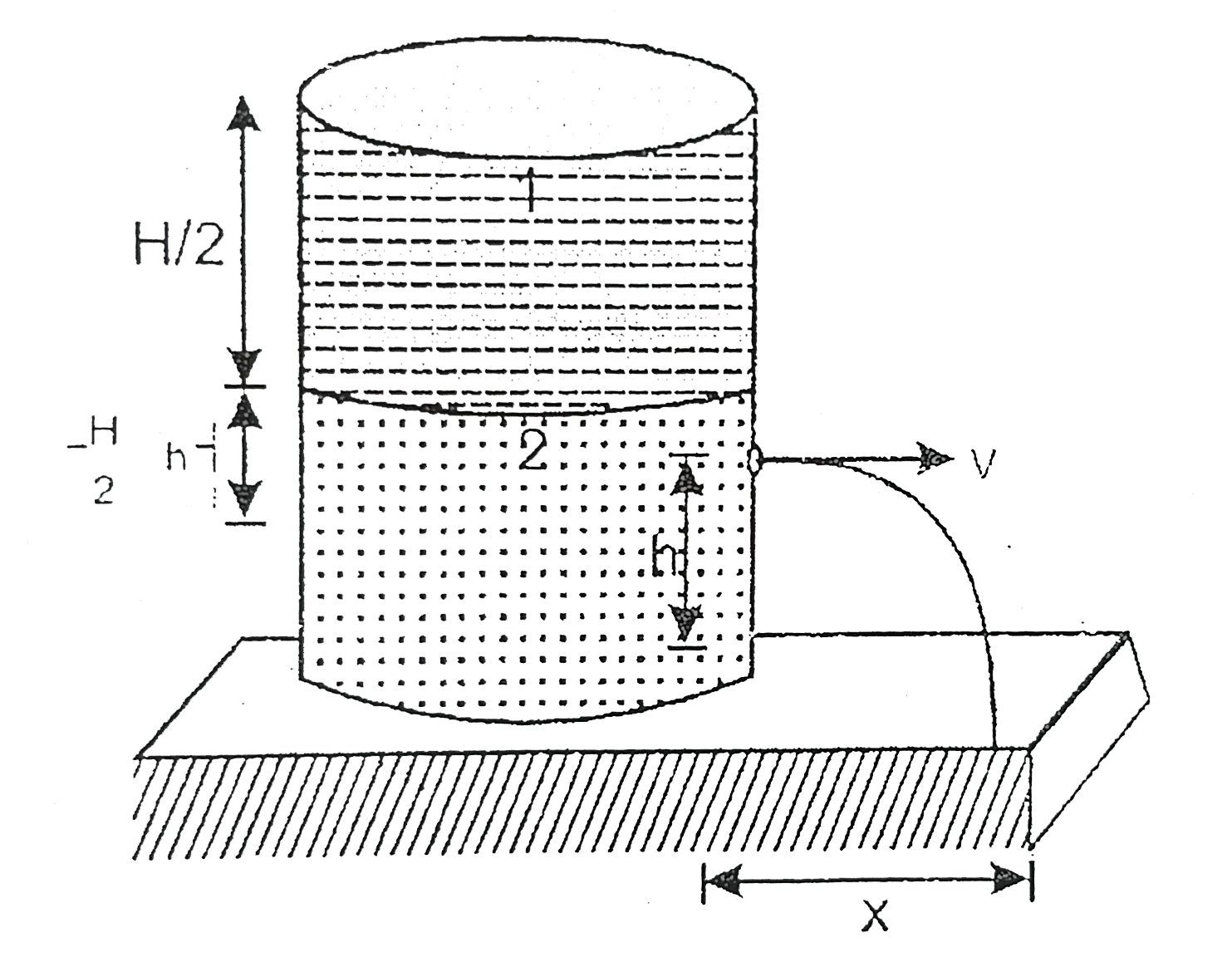 `(iii)` For `x` to be maximum `(dx)/(dh) = 0` or `(1)/(2sqrt(h(3H - 4h))) (3H - 8h) = 0` or `h = (3H)/(8)` Therefore, `x` will be maximum at `h = (3H)/(8)`. The maximum value of `x` will be `x_(m) = sqrt((3H)/(8)3H - 4(3H)/(8))` `x_(m) = (3)/(4)H` |
|