

Saved Bookmarks
| 1. |
A cylinder rests on a horizontal rotating disc, as shown in the figure. Find at what angular velocity, omega, the cylinder falls off the disc, if the distance between the axes of the disc and cylinder is R, and the coefficient of friction mugtD//h where D is the diameter of the cylinder and It is its height. |
Answer» 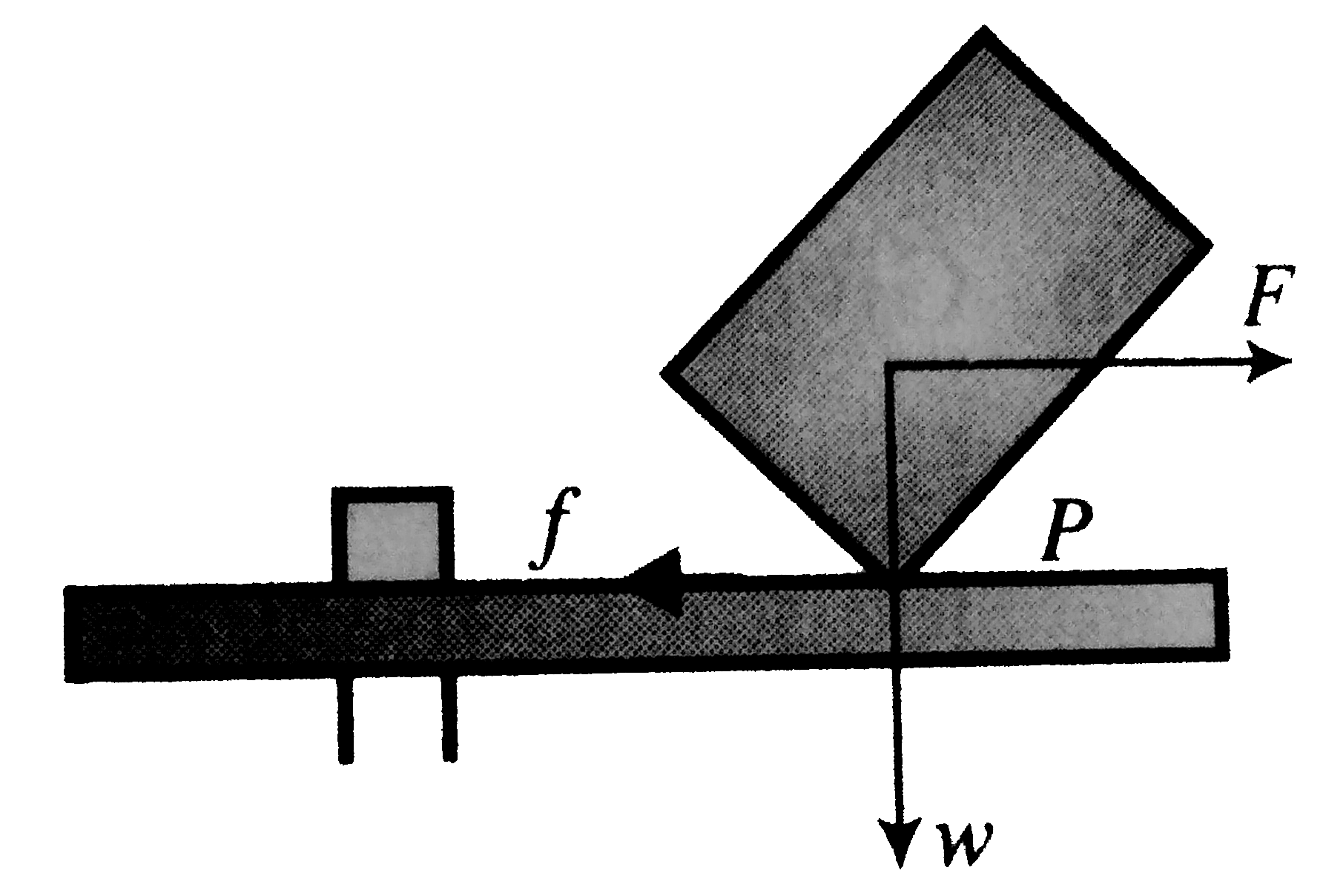 `F=MOMEGA^(2)R` where `M` is the mass of the cylinder. The cylinder can fall off either by slipping away or by tilting about point `P`, depending of whichever takes place first. the critical agular speed `w_(1)` for slipping occurs when `F` equals `f:F=f` `Momega_(1)^(2)R+mugM` where `g` is the gravitational acceleration. HENCE `omega_(1)=sqrt((mug)/R)` `F` TIES to rotaste the cylinder about `P`, but the weight `W` OPPOSES it. The rotatiion becomes pssible, when the torque caused by `W`. `Fh/2=W D/2implies F=W D/h` `Momega_(2)^(2)R=Mg D/h` giving `omega_(2)=sqrt(D/(hR))` Since we are given `mugtD/h`, we see that `omega_(1)gtomega_(2)` and the cylinder falls off by rolling over at `omega=omega_(2).` |
|