

Saved Bookmarks
| 1. |
A disc of radius R is rotating with an angular speed omega_(0) about a horizontal axis. It is placed on a horizontal table. The coefficient of kinetic friction is mu_(k). (a) What was the velocity of its centre of mass before being brought in contact with the table ? (b) What happens to the linear velocity of a point on its rim when placed in contact with the table ? (c ) What happens to the linear speed of the centre of mass when disc is placed in contact with the table ? (d) Which force i sresponsible for the effects in (b) and (c ). (e) What condition should be satisfied for rolling to begin ? (f) Calculate the time taken for the rolling to begin. |
|
Answer» `t=(Romega_(0))^(2)/(mu_(k)g(1+(mR^(2))/(I)))` 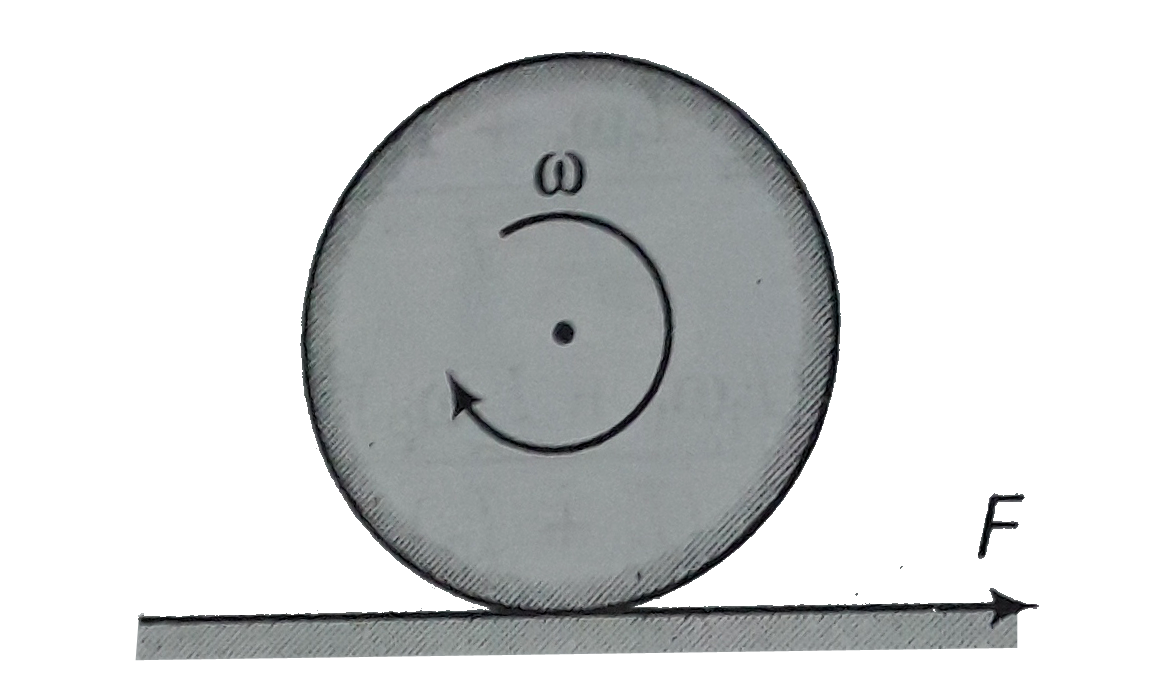 (b)when thedisc is placedin contact with thetable duetofrictionvelocityof a pointon therimdecreases , (c)when therotatingdiscis placed in correctwith the tabledueto frictioncentre of massacquiriessomelinear velocity. frictionisresponsiblefor theeffects in (b) and ( c) (e)whenrollingstarts `v_(CM)-omegaR.` 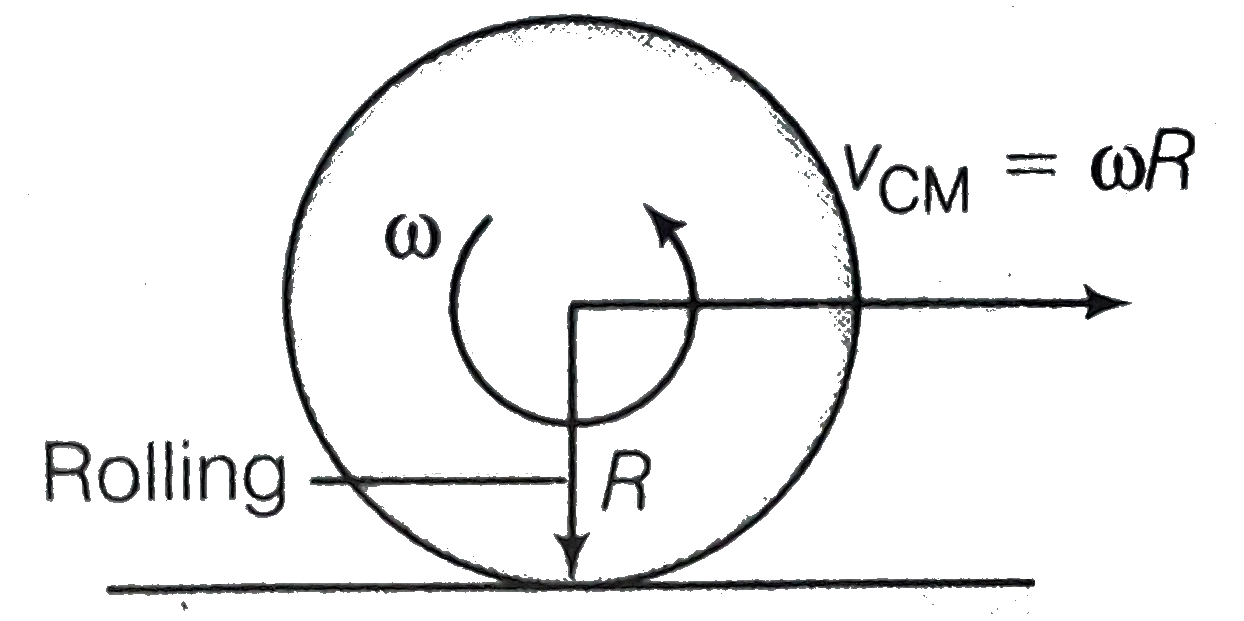 where `omega` is angular speedof thediscwhenrolling just starts. (f)Accelerationproduced in CENTRE of massdue to friction `a_(CM)=(F)/(m)=(mu_(k)mg)/(m)=mu_(k)g.` 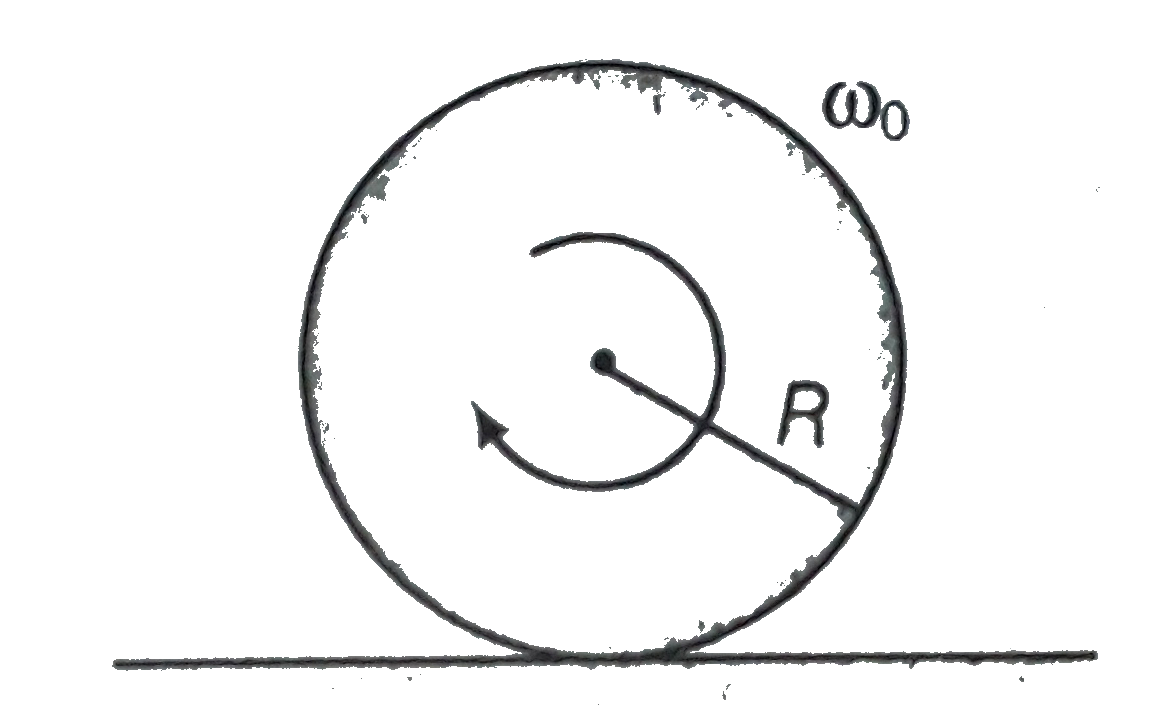 Angular retardation produced by the torquedueto fricton . `alpha=(tau)/(I)=(mu_(k)MGR)/(I) ""[:' tau=(mu_(k)N)R=mu_(k)mgR]` `therefore v_(CM=u_(CM))+a_(CM^(t))` ` implies V_(CM)=mu_(k)"GT" ( :'U_(CM)=0)` ` andomega=omega_(0)+at` ` implies omega=omega_(0)-(mu_(k)mgR)/(I)t` Forrolling withoutsliping ,`(V_(CM))/(R)=omega` `implies (V_(CM))/(R)=omega_(0)-(mu_(k)mgR)/(I)t` `(mu_(k)g t)/(R)=omega_(0)-(mu_(k)mgR)/(I)t` `t=(Romega_(0))/(mu_(k)g(1+(mR^(2))/(I)))` NOTE in thisproblem , frictional forcehelp in seting purerolloing motion . |
|