

Saved Bookmarks
| 1. |
A helicopter files horizontally with constant velocity in a direction theta east of north between two points A and B, at distance d apart. Wind is blowing from south with constant speed u , the speed of helicopter relative to air is nu where n gt 1. find the speed of the helicopter along AB. The helicopter returns from B to A with same speed nu relative to air in same wind. Find the total time for the journeys. . |
|
Answer» Solution :Velocity of helicopter w.r.t. groundn is given by `vec V_(Helicopter, air) = vec V_(Helicopter,air) + vec V _(Air) = vec V_(Air) + vec V_(Helicopter, air)` `|vec V_(H A)| = n u, |vec V_A| = u, |vec V_H| = V` Hence, the actual velocity of helicopter is the vector sum of its velocity of helicopter relative to air and velocity of air. Using cosine rule, for motion from `A to B`, `n^2 u^2 = u^2 + v^2 - 2 u v COS THETA` or `v^2 - 2 u v cos theta = u^2 (n^2 - 1)` or `(v - u cos theta)^2 = u^2 (n^2 - 1) + u^2 cos^2 theta` =`u^2 (n^2 - sin^2 theta)` `v - u cos theta = +- u sqrt(n^2 - sin^2 theta)` `v = u cos theta +- u sqrt(n^2 - sin^2 theta)` As `n ge 1`, `n^2 - sin^2 theta ge 1 - sin^2 theta ge cos^2 theta` Hence, speed of helicoper is `v = u cos theta + u sqrt(n^2 - sin^2 theta))` Now we consider motion from `B` to `A`. Similar to first case, the helicopter will return to `A along BA` when its velocity after being deflected by wind is along `BA`. Once again using consine rule inthe vector TRIANGLE, we get `n^2 u^2 = u^2 + V^2 - 2u V cos (180^@ - theta)` =`u^2 + V^2 + 2u V cos theta` `V = -u cos theta + u sqrt(n^2 - sin^2 theta)` The TOTAL time for motion `A` to `B` and `B` to `A`, `t = (d)/(v) + (d)/(V)` =`(d (u + V))/( uV)` =`(2 d usqrt(n^2 - sin^2 theta))/(u^2 (n^2 - sin^2 theta) - u^2 cos^2 theta)` =`(2 d usqrt(n^2 - sin^2 theta))/(u^2 (n^2 - 1)) = (2 dsqrt(n^2 - sin^2 theta))/(u(n^2 - 1))`. 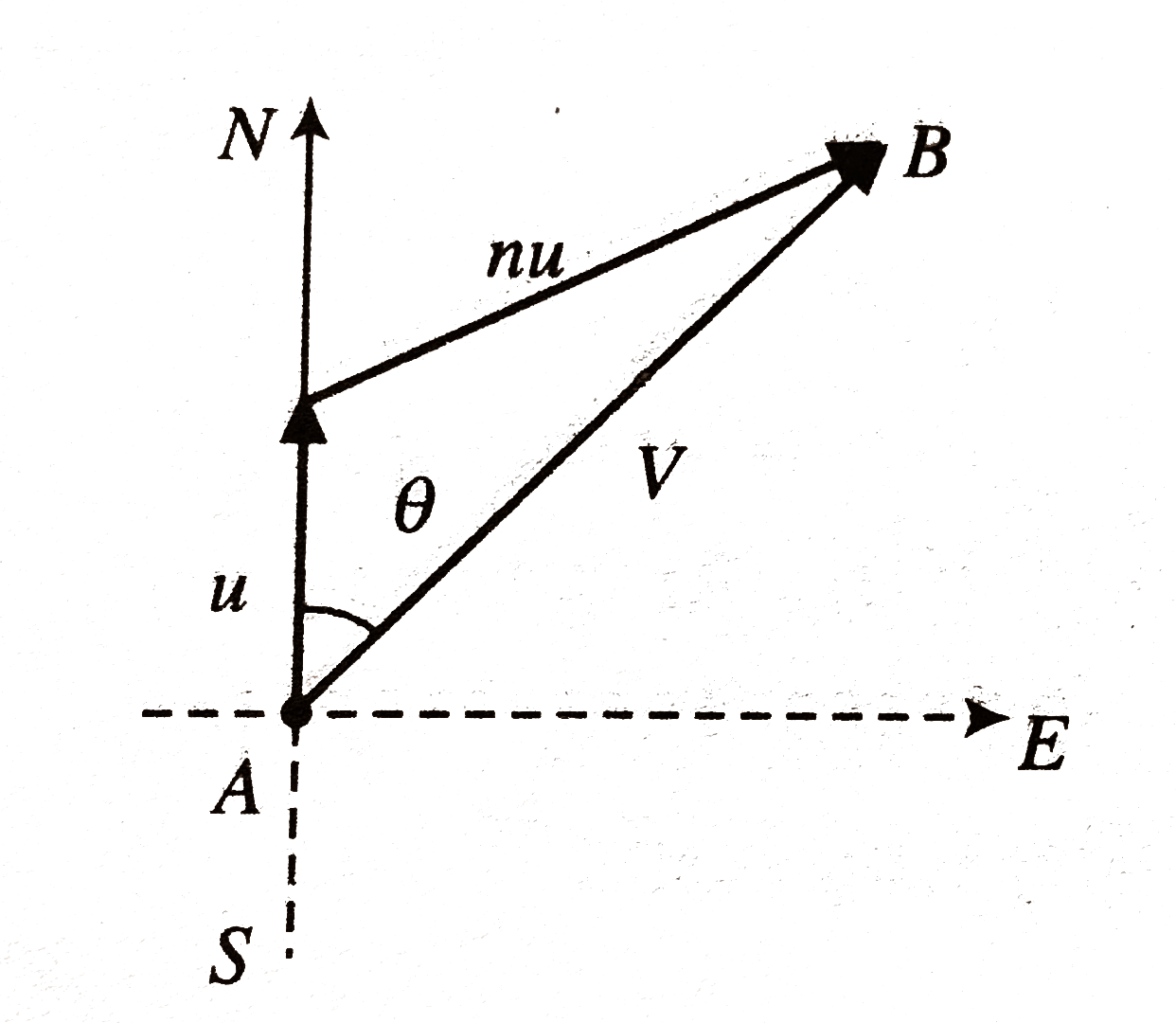 , 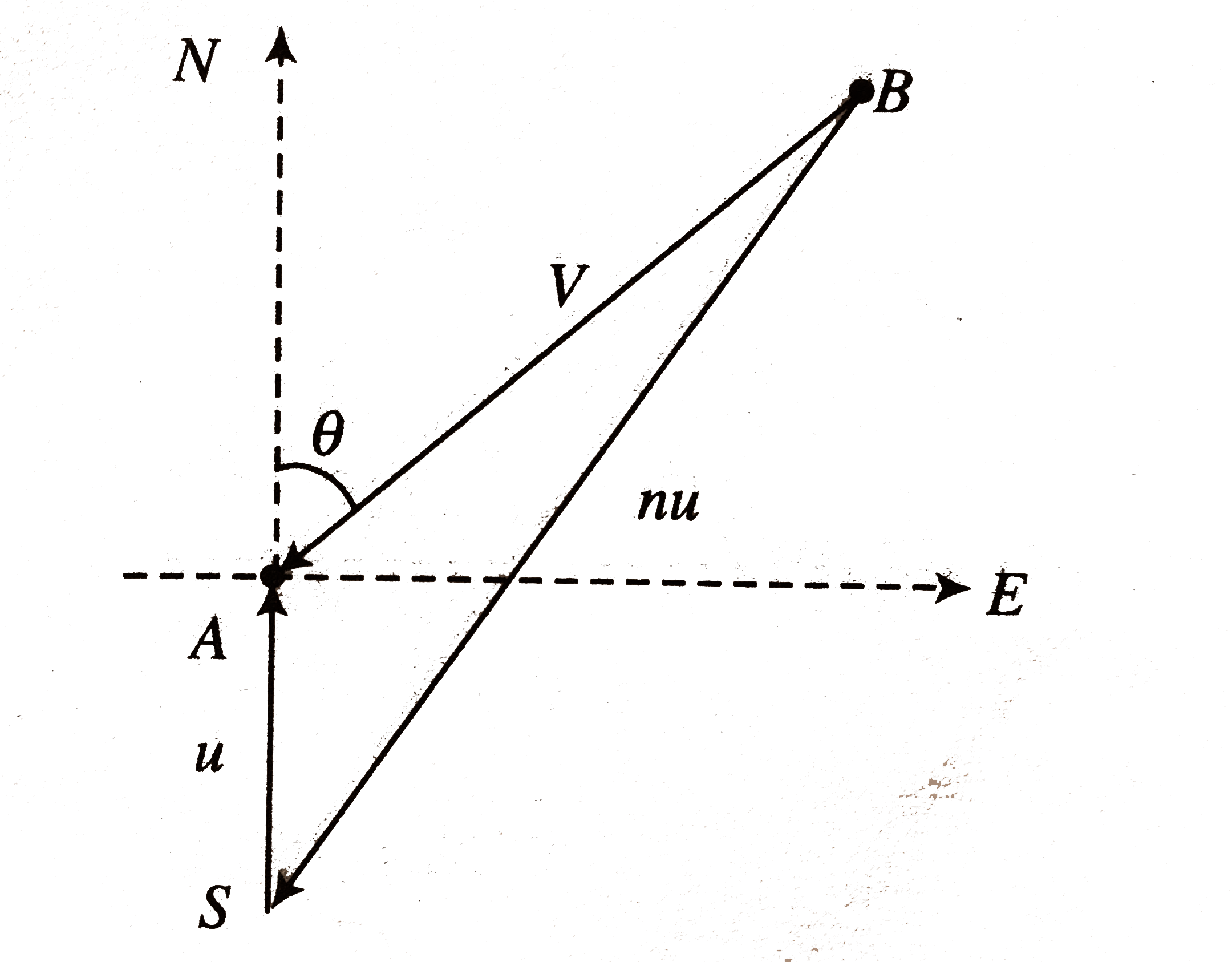 . |
|