

Saved Bookmarks
| 1. |
A hot body placed in a surrounding of temperature theta_(0) obeys Newtons's law of cooling d theta // dt = - k (theta - theta_(0)). Its temperature at t = 0 is theta_(1). The specific heat capacity of the body is s and its mass ism. Find (a) the maximum heat that the body can lose and (b) the time starting from t = 0 in which it will lose 90% of this maximum heat. |
|
Answer» Solution :(a) The body will lose heat until its TEMPERATURE equals that of surrounding `(Delta Q)_(max) = mx (theta_(1) - theta_(0))` (b) Let in TIME `t`, body LOSES `90%` of `(Delta Q)_(max)`. It will lose `10%` of `(Delta Q)_(max)` further. `(1)/(10) (Delta Q)_(max) = ms (theta - theta_(0))` `(1)/(10) (theta_(1) - theta_(0))_(max) = ms (theta - theta_(0))` `(theta - theta_(0)) = (1)/(10) (theta_(1) - theta_(0))` The temperatuure DIFFERENCE of body and surrouding after time `t` `(theta - theta_(0)) = (theta_(1) - theta_(0)) e^(-kt)` `(1)/(10) (theta_(1) - theta_(0)) = (theta_(1) - theta_(0)) e^(-kt)` `e^(kt) = 10` `kt 1n e = 10` `t = (1n 10)/(K)` 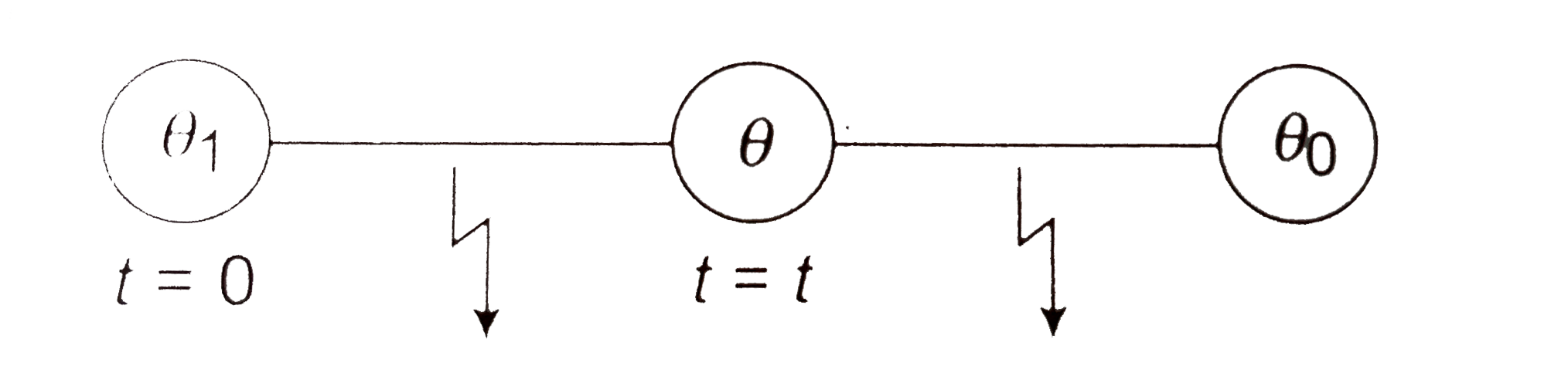
|
|