

Saved Bookmarks
| 1. |
A metal rod length l=100 cm is changed at two points A and B as shown in fig. Distance of each clamp from neared and is a=30 cm. if density and Young's modulus of elesticity of rod material are rho=9000 kg//m^(3) and Y=144 Gpa, respectively, calculate minimum and next higher frequency of natural longitudinal oscillations of the rod. |
|
Answer» Solution :Speed of longitudinal waves in the rod is `v = sqrt(( Y)/( rho)) = 4000 m//s` Since points `A and B` are clamped , therefore , nodes are formed at these points or rod oscillates with integer number of loops in the middle part . Let number of these loops be `m` . Since , LENGTH of each loop is `lambda //2` , therefore , ` m lambda//2 = ( 1 - 2 a)` or`m lambda = 80 cm`(i) Since the ends of the rod are free, therfore , antinodes are formed at each end of the rod or at one end of each end part is an antinode and at the other end is a node . It means that number of loops in each end part will be an odd multiple of half .Let these be `( 2n - 1)//2` where `n` is an integer.Then, `(( 2n -1)/( 2)) ( lambda)/(2) = a or ( 2n - 1) lambda = 120 cm`(II) Dividing Eq. (i) by Eq. (ii), `(m)/(( 2n -1)) = (2)/(3)`(iii) Minimum possible frequency corresponds to maximum possible wavelength , hence , minimum number of loops. Hence , from Eq. (iii) , for minimum frequency `m` should be wqual to `2 and ( 2 n -1 )` should be equal to `3 or n = 2`. Substituting ` m = 2` in Eq . (i), Maximum wavelength `lambda_(0) = 40 cm` Minimum frequency , `f_(0) = (v)/( lambda_(0)) = 10 KHz` NEXT HIGHER frequency corresponds to next higher integer values of `m and n` which satisfy Eq. (iii). Hence , for this case `m = 6 and ( 2n -1) = 9 or n = 5`. Substituting ` m = 6 ` in Eq. (i) , ` lambda = ( 80)/( 6) cm or ( 40)/( 3) cm` Therefore , next higher frequency , `f_(1) = (v)/( lambda) = 30 Hz` ( It means rod oscillates with odd harmonics.) 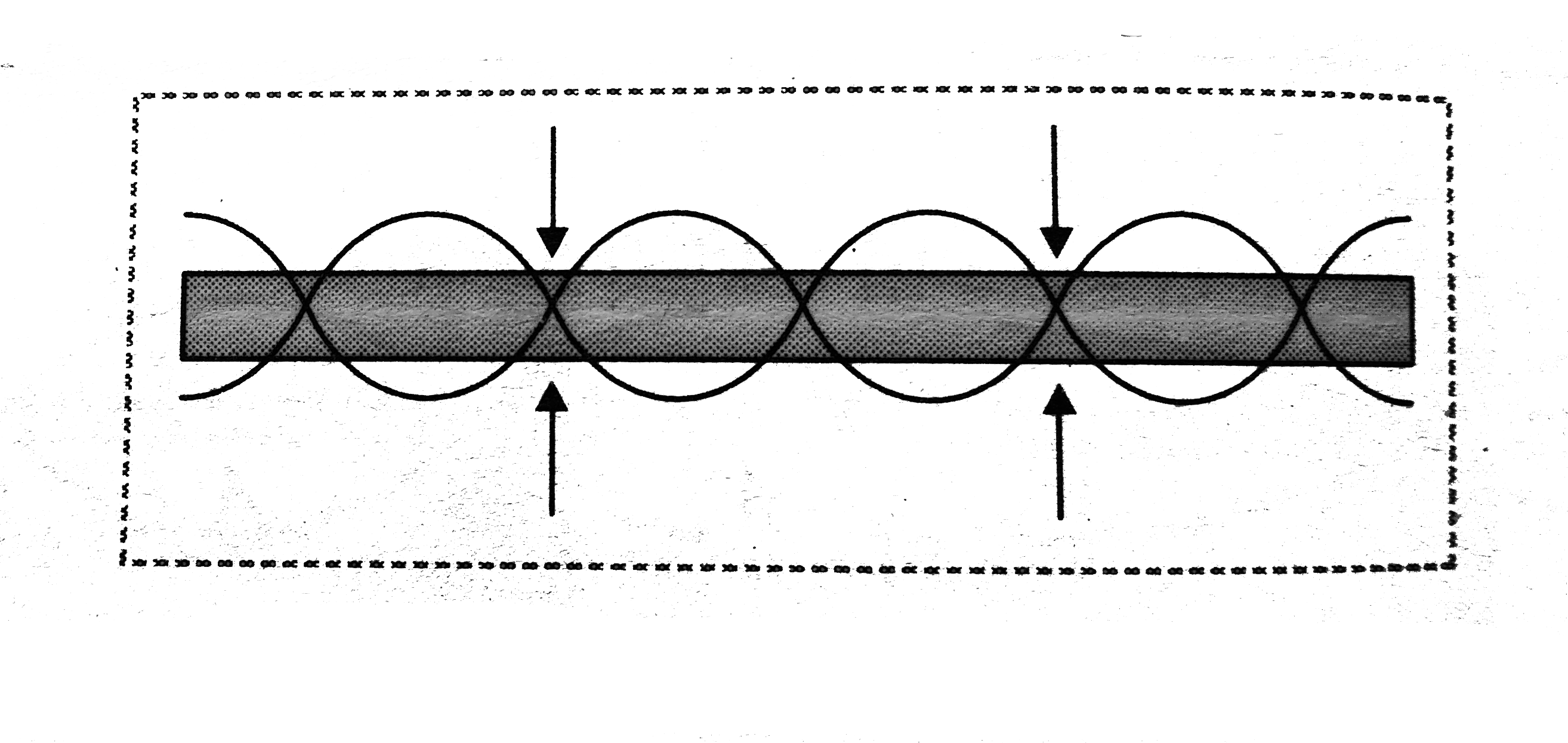 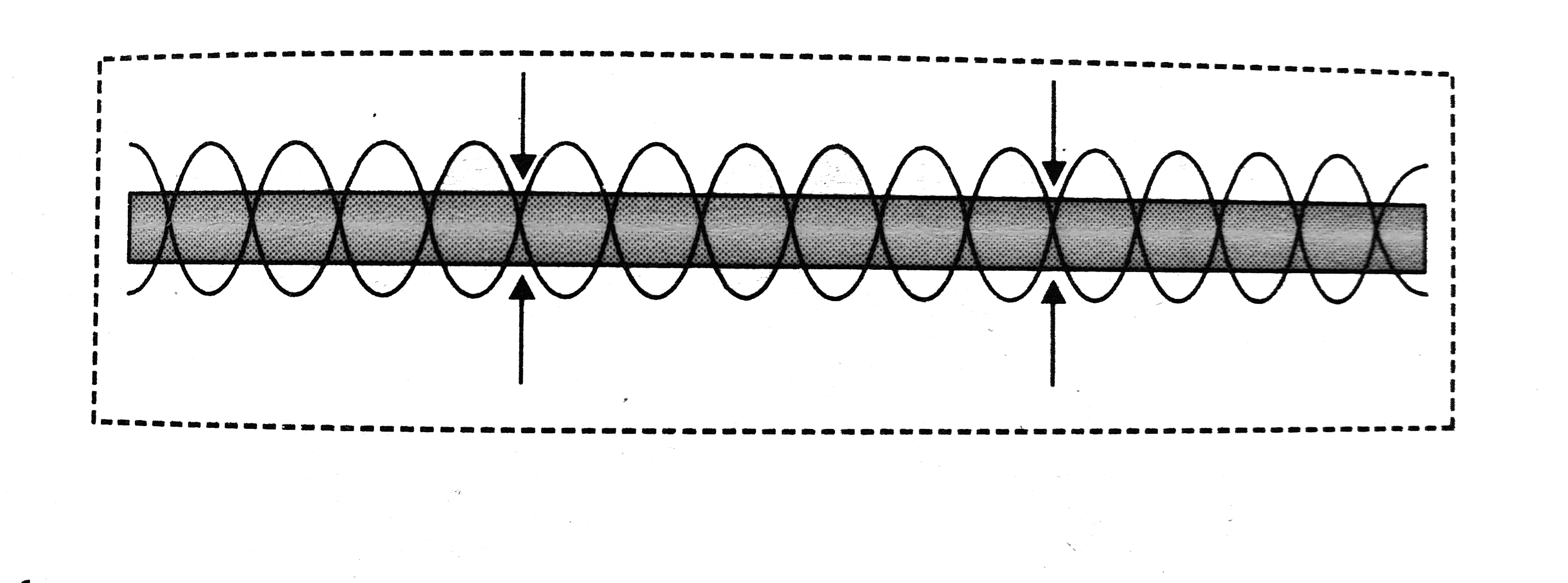
|
|