

Saved Bookmarks
| 1. |
A metallic rod of length1m is rigidly clamped at its midpoint. Longitudinal stationary waves are set up in the rod in such a way that there are two nodes on either side of the mid - point and those of constituent waves in the rod . ( Y = 2 xx 10^(11) N//m^(2) and rho = 8 xx 10^(3) kg// m^(3)) |
|
Answer» Solution :As found in case of strings , in case of RODS also the clamped point behaves as a node while the free end ANTINODE . The SITUATION is shown in FIG . 7.63. Because the distance between two consecutives nodes is `(lambda//2)` while between a node and antinide is `lambda//4` , hence ` 4 xx [ (lambda)/( 2)] + 2 [(lambda)/( 4)] = Lor lambda = ( 2 xx 1)/( 5) = 0.4 m` Further , it is given that ` Y = sqrt((Y)/( rho)) = sqrt(( 2 xx 10^(11))/( 8 xx 10^(3))) = 5000 m//s` Hence , from ` v = n lambda`, ` n = (v)/( lambda) = (5000)/( 0.4) = 12500 Hz` Now if incident and reflected WAVES along the rod are `y_(1) = A sin ( omega t - kx) and y _(2) = A sin ( omega t + k x + phi )` Hence , from ` v = n lambda` , ` n = (v)/( lambda) = ( 5000)/(0.4) = 12500 Hz` Now if incident and reflected waves along the rod are `y_(1) = A sin ( omega t - kx)and y_(2) = A sin ( omega t + kx + phi)` The resultant wave will be ` y = y_(1) + y_(2) A [ sin ( omega t - kx) + sin ( omega t + kx + phi)]` `= 2 A cos ( kx + (phi)/( 2)) sin ( omega t + ( phi)/(2))` Because there is an antinode at the free end of the rod , henceamplitude is maximum at ` x = 0` . So ` Cos (k xx 0 + (phi)/(2)) = "Maximum" = 1 i.e., phi = 0` And `A_(max) = 2 A = 2 xx 10^(-6) m` (given) ` y = 2 xx 10^(-6) cos kx sin omega t` ` y = 2 xx 10^(-6) cos [ ( 2pi x )/( lambda)]sin ( 2 pi nt)` Putting values of `lambda and n` , we get ` y = 2 xx 10^(-6) cos 5 pi x sin 25000 pi t` Now , because for a point ` 2cm` from the midpoint ` x = (0.50 +- 0.02)`, hence `y = 2 xx 10^(-6) cos 5 pi ( 0.5 +- 0.02) sin 25000 pi t` 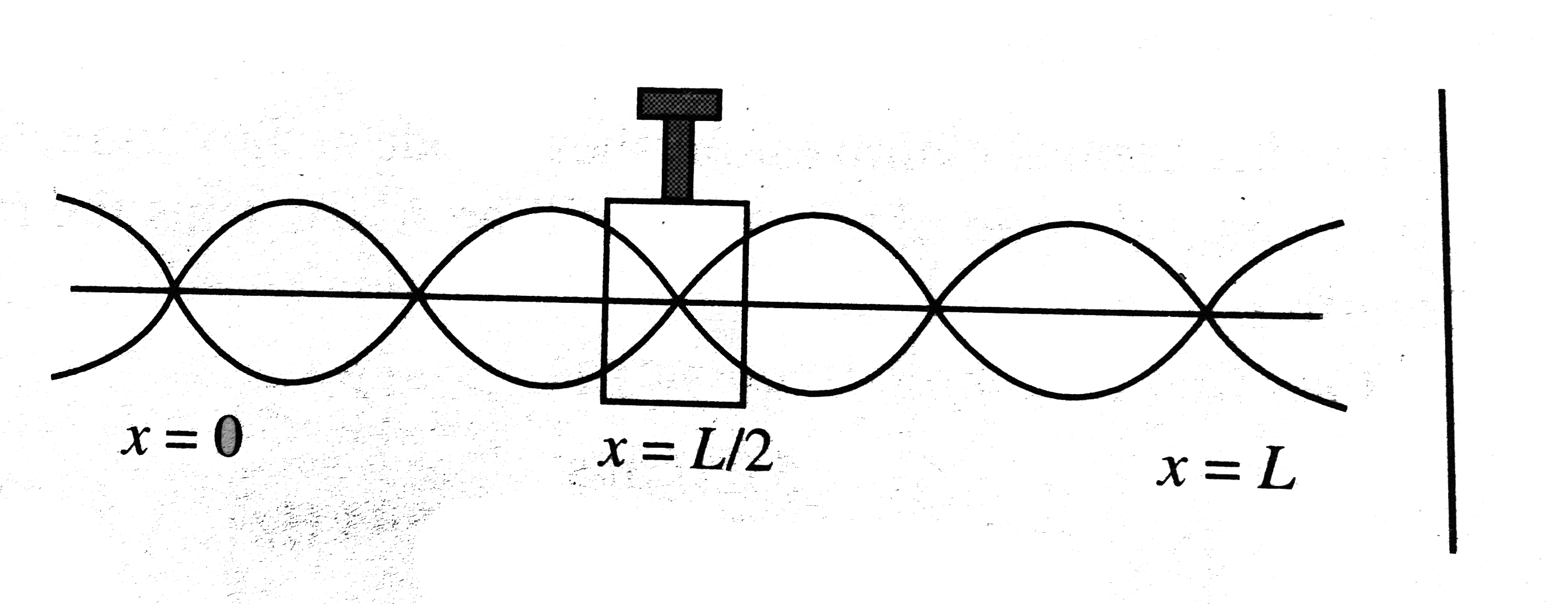
|
|