

Saved Bookmarks
| 1. |
A plank of mass M, whose top surface is rough with coefficient of friction mu is placed on a smooth ground. Now a disc of mass m=M//2 and radius r is placed on the plank. The disc is now given a velocity v_(0) in the horizontal direction at t=0 a. Find the time when the disc starts rolling b. Find the velocity of the plank and the disc up to that time. c. Find the distance travelled by the plank up to this instant. Find the work done by the friction force up to this instant. |
Answer» Solution :a. Step 1: Free body diagram 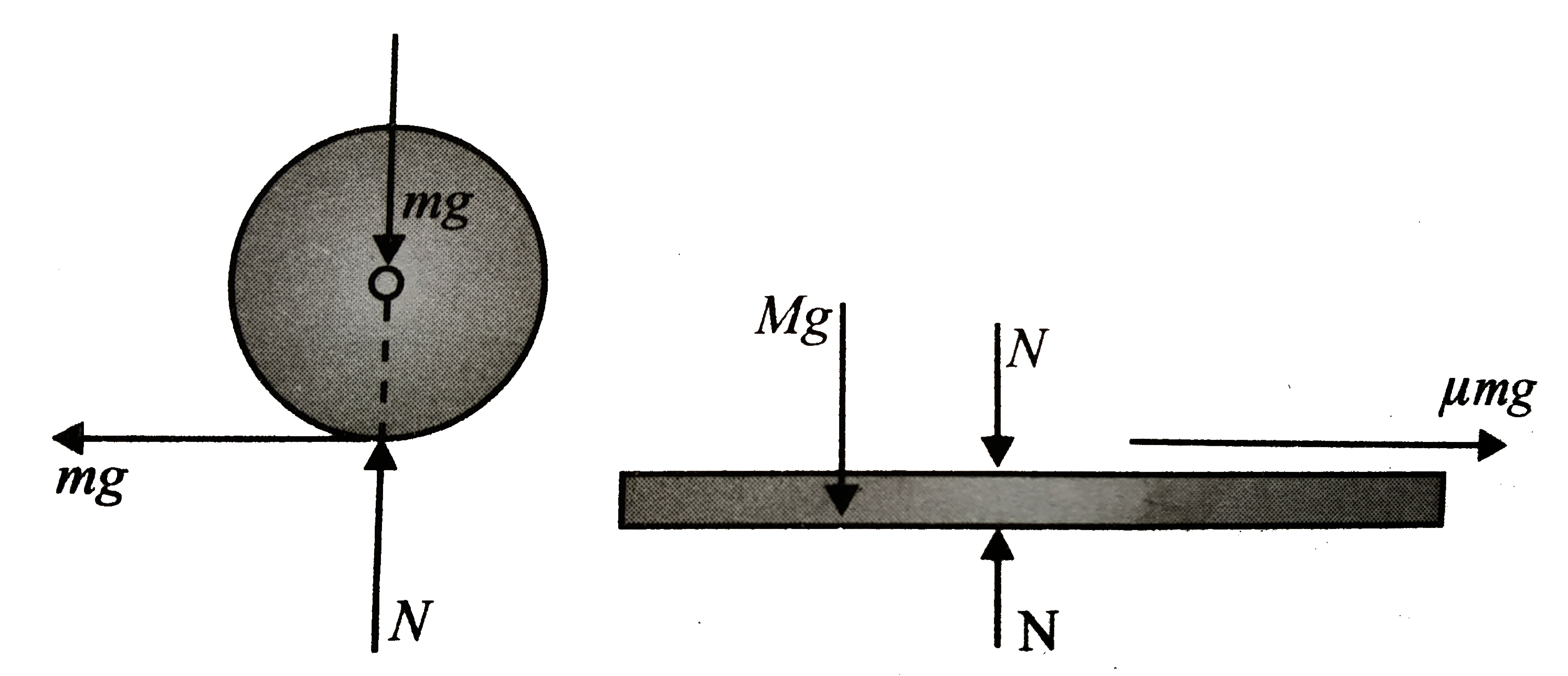 B. Step 2: Equation of motion For the plank: `mumg=MA` `impliesA=(mumg)/M` (towards right) …………i `impliesA=(mug)/2` (as `m=M/2`) (will be positive) Forthe disc: `mumg=ma` `a=mug` (backwards, towards left) (will be negative) c. Step 3: Torque equation `mumgR=Ialpha` `mumgR=(MR^(2))/2alpha` `alpha=(2mug)/R` (clockwise) (will be positive) d. Step 4: Constraint relations At the time of rolling point `P` should not slide with respect to the plank. 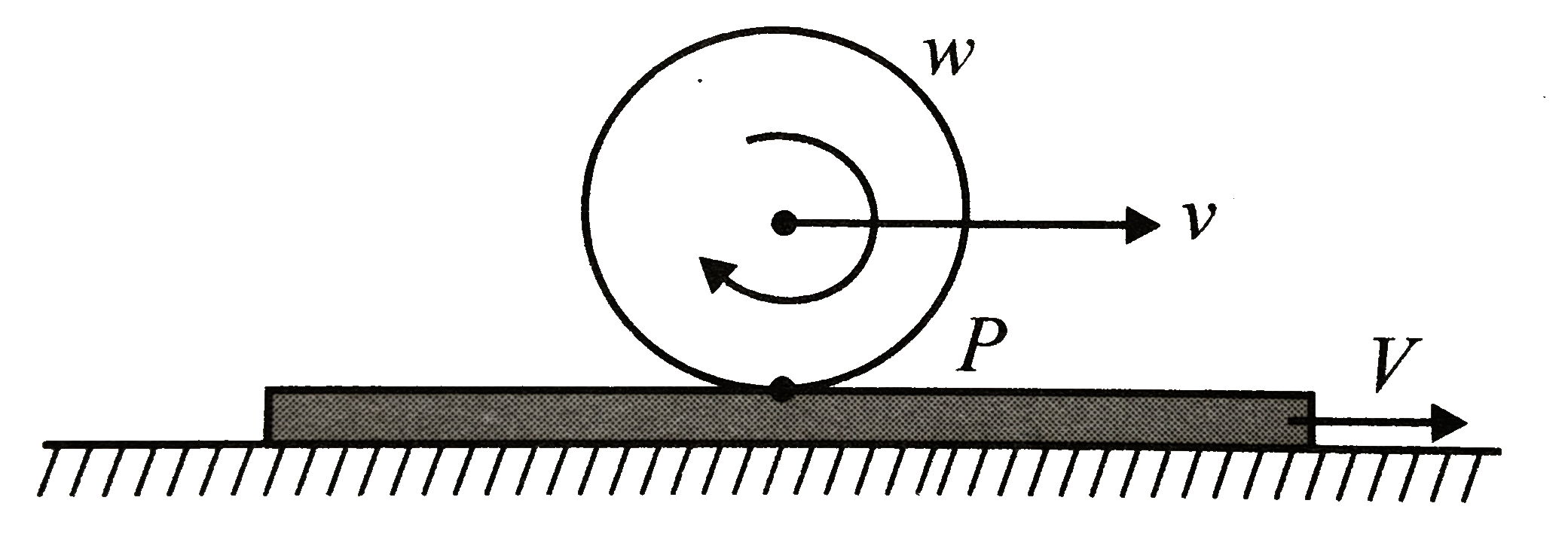 `-omegaR` `(0+at)=(v_(0)-a)-(0+alphat)R` Now substituting the values of `A` and a, we can calculate `t`, `(mumg)/Mt(v_(0)-mugt)-((2mug)/Rt)R` `((mumg)/M+mug+2mug)t=v_(0)` Which gives `t=v_(0)/(mug(m/M+3))=(v_(0))/(5mug)` (as`m=M//2`) Velocity of the plank when rolling STARTS `V=At=((mug)/2)((v_(0))/(5mug))=(v_(0))/10` Velocity of the disc when rolling starts `v=v_(0)+at=v_(0)+(-mug)((v_(0))/(5mug))=4/5v_(0)` Angular velocity at time of rolling, `omega=alphat=((2mug)/R)((v_(0))/(5mug))=2/5 (v_(0))/R` DISTANCE travelled by the plank, `S_("plank") =1/2At^(2)=1/2((mug)/2)((v_(0))/(5mug))^(2)=(v_(0)^(2))/(100mug)` Work done by friction FORCE, `W_("friction") =/_\K_("translation")+/_\K_("rotation")` `=[/_\K_("disc")+/_\K_("plank")]_("translation")+/_\K_("rotation")` `[(1/2mv^(2)-1/2mv_(0)^(2))+(1/2MV^(2)-0)(1/2Iomega^(2)-0)]` substituting the vaues of `v, V` and `omega`, we get the work done by friction i.e., `W_("friction")=13/200Mv_(0)^(2)` |
|