

Saved Bookmarks
| 1. |
A point moves such that the sum of the square of its distances from two fixed straight lines intersecting at antle 2alpha is a constant. The locus of points is an ellipse os eccentricity |
|
Answer» <P>`(sqrt(cos 2 alpha))/(sin alpha)if alphalt(pi)/(4)` 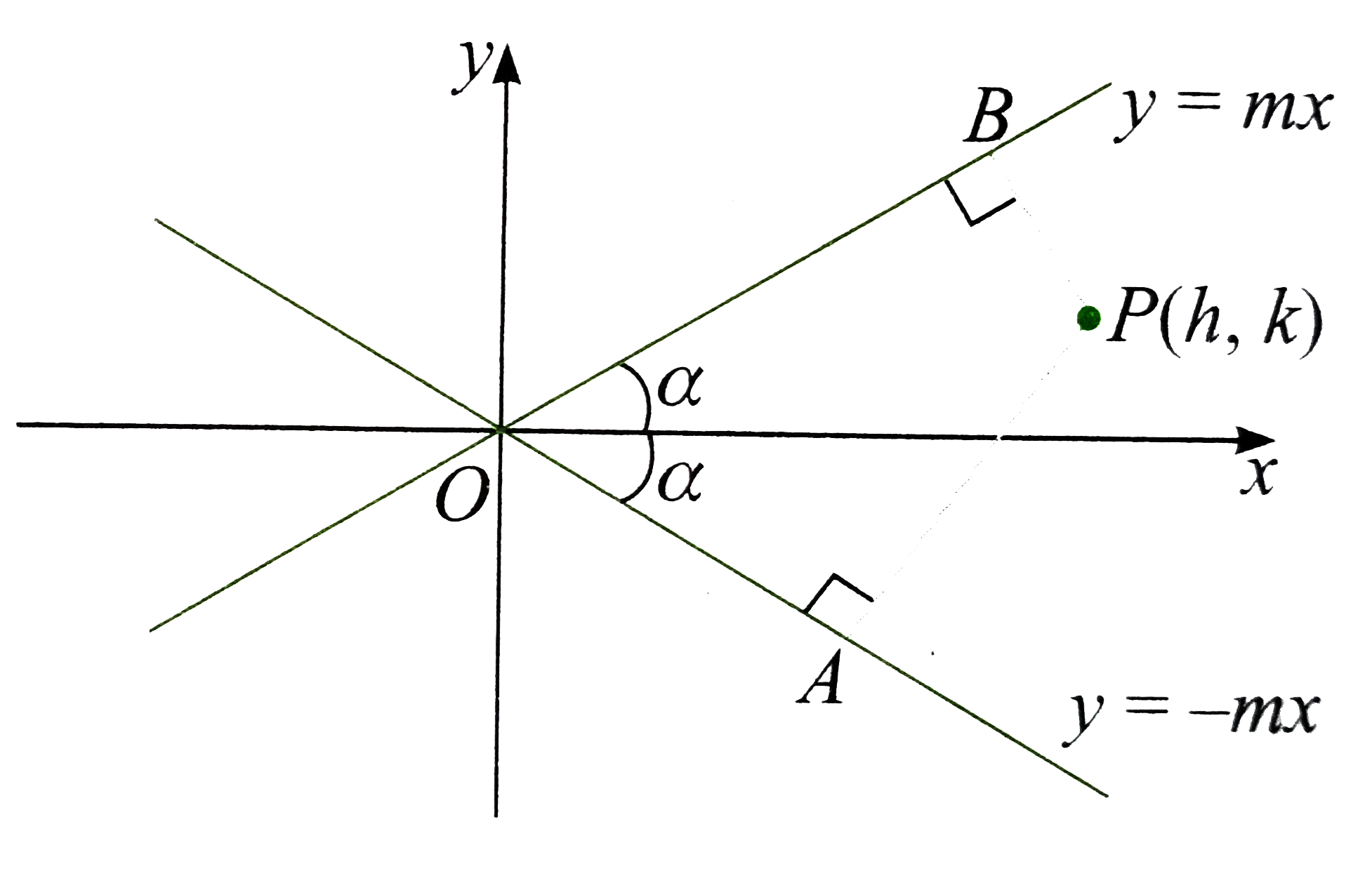 Let P(h,k) be the point whose locus is to be foud. Then accroding toe the GIVEN condition, `PA^(2)+PB^(2)`= Constant `RARR((k-mh)^(2))/(1+m^(2))+((k+mh)^(2))/(1+m^(2))"" ("c is constant")` `rArr 2(k^(2)+m^(2)h^(2))=c(1+m^(2))` Therfore, the locus of pointP is `(x^(2))/(a^(2))+(y^(2))/(b^(2))=1` where `a^(2)=(c(1+m^(2)))/(2m^(2)) and b^(2)=(c(1+m^(2)))/(2)` M If `alpha lt pi //4`, then `m lt1, and a^(2)gtb^(2)` `:.`Ecentricity `=sqrt(1-(b^(2))/(a^(2)))=sqrt(1-m^(2))=(sqrt(cos2alpha))/(cos alpha)` If `alpha gt pi//4` then `mgt1 and a^(2)ltb^(2)` `:.` Ecentricity `=sqrt(1-(b^(2))/(a^(2)))=sqrt(1-(1)/(m^(2)))=(sqrt(-cos 2 alpha))/(sin alpha)` |
|