

Saved Bookmarks
| 1. |
A projectile is fired horizontally with a velocity u . Show that its trajectory is a parabola. Also obtain the expression for Time of flight . |
|
Answer» Solution :Let us consider a PROJECTILE, that is, thrown horizontalwith an initialvelocity `vec(u)`from the topof a tower of height h in the figure . Motion along horizontal direction :The particle has zero acceleration along x direction. So, the initial velocity `u(x)`remains constant throughout the motion. The distance traveled by the projectile at a time t is givenby `x = u_(x) t + (1)/(2) at^(2)` Since a = 0 along x direction, we get `x =u_(x)t "". . . (1)` Motion along downward direction : Here `u_(y) = 0 ` (initial velocity has no downward component), a = g .The distance y at time y is given by `y = u_(y) t + (1)/(2) at ^(2)`, we get `y = (1)/(2) g t^(2) `[u = 0, a = g]. . . (2) Substituting the value of t from equation (1) in equation (2) we have `y = (1)/(2) g""(x^(2))/(u_(x)^(2))= ((g)/(2u_(x)^(2)))x^(2)` `y = Kx^(2) "" . . . (3)` Where `K = (g)/(2u_(x)^(2))` is a constant of proportionality . Equation (3) GIVES the trajectory of the projectile. Thus , the path followed by the projectile is a parabola . Time of Flight:The time taken for the projectile to complete its trajectory . It is ALSO time taken by the projectile to hit the GROUND . Consider a tower and a projectile . Let h be the height of a tower . Let T be the time taken by the projectile to hit the ground, after being thrown horizontally from the tower . We know that`s_(y) =u_(y) t+ (1)/(2) at ^(2)`for vertical motion . Here `s_(y) = h, t = T`(since there is no initial vertical velocity `u _(y) = 0` `:. h = (1)/(2) g T^(2) (or) T = sqrt((2h)/(g))` 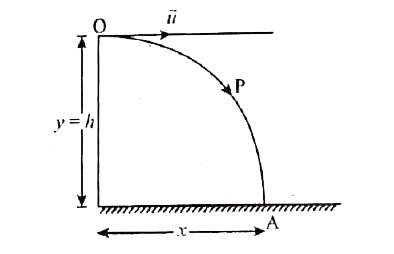
|
|