

Saved Bookmarks
| 1. |
A rocket is launched from the suface of the earth vertically upward from rest. It moves under acceleration 8 m//s^(2). After 15 s the fuel is finished, the rocket moves under gravity and ultimately strickes the ground. Assuming upward direction position and launching point as the origin, sketch the v-t, s-t and a-t graph. |
Answer» Solution :Here the motion is in two parts: first acceleration and then motion under gravity. 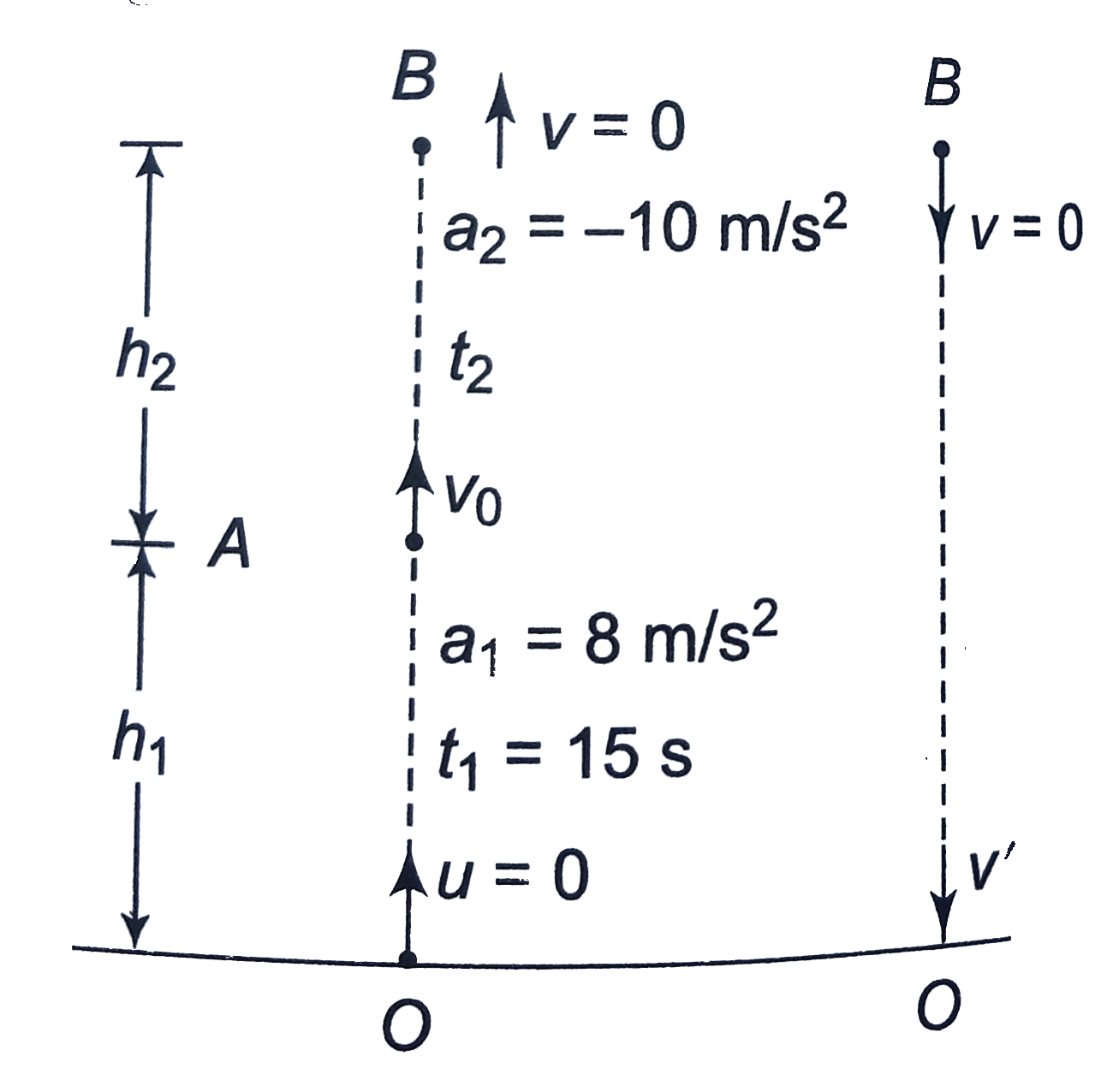 Acceleration motion O to A: `h_(1)=0+1/2a_(1)t_(1)^(2)=1/2xx8xx(15)^(2)=900 m` A to O through B A: ORIGIN Displacement`=-900 m` `S=ut-1/2 at^(2)` `-900=v_(0)t_(2)-1/2 a^(2)t_(2)^(2)=120 t_(2)-5t_(2)^(2)` `t_(2)^(2)-24t_(2)-180=0` `t_(2)=(24+-sqrt((-24)^(2)-4(1)(-180)))/2` `=(24+-36)/2` `t_(2)=30 s`, the rocket will strike the ground after 30 s (after the fuel is finished) `v^(')=u-g t_(2)` `=v_(0)-g t_(2)` `=120-10xx30=-180 m//s` The velocity of the rocket will be zero after TIME `t_(3)`. So, `0=120-10t_(3)impliest_(3)=12 s` To obtain the maximum HEIGHT attained by the rocket above A, we have `0=(v_(0))^(2)-2xx10xxh_(2)impliesh_(2)=720 m` at time `t^(')=12 s` TOTAL time of journey `=15+30=45 s` v-t graph `t=0, v=0` `t=15 s, v=120 m//s` `t=27 s, v=0` `t=45 s, v=-180 m//s` `t=0` to `t=15 s`, `v=8t` (straight line) `t=15` to `t=45s` `v=120-10(t-15)` (straight line) `[15 s lt = t lt = 45 s]` 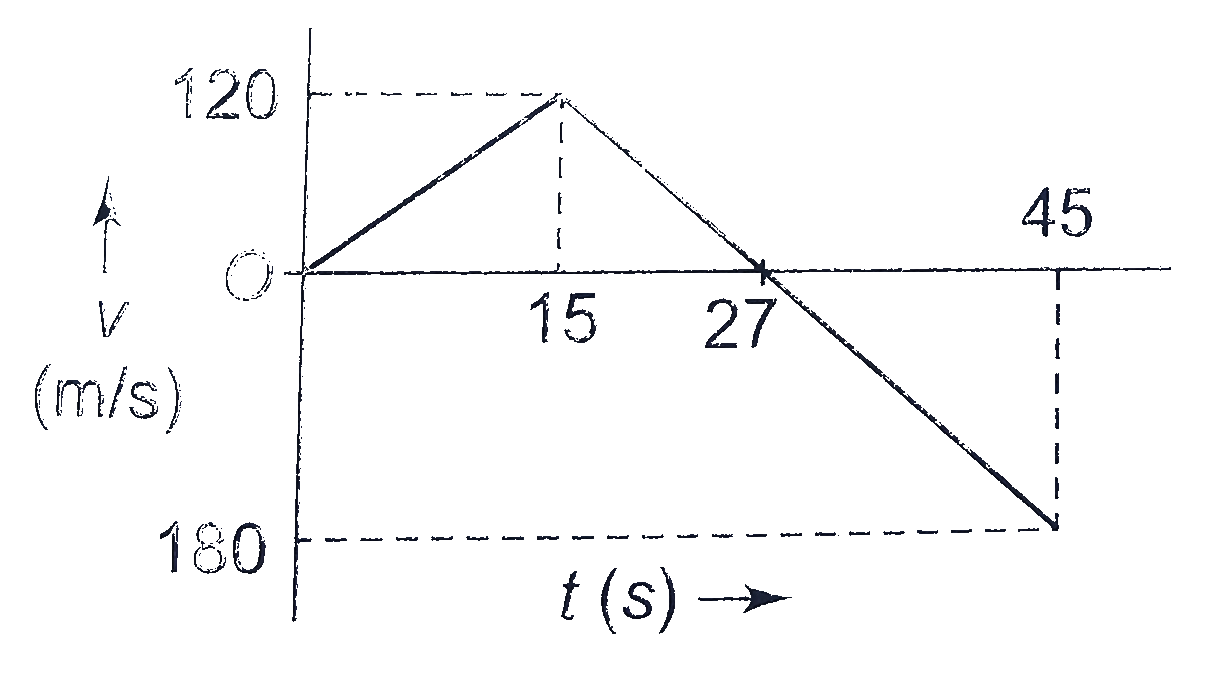 s-t graph `t=0, s=0` `t=15 s, s=900 m` `t=27 s, s, s=900+720=1620 m` `t=45 s, s=0` `t=0` to `t=15 s`, `s=1/2 a_(1)t^(2) implies s=4t^(2)` Shape: `y=4x^(2)` (parabola, open upward) `t=15 to 45 s` `s=900+v_(0)(t-15)-1/2a_(2)(t-15)^(2)` `=900+120(t-15)-5(t-15)^(2)` Shape: `y=900+120x-5x^(2)` (parabola, open downward) 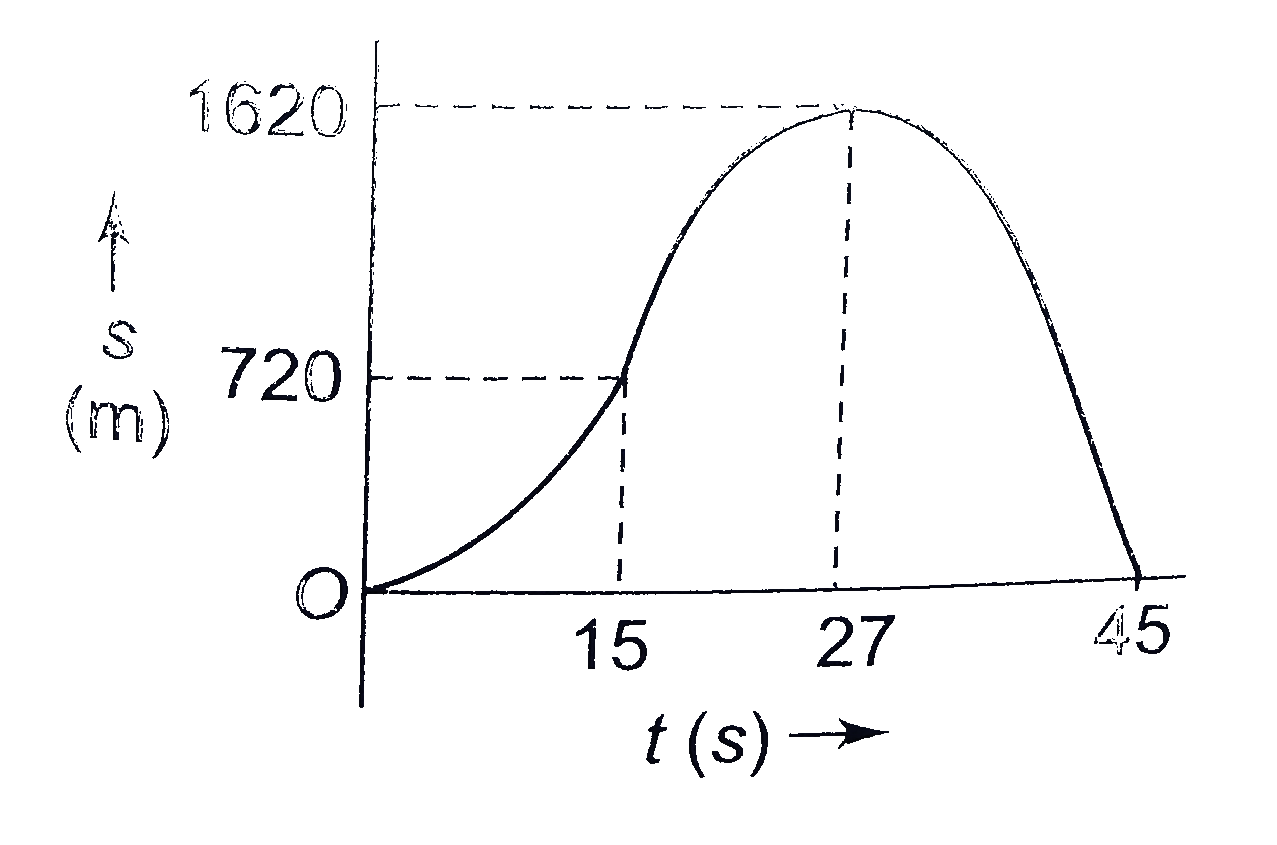
|
|