

Saved Bookmarks
| 1. |
A rod of length 1.05 m having negligible mass is supported at its ends by two wires of steel (wire A) and aluminium (wire B) of equal lengths as shown in figure. The cross-sectional areas of wires A and B are 1.0 mm^(2) and 2.0 mm^(2), respectively. At what point along the rod should a mass m be suspended in order to produce (a) equal stresses and (b) equal strains in both steel and aluminium wires. |
|
Answer» Solution :Let system 1 for streel and 2 for aluminium, Length of steel WIRE `A, l _(1) = l` Area of cross section of steel wire `A _(1) = 1 mm ^(2)` Young.s modulus of steel wire `Y_(1) = 2 xx 10 ^(11) Nm ^(-2)` 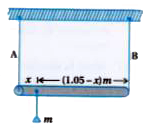 Length of aluminium `l _(2) =l` Area of cross-section `A _(2) =2mm ^(2)` Young.s modulus `Y_(2) = 7 xx 10 ^(10) Nm ^(-2)` (a) Let mass m be suspended from the rod at distance x from the end. Let `F_(1) and F_(2)` be the tension in two wires and there is equal stress in two wires then, `therefore (F _(1))/(A _(1)) = (F_(2))/(A _(2))` `therefore (F _(1))/(F_(2)) = (A_(1))/(A_(2))` `therefore (F _(1))/(F_(2)) = 1/2 ""...(1)` Taking MOMENT of forces about the point of suspension of mass from the rod. `F_(1) x =F_(2) (1.05 -x)` `therefore (F_(1))/(F _(2))= (1.05 -x)/(x)` `therefore 1/2 = (1.05 -x)/(x) ""[because` From equation (1)] `therefore x =2.1 -2x` `therefore 3x =2.1` `therefore x =0.7 m or x = 70 cm` (B) Let mass m be suspended from the rod at distance x from the end. There is equal STRAIN in two wires, `Y = (F //A)/( EPSI _(l ))` where `epsi _(l) =` longitudinal strain `therefore epsi _(l) = (F)/(AY)` `therefore` For steel wire `: (epsi _(l)) _(1) = (F_(1))/( A _(1) Y_(1))` For aluminium wire `: (epsi _(l)) _(1) = (F_(1))/( A _(1) Y_(1))` For aluminium wire `: (epsi _(l)) _(2) = (F_(2))/(A_(2) Y_(2))` but `(epsi l ) _(1) = (epsi _(l)) _(2)` `therefore (F._(1))/(A _(1) Y _(1)) =(F._(2))/(A _(2) Y_(2))` `therefore (F ._(1))/(F ._(2)) = (A_(1)Y _(1))/( A _(2) Y _(2))` `= 1/2 xx (2 xx 10 ^(11))/( 7 xx 10 ^(10))` `(F._(1))/(F ._(2)) = (10)/(7)""...(2)` Taking moment of force about the point of suspension of mass from the rod, `F._(1) x = F ._(2) (1.05 -x)` `therefore (F._(1))/(F._(2)) = (1.05 -x)/(x)` `(10)/(7) = (1.05 -x)/(x) ""[because `From equation (2)] `therefore 10 x =7.35 -7x` `therefore 17 x -7.35` `therefore x = (7.35)/(17) =0.43235 m or ~~43.2 cm` |
|