

Saved Bookmarks
| 1. |
A rod of length 1 and negligible mass is suspended at its two ends by two wires of steel (wire A) and aluminium (wire B) of equal lengths as shown in figure. The cross-sectional areas of wires A and B are 1.0 mm^(2) and 2.0 mm^(2) respectively. Y_("steel”) = 200 xx 10 ^(9) Nm ^(-2) and Y_("auminium”) = 70 xx 10 ^(9) Nm ^(-2) |
|
Answer» Mass m should be suspended close to wire A to have equal stresses in both the wires. 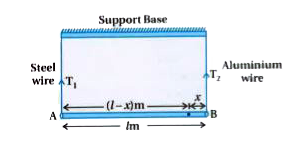 Let 1 is for steel wire and 2 is for aluminium wire. `T_(1) and T_(2)` are the tension in steel and aluminium wire RESPECTIVELY and `S_(1) and S_(2)` are stress and `in _(1) and in _(2)`are strain `a_(1) and a_(2)` are cross sectional areas. For BALANCE of wire. `sum T = 0` `therefore T_(2) x - T_(1) (l -x) =0` `therefore T _(2) x = T (l -x)` `therefore (T_(2))/( T _(1)) = (l-x)/( x) ""...(1)` Stress: For steel wire `S _(1) = (T_(1))/(a_(1)) ""...(2)` For aluminium wire `S_(2) = (T_(2))/( a _(2)) ""...(3)` If stress is equal, `S_(1) = S_(2)` `therefore (T_(1))/( a _(1)) = (T_(2))/(a_(2))` `therefore (T_(1))/( T _(2)) = (a_(1))/( a _(2)) = (1.0)/( 2.0 ) = 1/2 ` `therefore (x)/( l -x) = 1/2 [ because ` From eq. (1)] `therefore 2x =l -x` `therefore 3x =l` `therefore x = l /3` is the distance from end B and `l-x =l - l/3 = (2l)/(3)` is the distance from end A. `therefore (l)/(3) lt (2l)/(3)` hence option (B) is correct. Now, if strain are same, `Y_(1) = (S_(1))/( in _(1)) .and Y_(2) = (S_(2))/( in _(2))` but ` in _(1) = in _(2)` `therefore ( Y_(1))/( Y _(2)) = (S_(1))/( S _(2)) ` `therefore (200 xx 10 ^(9))/( 70 xx 10 ^(9)) = (T_(1))/( a _(1)) xx (a _(2))/( T_(2))` [`because` From equation (2) and (3)] `therefore (20)/(7) =(T_(1))/( T _(2)) xx (a _(2))/( a _(1))` `therefore (20 )/(7) = (x)/(l -x) xx (2.0)/(10) [because ` From eq. (1)] `therefore ( 10 )/(7) = (x)/( l -x)` `therefore 10 l -10 x = 7x` `therefore 10l = 17x` `therefore x = (10 l )/(17)` is the distance from end B `and l - x =l - (10l)/(17) = (7l)/(17)` is distance from end A. `therefore ( 7l)/(17) lt (10 l)/( 17)` hence option (D) is correct. |
|