

Saved Bookmarks
| 1. |
(a) Show that for a projectile the angle between the velocity and the X-axis as a function of time is given by theta(t)=tan^(-1) [(v_(oy)-"gt")/(v_("ox"))] (b) Show that the projection angle theta_(0) for a projectile lunched from the origin is given by theta_(0)=tan^(-1)((4 h_(m))/(R)), where the symbols have their usual meanings . |
Answer» Solution :(a) LET a PROJECTILE be fired with velocity `v_(0)` making an angle `theta` with X-axis , as shown in the figure . The X-component of velocity remains constant throughout the motion of the projectile but the y-component changes . 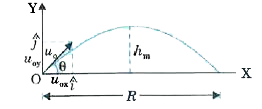 From the figure , we have `tan theta (t) =(v_(y))/(v_(x))` and `v_(y)=u_("OY")+a_(y)t=u_("oy")="gt"[:.a_(y)=-g]` and `v_(x)=u_("ox")` Putting the values of `v_(x)v_(y)` in equation (1) we get `tan theta (t) =(u_("ox")-"gt")/(u_("ox"))` or `theta(t) =tan ^(-1) ((u_("oy")-"gt")/(u_("ox")))` (b) In ANGULAR projection Let `theta=theta_(0)` The maximum height attained by the projectile `h_(m)=(u_(0)^(2) sin ^(2) theta)/(2g)` The horizontal range of projectile is given by `R=(u_(0)^(2) sin 2theta)/(g)=(u_(0)^(2) sin theta COS theta)/(g) ` therefore , `(h_(m))/(R)=(u_(0)^(2) sin ^(2) theta)/(2g) . (g)/(u_(0)^(2) 2 sin theta cos theta)` `=(tan theta)/(4)` or `tan theta=(4 h_(m))/(R)` or `theta=tan ^(-1) ((4 h_(m))/(R))` Hence , `theta_(0) =tan ^(-1) ((4h_(m))/(R))` |
|