

Saved Bookmarks
| 1. |
A simple pendulum of time period 1s and length l is hung from a fixed support at O, such that the bob is at a distance H vertically above A on the ground (figure). The amplitude is theta_(0). The string snaps at theta=theta_(0)//2. Find the time taken by the bob to hits the ground. Assume theta_(0) to be small so that sintheta_(0)~~theta_(0) andcostheta_(0)~~1 |
|
Answer» SOLUTION :Here, `theta_(0)` is the angular amplitude of simple pendulum and time period, `T=1s`. The angular displacement of the bob of the pendulum at any inisant t is given by `THETA=theta_(0)sinomegat=theta_(0)sin((2pi)/(T))t` `=theta_(0)sin((2pi)/(1))t=theta_(0)sin2pit` ..(i) `( :' T=1s.)` At time `t_(1)`, let `theta=theta_(0)//2` then from (i), we have `(theta_(0))/(2)=theta_(0)sin 2pit_(1)` or `2pit_(1)=(pi)/(6) or t_(1)=(1)/(12)s` Differentiating (i) w.r.t. t, we have `(d theta)/(dt)=2pitheta_(0)cos2pit` When `t=t_(1)=(1)/(12),` then `(d theta)/(dt)=2pithet_(0)cos2pixx(1)/(12)=2pitheta_(0)xx(sqrt(3))/(2)=sqrt(3)pitheta_(0)` Angular velocity of the bob ofsimple pendulum is `omega=(d theta)/(dt)=sqrt(3)pitheta_(0)` velocity of the bob of simple pendulum, `v=romega=lomega=L(sqrt(3)pitheta_(0))` It is acting perpendicular to STRING. The vertical COMPONENT velocity of bob, `v_(y)=vsin(theta_(0)//2)=l sqrt(3)pitheta_(0)sin(theta_(0)//2)` Horizontal component velocity of bob, `v_(x)=vcos(theta_(0)//2)=lsqrt(3)pitheta_(0)cos(theta_(0)//2)` The height of the bob when the pendulum snaps is , `H^(')+H+lcos(theta_(0)//2)=H+l[1-cos(theta_(0)//2)]` If `t'` is the time taken by the bob to fall through height `H(')` , then using the relation , `S=ut+(1)/(2)at^(2)`, we have `s=H^('), u^(')=v_(y)=lsqrt(3)pitheta_(0)sin(theta_(0)//2), t=?` `:. H^(')=[sqrt(3)pitheta_(0)lsin(theta_(0)//2)]t+(1)/(2)g t^(2)` or`t^(2)+[(2sqrt(3)pitheta_(0)lsin(theta_(0)//2))/(g)]t-(2H^('))/(g)=0` `:. t=(-[(2sqrt(3)theta_(0)lsin(theta_(0)//2))/(g)]+-sqrt([(12pi^(2)theta_(0)^(2)l^(2)sin^(2)(theta_(0)//2))/(g^(2))]+4xx2H^(')lg))/(2)` `=(-[sqrt(3)pitheta_(0)lsin(theta_(0)//2)]+-sqrt(3pi^(2)theta_(0)^(2)l^(2)sin^(2)(theta_(0)//2)+2H^(')g))/(g)` `=(-sqrt(3)pi(theta_(0)//2)+- sqrt(3pi^(2)theta_(0)^(2)(theta_(0)^(2)//4)+2H^(')g))/(g)` As `theta_(0)` is small so the terms with `theta_(0)^(2)` beign very very small can be neglected. `:. t=(sqrt(2H^(')g))/(g)=sqrt((2H^('))/(g)` Now, `H^(')=H+l-lxxl=H` `[:'cos(theta_(0)//2)=1]` ` :. t=sqrt((2H^('))/(g))=sqrt((2H)/(g))` The horizontal distance travelled by bob after snapping `x=v_(x)t=[sqrt(3)lpitheta_(0)cos(theta_(0)//2)]sqrt((2H)/(g))=sqrt(3)lpitheta_(0)xx1xxsqrt(2H//g)=sqrt((6H)/(g))xxtheta_(0)lpi`j At the time of snapping, the horizontal distance of the bob from point A is `=lsin(theta_(0)//2)=l theta_(0)//2` Thus the distance of bob from A where it meets the ground is `=(l theta_(0))/(2)-sqrt((6H)/(g))l pi theta_(0)=l theta_(0)[(1)/(2)-pisqrt((6H)/(g))` 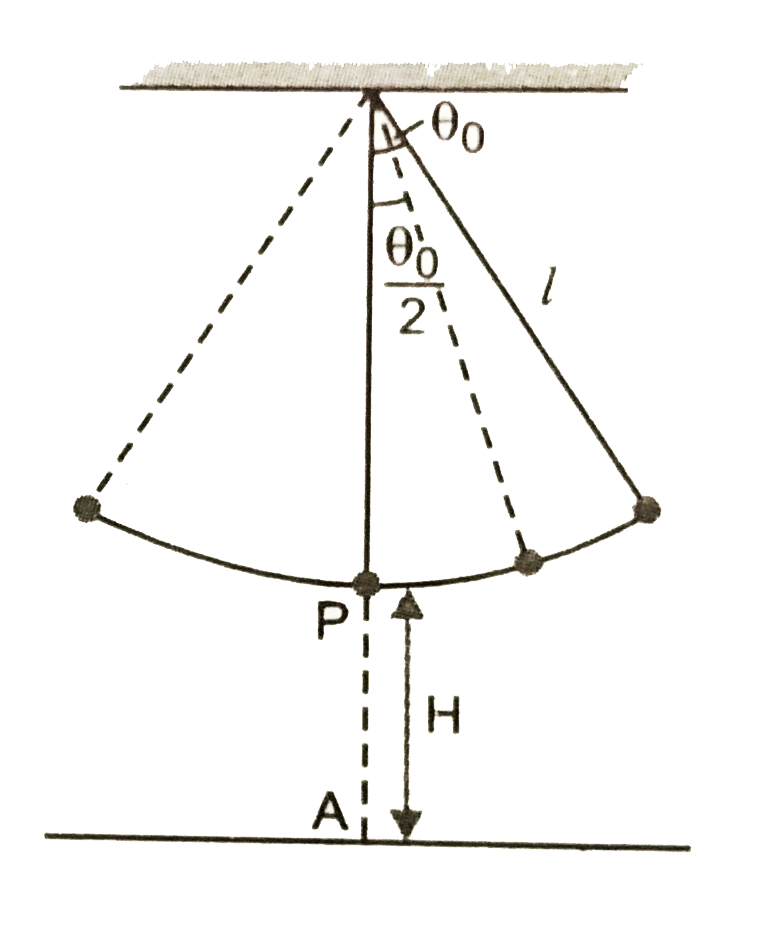
|
|