

Saved Bookmarks
| 1. |
A soap bubble of radius 'r' and surface tension 'T' is given a potential of 'V' volt. If the new radiys 'R' of the bubble is related to its initial radius by equation. P_(0)[R^(3) - r^(3)] + [lambda T [R^(2) - r^(2)] - epsilon_(0) V^(2)R//2 = 0, where P_(0) is the atmospheric pressure. Then find lambda |
|
Answer» [`sigma^(2)/(2epsilon_(0))` is EXCESS pressure due to uniform charge distribution on the surface of a bubble pressure is larger than OUTSIDE] 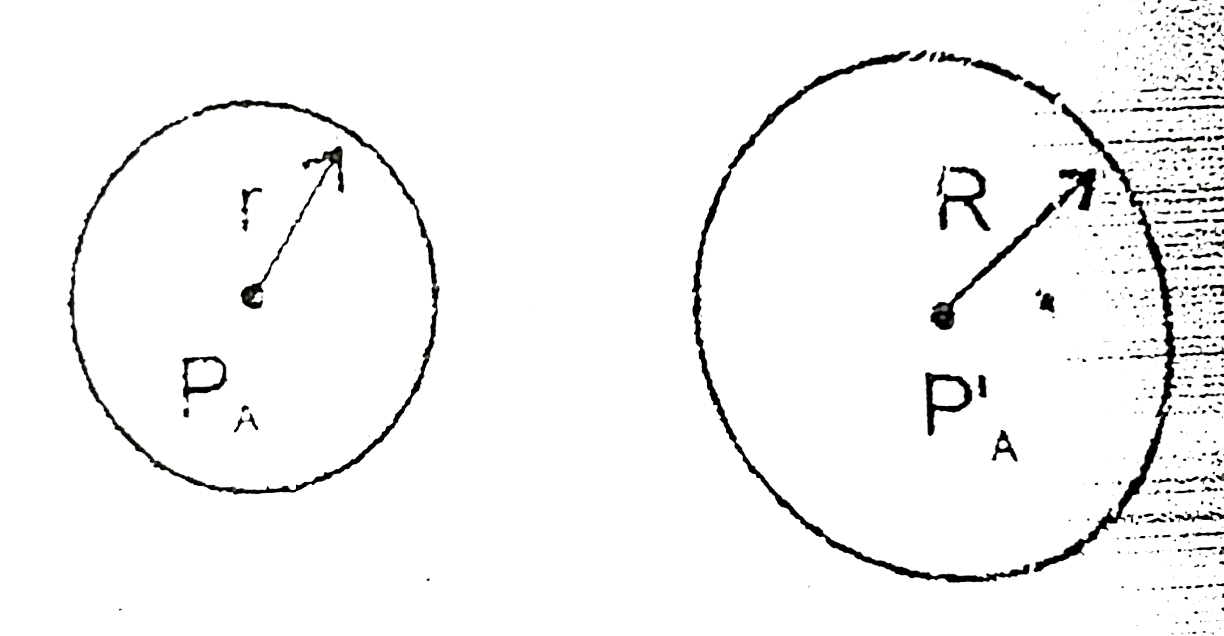 Clearly `P_(A) XX (4)/(3)pir^(3) = P_(A)^(') xx (4)/(3) piR^(3) rArr P_(A) = P_(A) ((r)/(R))^(3)` Clearly `P_(A) XX (4)/(3)pir^(3) = P_(A)^(') xx (4)/(3) piR^(3) rArr P_(A) = P_(A) ((r)/(R))^(3)` Now `P_(A) - P_(0) = (4T)/(r)` & `P_(A) - P_(0) = (4T)/(R) - (sigma^(2))/(2epsilon) .......(3)` so form `P_(A)((r)/(R))^(3) - P_(0) = (4T)/(R) - (sigma^(2))/(2epsilon) .....(4)` `[Eq^(N)(2)xx((r)/(R))^(3)-Eq^(n)(4)]` `P_(0) - P_(0)((r)/(R))^(3)=(4T)/(r){((r)/(R))^(3)-(r)/(R)}+(V^(2)epsilonR)/(2)` `rArr P_(0) (R^(3) - r^(3)) + 4T (R^(2) - r^(2)) - (V^(2)epsilon_(0)R)/(2) = 0`., (Hence provide) Ans. `lambda = 4` |
|