

Saved Bookmarks
| 1. |
A spring is loaded with two blocks m_(1) and m_(2), where m_(1) is rigidly fixed with the spring and m_(2) just kept on the block m_(1) as shown in the figure. The maximum energy of oscillation that is possible for the system having the block m_(2) in contact with m_(1) is |
|
Answer» `(m_(1)^(2)g^(2))/(k)` 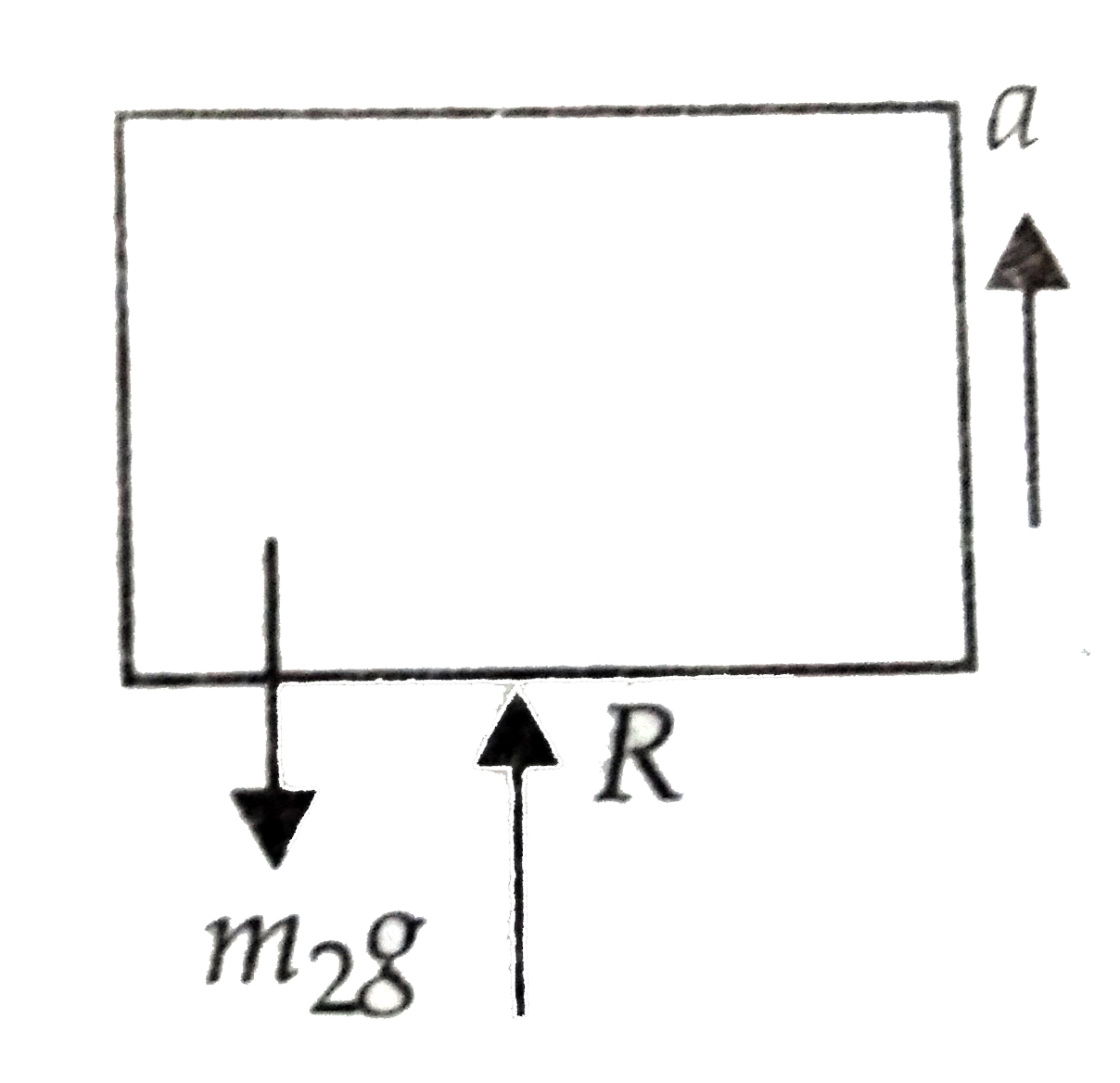 let x be the required amplitude of oscillation for this amplitude of oscillation the normal contact FORCE between the BLOCKS can be GIVEN by `R-m_(2)g=m_(2)a` where, acceleration `a=-omega^(2)x` `thereforeR-m_(2)g=-m_(2)omega^(2)x` For maximum amplitude of oscillation without loosing contact of block `m_(2)` with block `m_(1)`, R=0 we get, `x=g//omega^(2)` Where `omega` is the angular frequency of oscillation of `(m_(1)+m_(2))` and spring. therefore `omega=sqrt((k)/((m_(1)+m_(2))))` or `omega^(2)=(k)/((m_(1)+m_(2)))` `impliesx=((m_(1)+m_(2))g)/(k)` Hence, the maximum energy of oscillation `u_(max)=(1)/(2)kx^(2)=((m_(1)+m_(2))^(2)g^(2))/(2k)` |
|