

Saved Bookmarks
| 1. |
A string 120 cmin length sustains a standing wave with the points of the string aat which the displacement amplitude is equal to 3.5 mm being separated by1.50 cm. Find the maximum displacement amplitude . To which overtone do these oscillations correspond ? |
|
Answer» Solution :When astring fixed at both the ensds sustains a standing wave , there are `n` (a whole number) segments of the length of the string , where particles in each segment of the string oscillate in phase with each other and are out of phase with the particles of the adjacent segment , the string contain `n` LOOPS between its ends . Under this condition the amplitude of the oscillation varies from the point to point on the string as a harmonic function ( a sine function or a cosine function ). A typical equation for the standing wave can be given as ` y = y _(max)sin kx cos omega t`. Let the string be lying along the x - axis between ` x = 0` and ` x = 120 CM`. Let the amplitude variation along the length of the string be given by ` a = a_(max) sin kx` , where `k` is the propagation constant. First Method : `(k = ( omega)/( v) = ( 2pi)/( lambda))` Let the string be OSCILLATING in its `nth` harmonic . The string will constant ` n` loops with end points as node . The points in a loop , where the displacement amplitudes are `3.5 mm` will be located symmetrically about antinode , as shown in the Fig . 7.37. Now `BC = DE = ... = 15 cm and CD = EF = ... = 15 cm cm`( A sine function given by ` y = sin x ( 0 le x le pi)` is symmetrical about ` x = pi//2`, etc.) ` CD = CN_(2) + N_(2) D` ` = ((120)/( 2 n) - 7.5) + ((120)/( 2n) - 7.5 ) = 2 (( 120)/( 2 n) - 7.5)` THus , ` 2(( 120)/( 2 n) - 7.5 ) = 15 or n = 4` The oscillations corresponds to the ` 4 th` harmonic ( the `3 rd` overtone ). The atring will oscillate in `4 ` loops . There are a total of ` 5` nodes ( including the nodes on the end of the next node the distance is ` lambda //2` , the length of the string ` l = 4 lamda //2` . or ` lamda //2 = l//4 = 30 cm or lambda = 60 cm` ` k = ( 2 pi)/( lambda) = (pi)/( 30)` Amplitude as function of ` x` is ` a = a_(max) sin kx = a _(max) sin (( pi x)/(30))` Now at ` x = 7.5 , 12.5 cm , a = 3.5 mm ` or` 3.5 =a _(max) sin (7.5 (pi)/( 30))` or ` 3.5 = a_(max) sin (pi) /(4) = ( a _(max))/( sqrt(2))` ` a _(max) = 3.5 sqrt(2) = 4.935 = 5 mm` Second Method : Suppose that the points shown in Fig . `7.38` REPRESENT the points which have equal amplitudes and are equally spaces . Now , distance two consecutives nodes is `lambda //2` . Therefore , ` a + b + c = lambda // 2`(i) From symmetry considerations ` a = c = d `(ii) Now , for such points to be equidistant throughout the string , `b = c + d`(iii) From Eqs. (ii) and (iii), ` b = 2 a ` From Eq. (i) , we get ` a + 2a + a = lambda //2` or ` a = lambda//8`(iv) ` b = 2 a = lamda//4`. The points where displacement amplitudes are ` 3.5 mm` are `lambda//4` apart. `:.lambda//4 = 15 or lambda = 60 cm` Hence , ` a = lambda//8 = 7.5 cm` [ Note that only one value for `b` , i.e., distance between to such consecutive points exist , hence only one such set of points exist on the string and such points are ` lambda//4 ` apart ] No. of loops `= (2L)/( lambda) = ( 2 xx 120 )/( 60) = 4` The string is in the ` 4 th` harmonic or `3 rd` overtone . 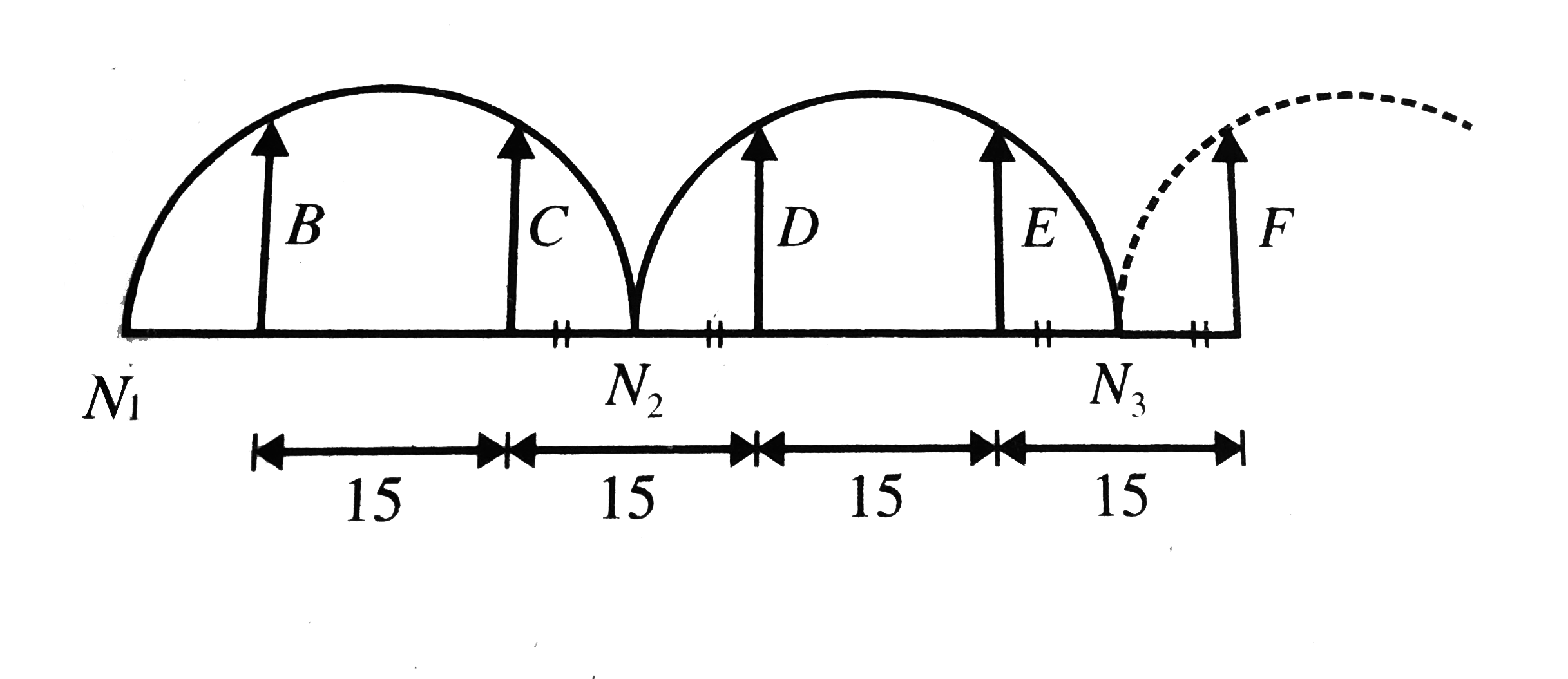 
|
|