

Saved Bookmarks
| 1. |
A string of length 3l is connected to a fixed cylinder whose top view is shown in Fig. The string is initially slack. The other end of the string (connected to a marble) is moving at a constant velocity of 10 m//s as shown. The string will get stretched at some instant and impulsive tension occurs in the string. If hinge is exerting a force of 40000 N for 0.25 ms on the cylinder to bear up the impact of impulsive tension, then mark the correct statements. (Take string to be light, breaking tension of the string is 2x10^5N) |
|
Answer» The angle made by the VELOCITY of marble with the length of string when it is just stretched is`60^(@)` 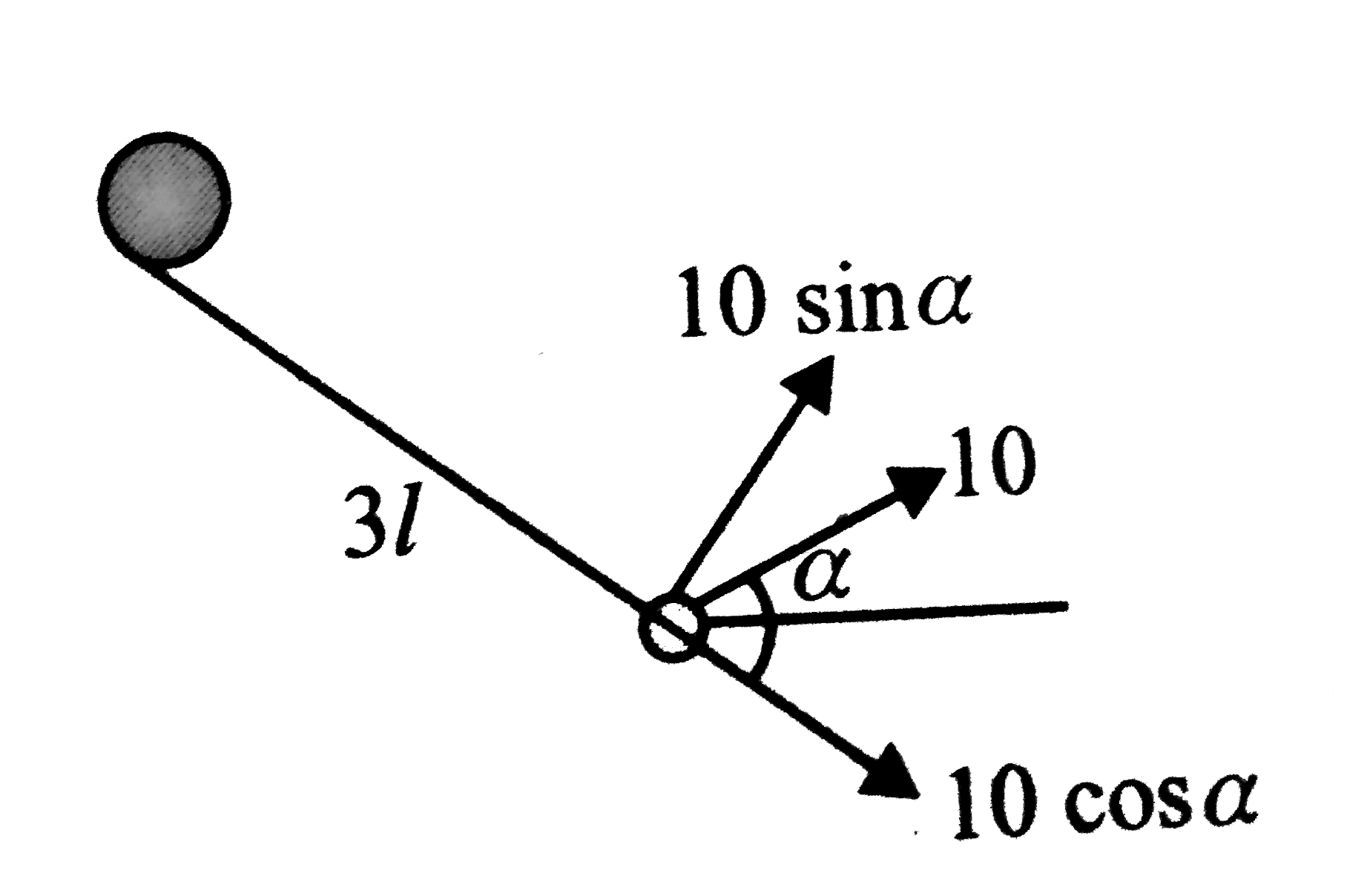 `|vecJ|=40000xx0.25x10^(-3)=10N` s along the string. For marble, `J=0-(2xx10cosalpha)` As final velocity of marble along the string is ZERO Putting `J=10Ns`, we get `alpha=60^(@)` The string wraps up AROUND the cylinder and marble MOVES in a circular path of varying radius with speed `10 sin alpha =5sqrt3 m//s`. The speed remain costasnt as only the tension force is present which is perpedicular to the velocity of the marble. For string to break, the impulsive tension has to be `ge2xx10^5N` `40000x0.25xx10^(-3)ge2xx10^(5)xx/_\t` `/_\tle0.05ms` |
|