

Saved Bookmarks
| 1. |
A uniform solid cyinder of radius R=15 cm rolls over a horizontal plane passing into an inclined plane forming an ange alpha=30^@ with the horizontal. Find the maximum value of the velocity v_(0) which still permits the cylinder to roll on the inclined plane section without a jump. (The sliding is asumed to be absent). |
|
Answer» <P> Solution :Initial ENERGY`E_(1)=1/2mv_(0)^(2)+1/2I_(cm)omega^(2)+mgR` 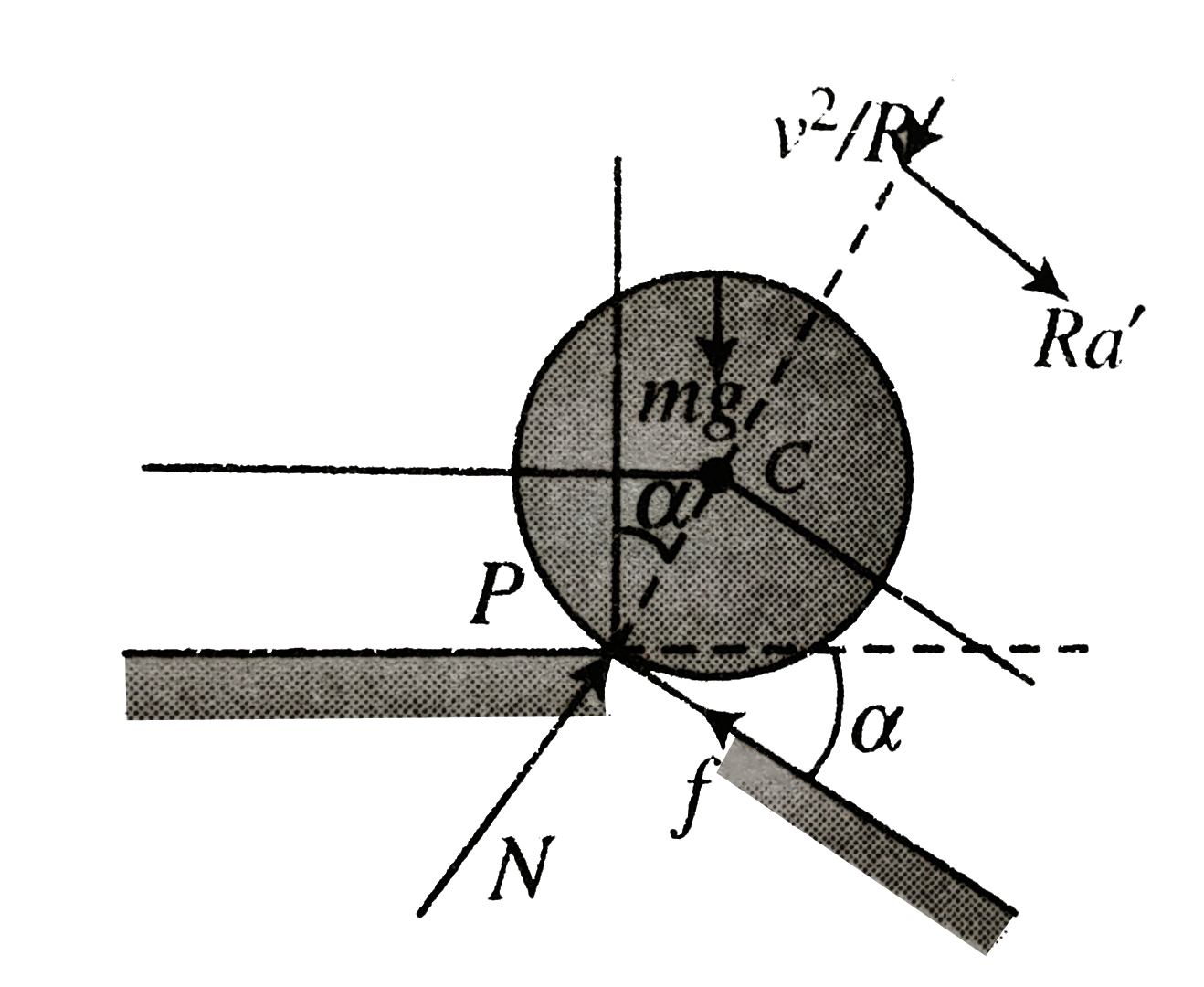 For rolling `(v_(0))/R=omega` `implies E_(1)=1/2mv_(0)^(2)+1/2.1/2mR^(2)v_(0)^(2).R^(2)+mgR` `=3/4mv_(0)^(2)+mgR` As it REACHES the edge `E_(2)=1/2I_(P)omega^('2)+mgRcosalpha` `E_(2)=1/2mv^(2)+1/2I_(cm)omega^('2)+mgRcosalpha` Here `omega'=v/R` `=3/4mv^(2)=mgRcosalpha` From `COE, 3/4 mv^(2)+mgRcosalpha=3/4mv_(0)^(2)+mgR` `implies mv^(2)=mv_(0)^(2)+4/3mgR(1-cosalpha)`.........i CONSIDER the `FBD` of the cyider when it is at the edge. Centre of mass of the cylinder describes circular motion about `P`.HENCE, `mgcosalpha-N=mv^(2)//R` `implies=mgcosalpha-mv^(2)//R` `=mgcosalpha- (mv_(0)^(2))/R-4/3mg+4/3mgcosalpha`, from i. For no jumping `Nge0` `implies 7/3 mgcosalpha-4/3mg-(mv_(0)^(2))/Rge0` `implies v_(0)lesqrt((7gR)/3cosalpha-4/3gR)` |
|