

Saved Bookmarks
| 1. |
A vertical frictionless semicircular track of radius 1m fixed on the edge og a movable trolley (figure). Initially, the system is rest and a mass m is kept at the top of the track. The trolly starts moving to the right with a uniform horizontal acceleration a=2g//9 . The mass slides down the track, eventually losing contact with it and dropping to the floor 1.3m below the trolly. This 1.3m is from the point where mass loses contact. (g=10m//s^(2)) (a) Calculate the angle theta at which it loses contact with the trolly and (b) the time taken by the mass to drop on the floor, after losing contact. |
|
Answer» From work energy theorem, `KE` of particle relative to track =Work done by FORCE of gravity+work done by pseudo force :. `(1)/(2)mv_(r)^(2)=mg(1-costheta)+m((2g)/(9))sintheta` opr `v_(r)^(2=2g(1-costheta)+(4g)/(9)sintheta` Particle leaves contact with the track where `N=0` 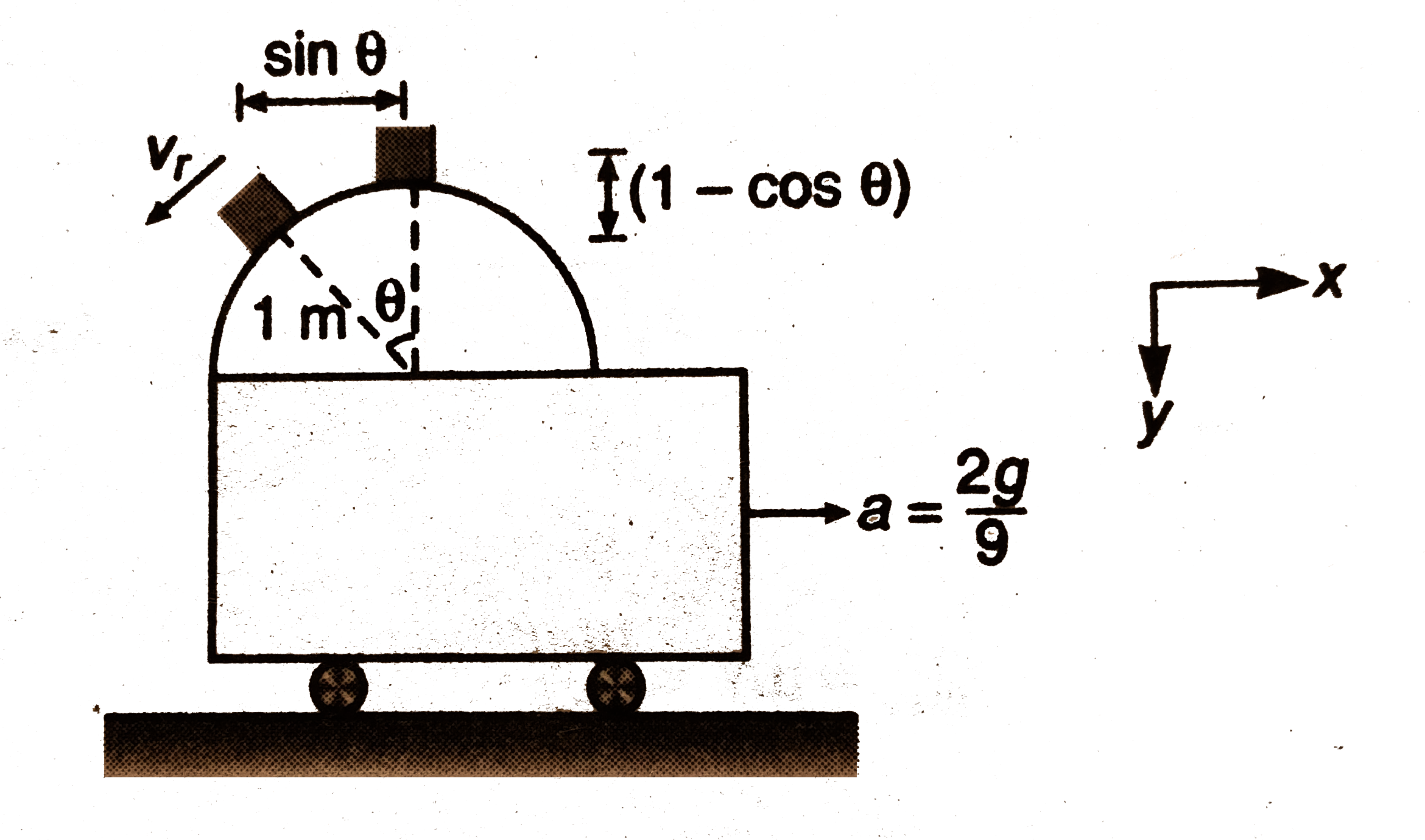 or `mgcostheta-m((2g)/(9))sintheta=mv_(r)^(2)` or `gcostheta-(2g)/(9)sintheta=2g(1-costheta)+(4g)/(9)sintheta` or `3costheta-(6)/(9)sintheta2` Solving this, we get `theta~~37^(@)` (b) From Eq. (i) we have, `v_(r)=SQRT(2g(1-cos theta)+(4g)/9 sin theta)` or `v_(r)=2.58 m//s at theta=37^(@)` Vertical component of its velocity is `v_(y)=v_(r) sin theta` `=2.58xx3/5` `=1.55 m//s` Now, `1.3=1.55t+5T^(2)( :' s=ut+1/2 GT^(2))` or `5t^(2)+1.55t-1.3=0` or `t=0.38 s` |
|