

Saved Bookmarks
| 1. |
Account for the following observations (a) AlCl_(3) is a Lewis acid (b) Though fluorine is more electronegative than chlorine yet BF_(3) is a weaker Lewis acid than CI_(3) (c) PbO_(2) is a stronger oxidising agent than SnO_(2) (d) The +1 oxidation state of thallium is more stable than its +3 state. |
|
Answer» Solution :(a) In `AlCl_(3),Al` has only six electron in its valence shell. It is an electron deficient SPECIES. Therefore, it acts as a Lewis acid (electron ACCEPTOR) (b) In `BF_(3)` boron has a vacant 2p-orbital and fluorine has one 2p-completely filled unutilised orbital. Both of these ORBITALS belong to same energy level therefore, they can overlap efficitively and form `p pi - p pi` bond. This type of bond formation is known as back bonding. While back bonding is not possible in `BCl_(3)`, because there is no EFFECTIVE overlapping between 2p-orbital of boron and 3p-orbital of chlorine. Therefore, electron deficiency of B is higher in `BCl_(3)` than that of `BF_(3)`. That's why `BF_(3)` is a weaker Lewis acid than `BCl_(3)` 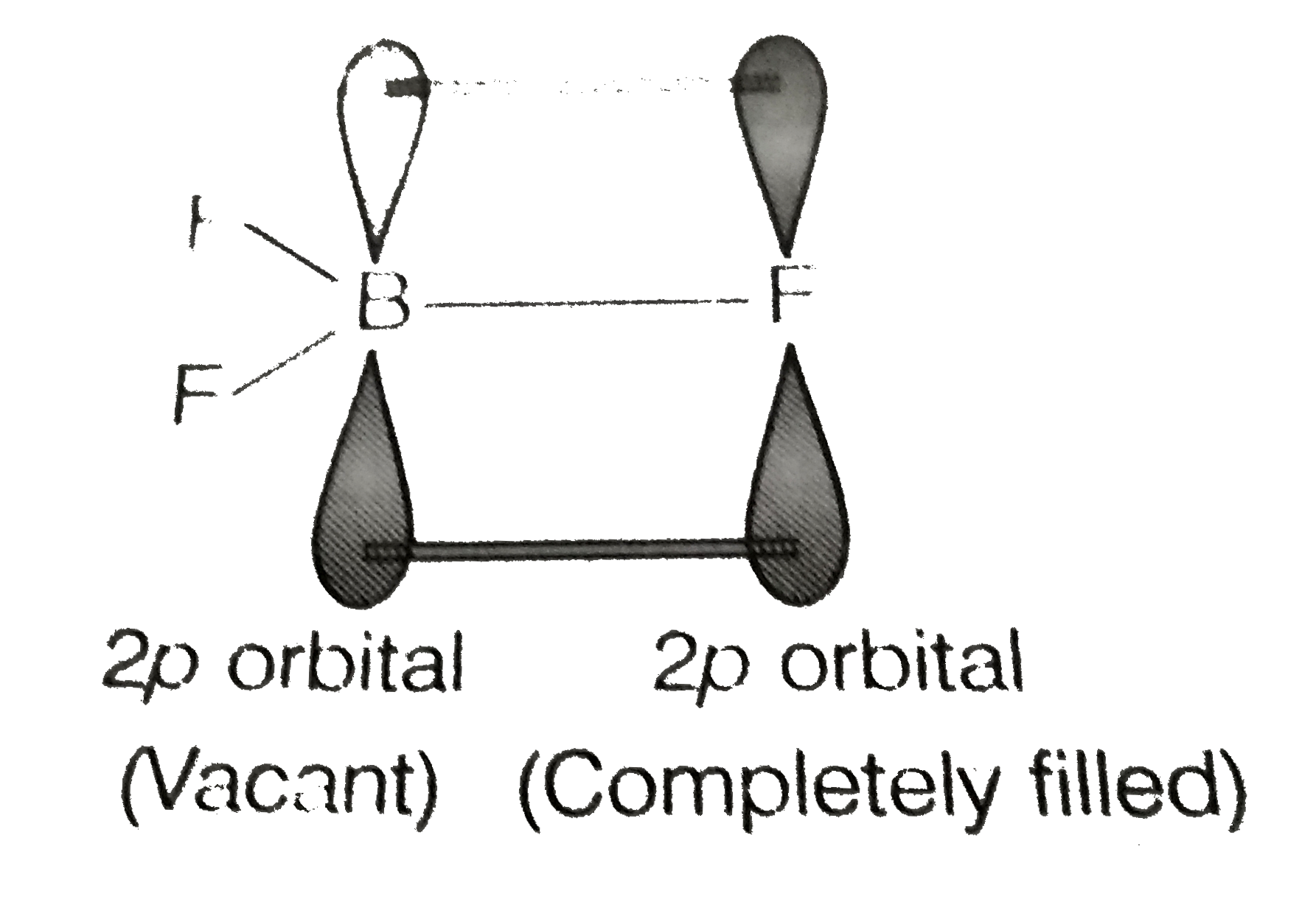 (c) In `PbO_(2) and SnO_(2)`, both lead and tin are present in +4 oxidation state. But due to stronger inert pair effect, `Pb^(2+)` ion is more stable than `Sn^(2+)` ion. In other words, `Pb^(4+)` ions i.e., `PbO_(4)` is more easily reduced to `Pb^(2+)` ions than `Sn^(4+)` ions reduced to `Sn^(2+)` ions. Thus, `PbO_(2)` acts as a stronger OXIDISING agent than `SnO_(2)` (d) `Tl^(+)` is more stable than `Tl^(3+)` because of inert pair effect. |
|