

Saved Bookmarks
| 1. |
An elastic string of constant k is attached to a block of mass m as shown. The block is given an extension of (2mg)/(k) from the equilibrium position and released. The time period of oscillations of the block is |
|
Answer» `2pi sqrt((m)/(k))` 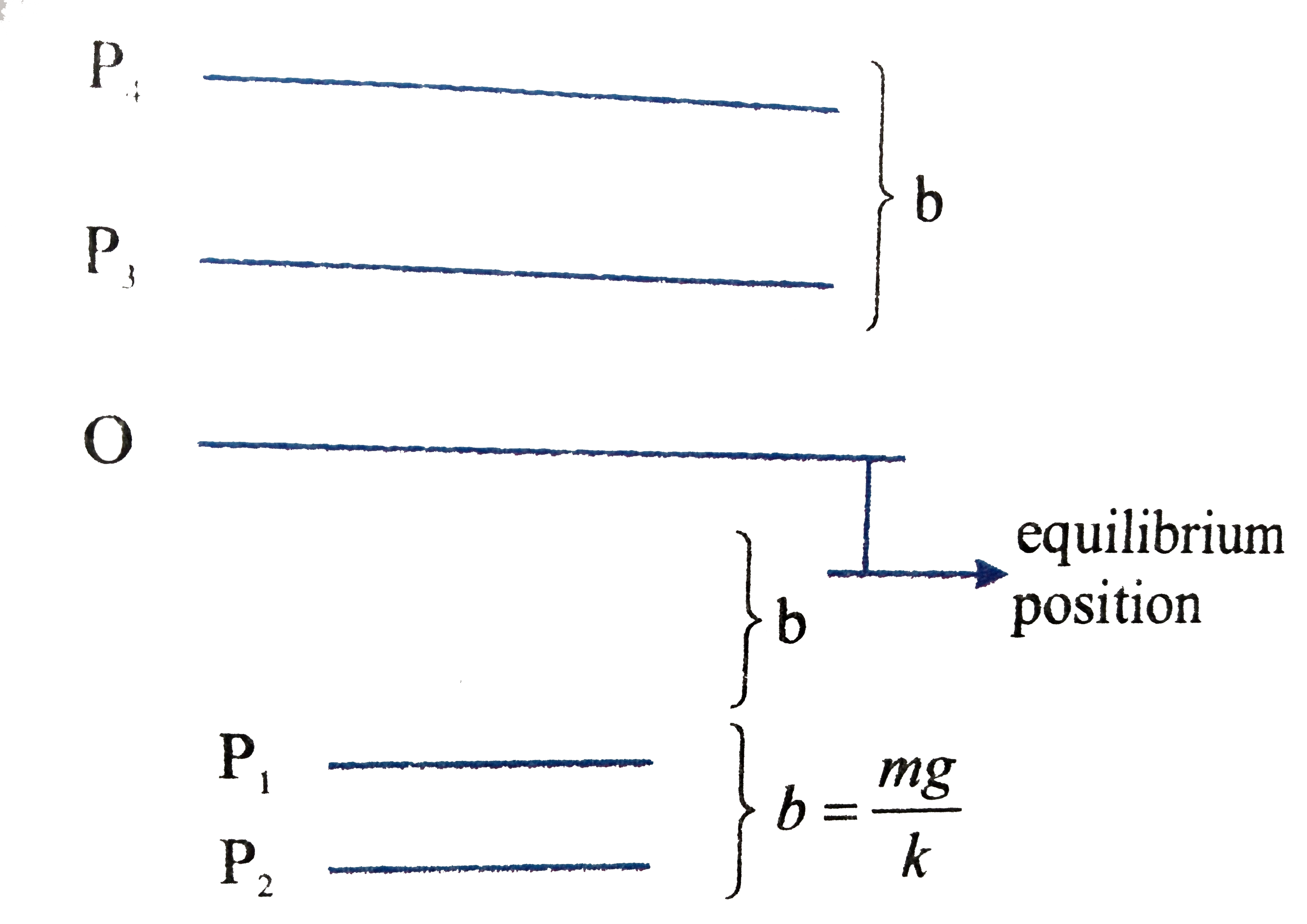 upto `P_(3), SHM` appears and between `P_(3) & P_(4), SHM` disapears. `= (2T_(1))/(3) +(t_(P_(3)P_(4))+t_(P_(4)P_(3))):` `:. T = t_(OP_(2))+t_(P_(2)O) +t_(OP_(3))+t_(P_(3)P_(4)) +t_(P_(4)P_(3)) +t_(P_(3)O)` where: `T_(1) = 2pi sqrt((,)/(k))` VELOCITY at `P_(3)` is: `v = omega sqrt(A^(2)-x^(2)) = omega sqrt(4b^(2)-b^(2)) = b omega sqrt(3)` `t_(P_(3)P_(4)) +t_(P_(4)P_(3)) = (2v)/(g)` |
|