

Saved Bookmarks
| 1. |
Arrange in decreasing order of basicity. (1) m-BO_2-C_6H_4-NH_2 (2) C_6H_5NH_2 (3) p-NO_2-C_6H_4NH_2 (4) o-NO_2-C_6H_4NH_2 (b) Acidic character of: (1) 3-Butenoic acid (2) 3-Butynoic acid ( c) (1) (CH_3)_3 N (2) (3) CH_3-C -= N (d) Acidic character of : (e) Basic character of : (f) Basic character at a,b, and c : H_2 overset(a) underset N(ddot) (g) Acidic Character : o-,m-, and p-aminobenzoic acid and benzoic acid. (h) Acidic character of p-chloro, bromo, iodo, and fluoro phenols and phenol. (i) Give the decreasing order of acidic character at a, b,c and d. . |
|
Answer» Solution :(a) `2 gt 1 gt 3 gt 4 gt [(2)` Aniline (standard) `gt (1) - NO_2` at m-POSITION , (only `-I` effect ar `m) gt (3) - NO_2` at `p-(-I` and `-R)gt (4)- NO_2` at `o (-I` and `-R`, but `-I` at `o- gt m - gt p -)` net `overline e` - withdrawing power of `-NO_2` at `orarr p- gt m -]` (b) `2 gt 1 [(2) sp` character due to `C -= C gt (1) sp^2` character due to `(C = C)` bond] `( c) 1 gt 2 gt 3 [(1) 3^@` amine `gt (2)` Aromatic heterocycle amine, `L P overline e^, s` are not delocalised) `gt (3) sp` character due to `(C -= N)` group.] (d) `1 gt 2 gt 3 gt [(1) - NO_2` at `p-(-I` and `-R) gt (2) - CN` at `p- (- I` and `-R)` but `- I`of `-NO_2 gt (-CN) gt (3)` Standard (phenol)] ( e) `1 gt 2 gt 3 gt 4 [(1) 1^@` aliphati camine `gt (2)` Aromatic amine (Aniline) `gt (3), - NO_2` at `p- (-I` and `-R)gt (4)` Three `- NO_2` groups `(-I` and `-R)` (f) `a gt b gt c` (i) Structure `(a)` has no resonance structure, so `L P overline e^, s` on `N` are available for donation, resulting in `(a)` as the strongest base. (ii) In (b) and (c), `LP overline e^, s` on `N` are in resonance but at `C EWG (C = O)` is present. (g) 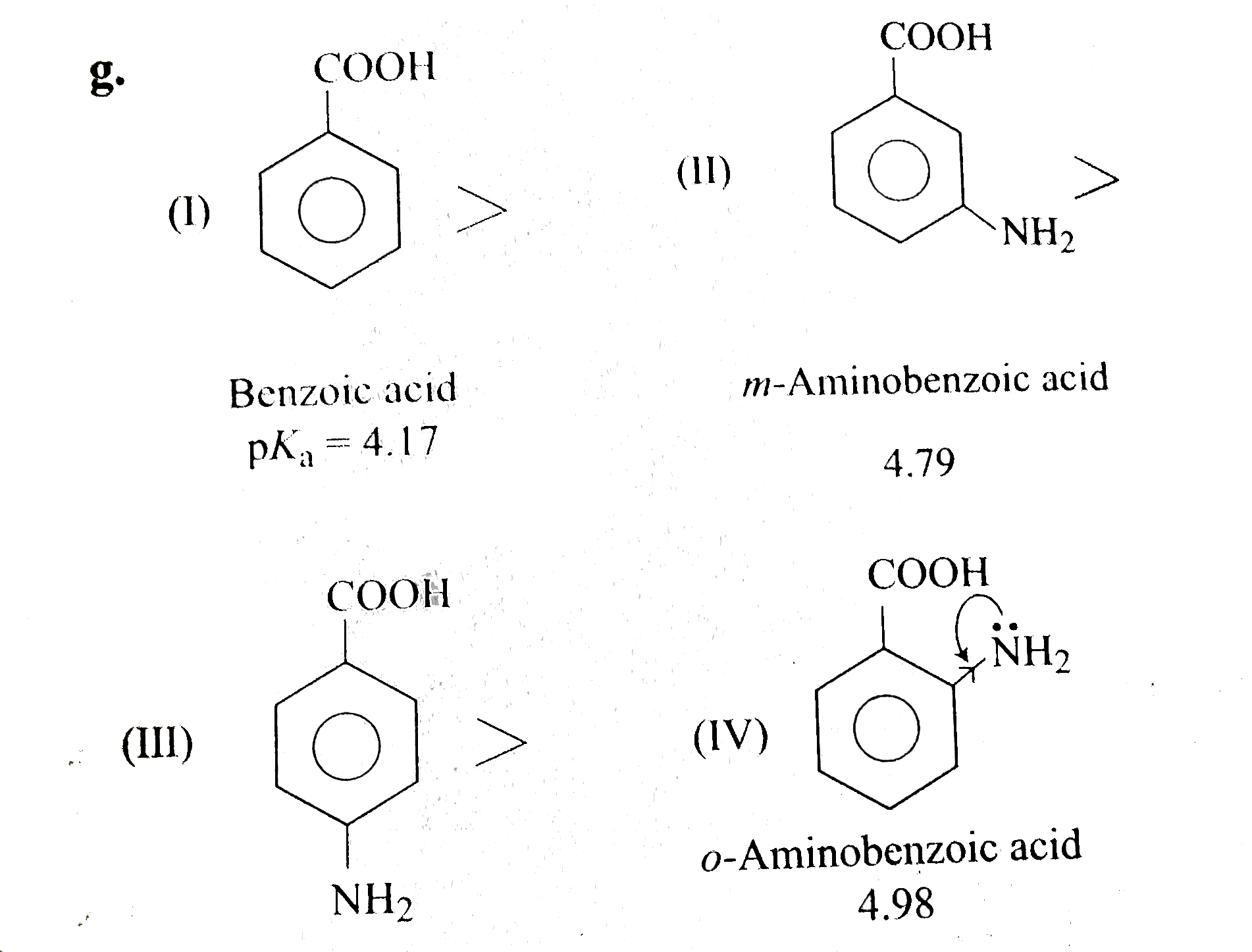 (h) 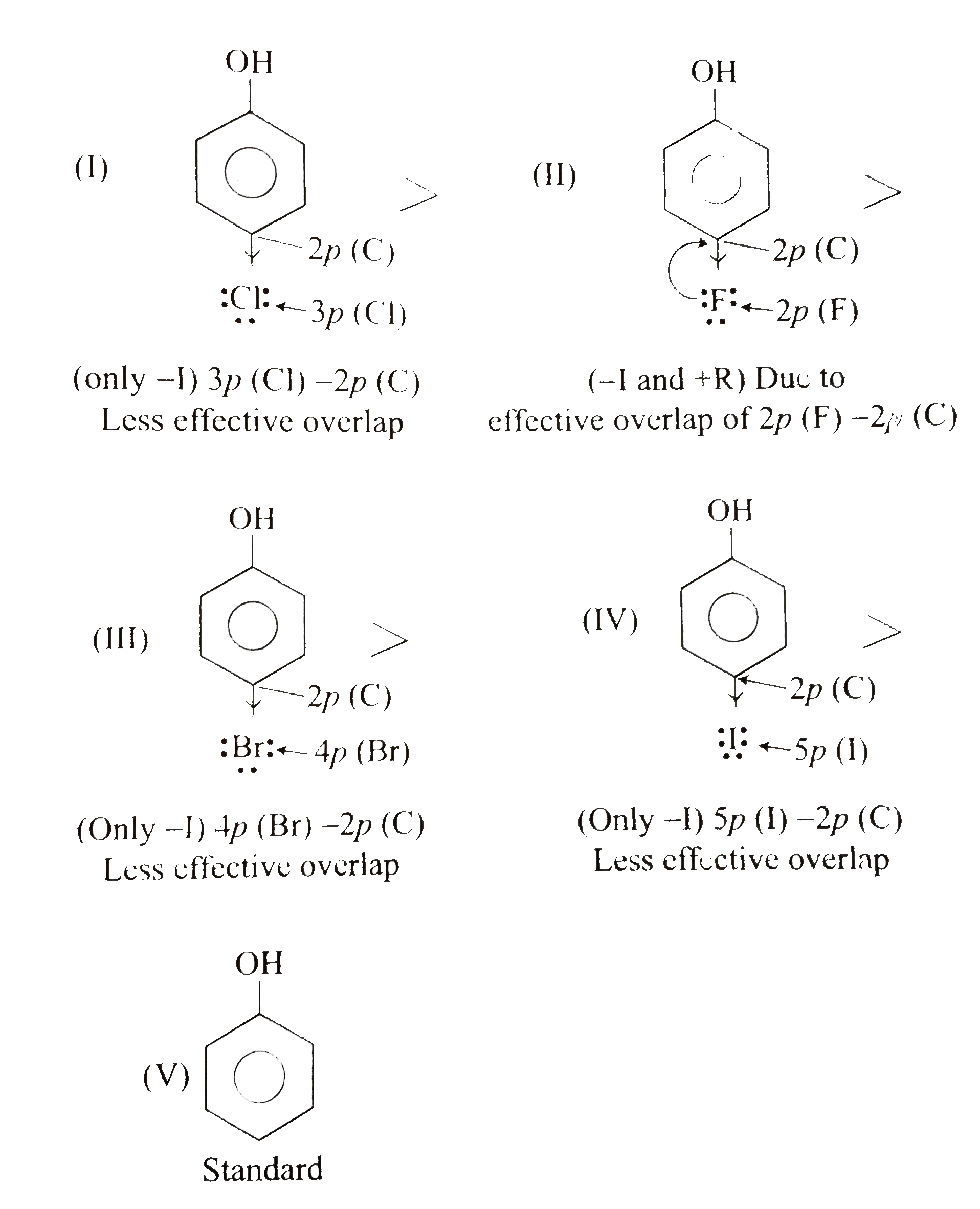 In case of `F`, both `-I` and `-R` effects are considered because of the effective overlap of `2 p (F) - 2p ( C)`. But in other halogens. only `-I` effect is considered due to the INEFFECTIVE overlap. So net `overline e` - withdrawing power of `C1 gt F gt Br gt I`. Hence, the acidic order is. `I gt II gt III gt IV gt V` (refer to `pK_a` , Table). (i) ( I) `c gt b gt a` (i) (c) is p-nitrophenol, which is stronger than o-nitro phenol `(b)` (due to intramolecular `H`-BONDING) (ii) In (a), acidic character is decreasing due to `+ I` and `H.C` effects of `(Me)` group at o-position. (II) `c gt d gt b` (i) Due to `EWG (NO_2` group) (`-I` and `-R` effects), `C` is most acidic. (ii) Due to ortho-effect, `(a)` is more acidic than `(b)` and `(d)` but less than `(c)` (iii) Due to only `+I` effect of `Me` at `m-`position, `(d)` is more acidic than `(b)` (iv) Due to `+ I` and `H.C` effects of `Me` at `p-`position (b) is least acidic. (III) `a gt c gt d ("Phenol" )gt "Aldehyde "gt (C = C) (sp` character) `gt(C = C) (sp^2` character). |
|