

Saved Bookmarks
| 1. |
Assume ideal gas behaviour for all the gases considered and neglect vibrational degrees of freedom. Separate equimolar sample. Separate equimolar samples of Ne, O_(2) , CO_(2) and SO_(2)were subjected to a two process as mentioned. Initially all are at same state of temperature and pressue.Step I rarr All undergo reversible adiabatic expansion to attain same final volume, which is double the original volume thereby causing the decreases in their temperature. Step rarr After step I all are given appropriate amount of heat isochorically to restore the original temperature. Mark the correct option(s) : |
|
Answer» Due to step I only, the decrease in temperature will be maximum for Ne Second step is isochoric (w = 0) 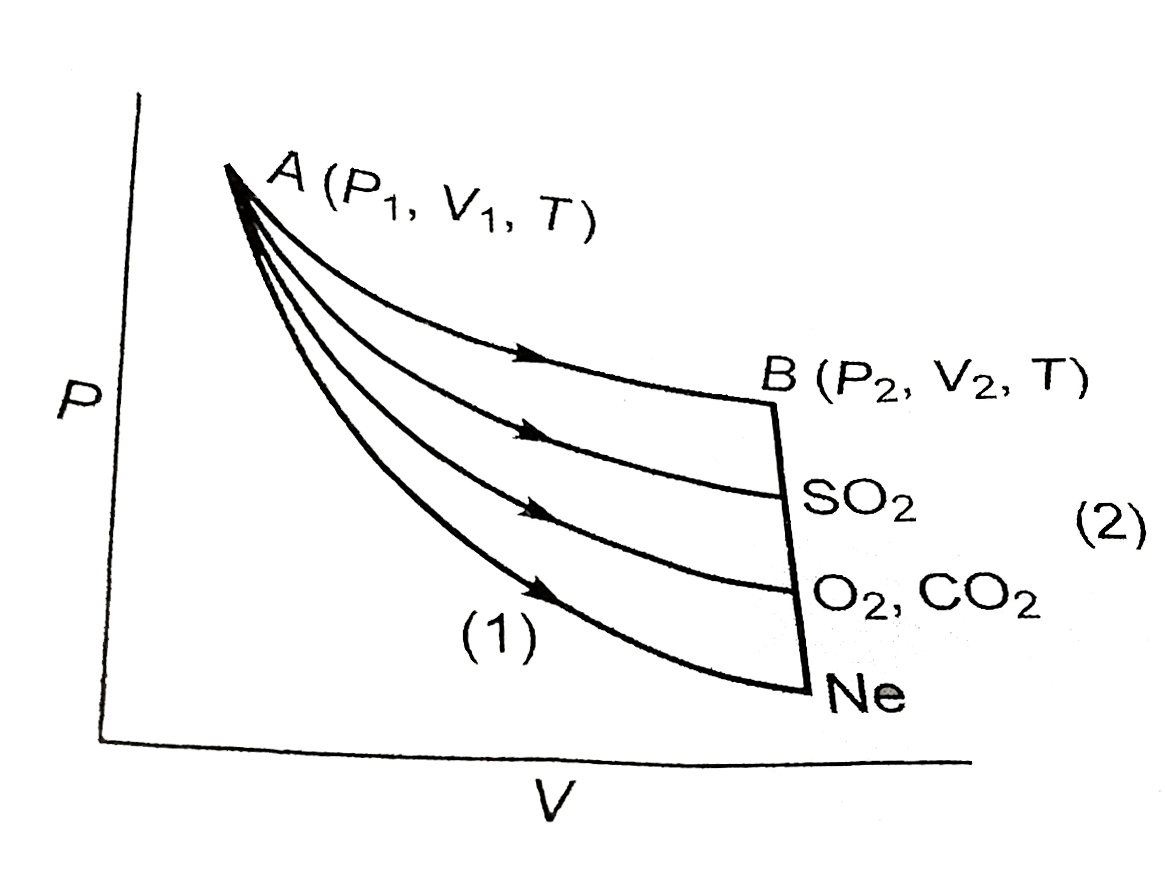 So, `""DeltaU_(2)=q_(2)` `because` initial and final temp. are same `therefore""DeltaU_("toal")=DeltaU_(1)+DeltaU_(2)=0` ` "or"w_(1)+q_(2)=0` Max. work done by the gas, `SO_(2)` is (area) under the curve so, `SO_(2)` absorbed `because ""gamma_(SO_(2))lt gamma_(CO_(2))=gamma_(O_(2))=ltgamma_(Ne)` so, max. decrease in temp. of Ne due to step 1. |
|