

Saved Bookmarks
| 1. |
Boron fluoride exists as BF_(3) but boron hydride does't exist as BH_(3). Give reason. In which form does it exist ? Explain its structure. |
Answer» Solution :Due to `p pi - p pi` back bonding, the LONE pair of electrons of F is donated to the B-atom. Thus delocalisation reduces the deficiency of electrons of B thereby incresing the stability of `BF_(3)` molecule 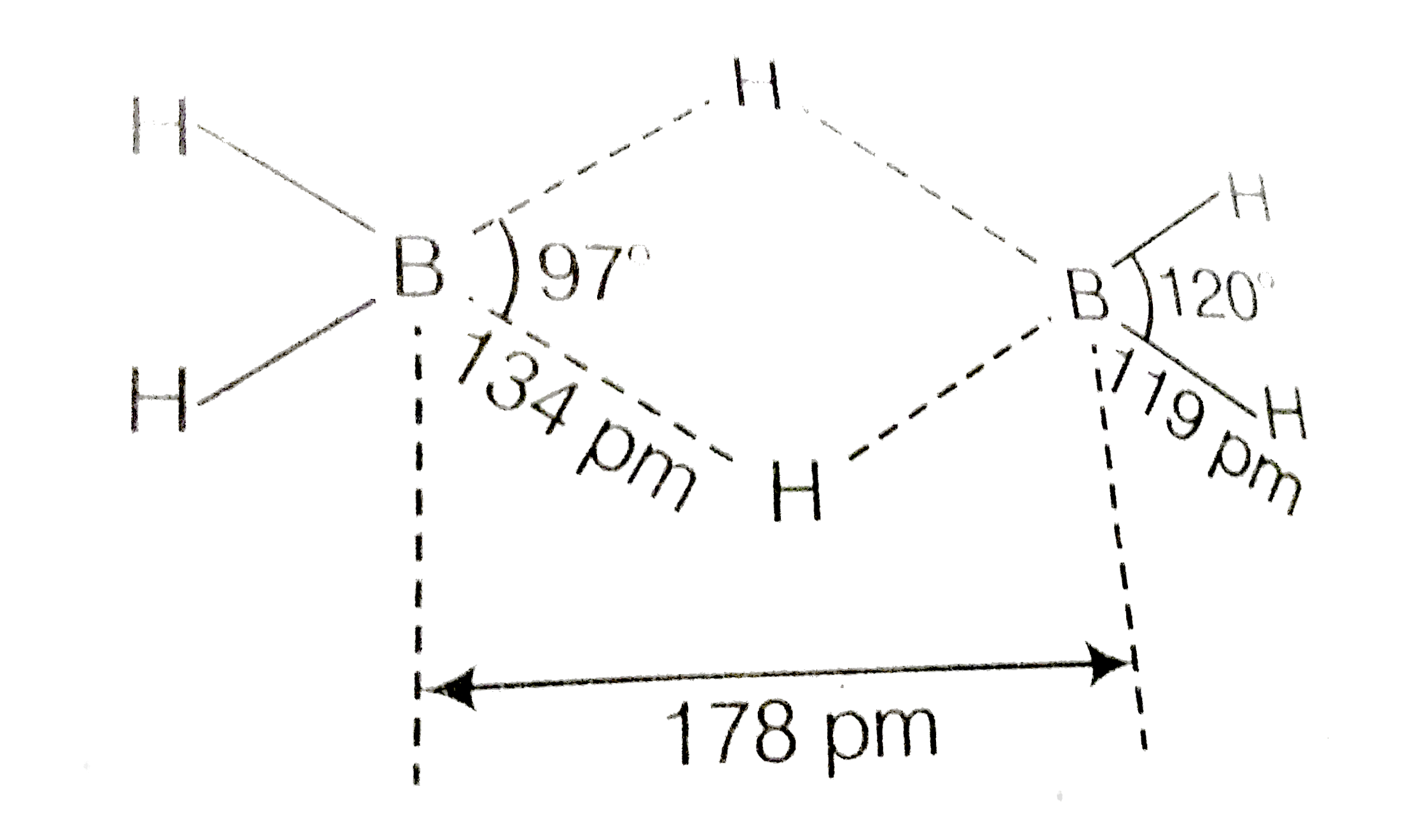 Due to absence of lone pair of electrons on H-atom, this compensation does not occur in `BH_(3)`. In other WORDS electron deficiency of B stays and hence to reduce its electron deficiency, `BH_(3)` dimerises, `BH_(3)` dimerises to form `B_(2)H_(6)` In `B_(2)H_(6)`, FOUR terminal hydrogen atoms and two boron atoms lie in one PLANE. Above and below this plane there are two BRIDGING H-atoms. The four terminal B-H bonds are regular while the two bridge (B-H-B) bonds are three centre-two electron bonds. |
|