

Saved Bookmarks
| 1. |
Consider a particle moving along x-axis. Its distance from origin O is described by the co-ordinate x which varies with time. At a time t_(1), the particle is at point P, where its co-ordinate is x_(1) and at time t_(2), the particle is at point Q, where its co-ordinate is x_(2). The displacement during the time interval from t_(1) to t_(2) is the vector from P to Q, the x-component of this vector is (x_(2) - x_(1)) and all other components are zero. It is convenient to represent the quantity x_(2) - x_(1) the change in x by means of a notation Delta, thus Delta x = x_(2) - x_(1) and Delta t = t_(2) - t_(1). The average velocity bar(V) = (x_(2) - x_(1))/(t_(2) - t_(1)) = (Delta x)/(Delta t) A particle moves half the time of its journey with u. The rest of the half time it moves with two velocities v_(1) and v_(2) such that half the distance it covers with v_(1) and the other half with v_(2). The net average velocity is: (Assume straight line motion) |
|
Answer» `(u (v_(1) + v_(2)) + 2 v_(1) v_(2))/(2 (v_(1) + v_(2)))` `s_(1) = u xx (T)/(2)` `(s_(2))/(2) = v_(1) xx t_(1)` and `(s_(2))/(2) = v_(2) xx t_(2)` where `t_(1) + t_(2) = (T)/(2)` Av. Velocity `= ("Total DISTANCE")/("Total time")` `= ((s_(1) + s_(2))/(T))` 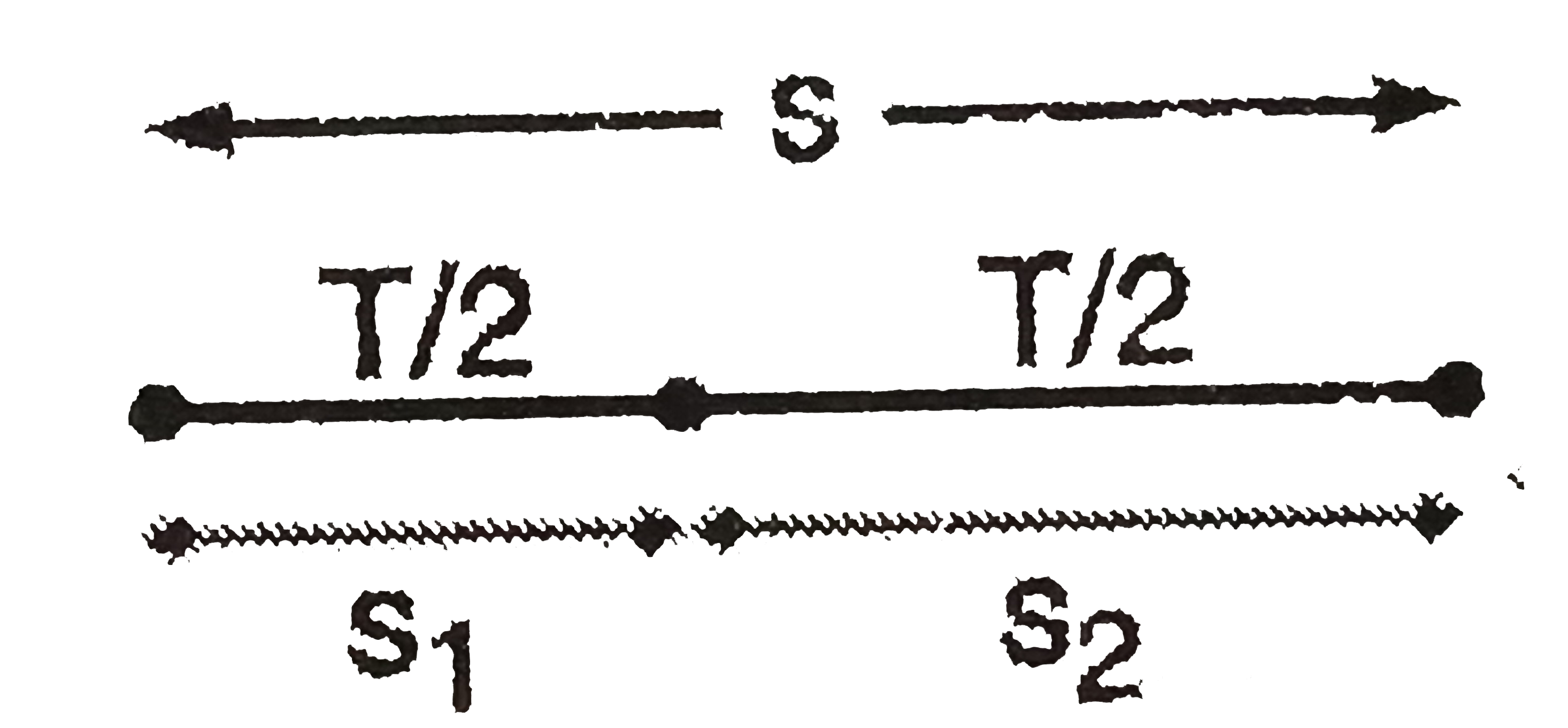
|
|