

Saved Bookmarks
| 1. |
Consider Example 8, taking the coefficient of friction, mu, to be 0.5 and calculate the maximm compression of the spring. |
|
Answer» SOLUTION :In presence of friction, both the spring force and the frictionless force act so as to oppose the compression of the spring as shown in fig. We invke the work-energy theorem, rather than the conservation of mechanical energy. The CHANGE in kinetic energy is 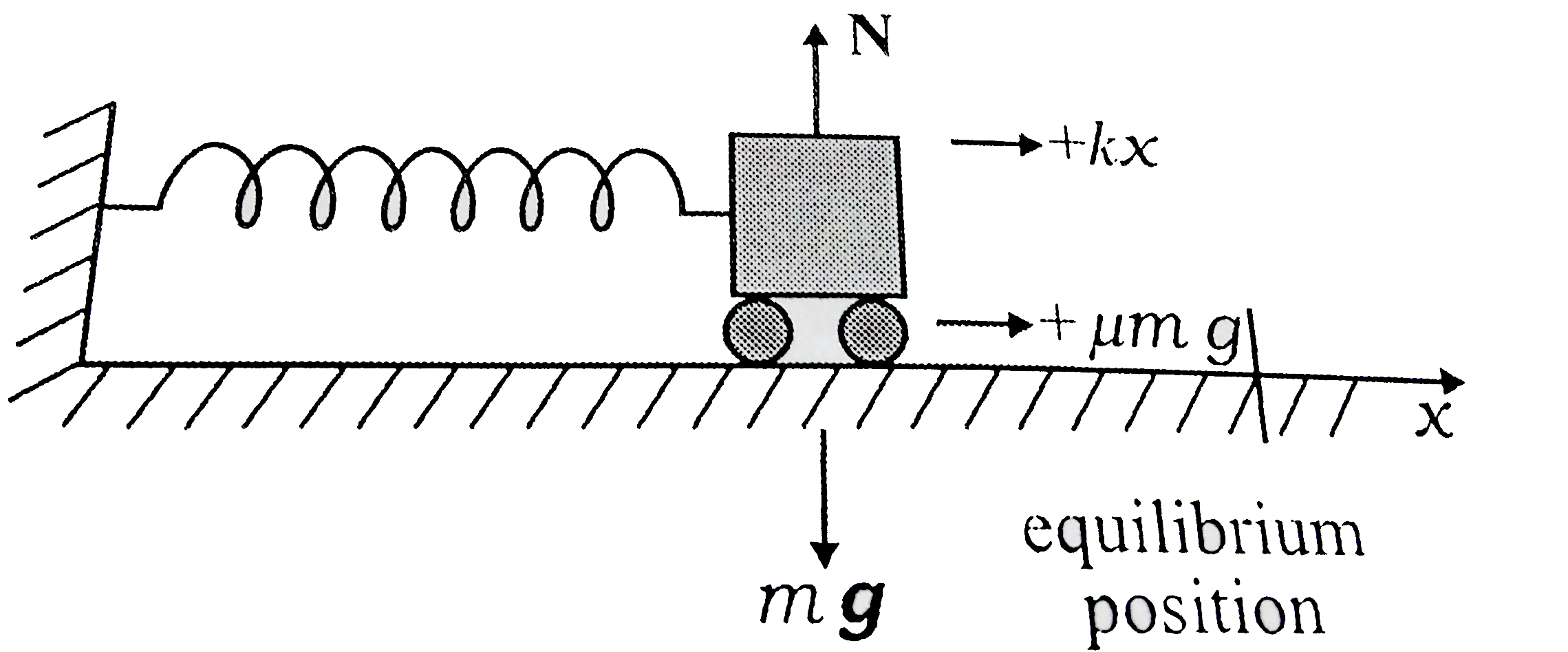 `DeltaK = K_(f)-K_(i)=0-1/2mv^(2)` The work done by the net force is `W=-1/2kx_(m)^(2)-mumgx_(m)` Equating we have `1/2mv^(2) = 1/2kx_(m)^(2)+mumgx_(m)` Now, `mumg=0.5 xx 10^(3) xx 10=5 xx 10^(3)`N (taking g=10.0 `mso^(-2))`. After rearranging the above equation we obtain the following quadratic equation in the unknown `x_(m)` `kx_(m)^(2) + 2mumgx_(m)-mv^(2)=0` `x_(m) = (-mumg+ [mu^(2)m^(2)g^(2)+mkv^(2)]^(1//2))/k` where we take the positive square root since `x_(m)`is positive. Putting in numerical values we obtain. `X_(m) = 1.35m` Which, as expected, is less than the result If the two forces on the body consist of a conservation force `F_(c)` and a non-conservative force `F_(NC)`. the conservation of mechanical energy formula will have to be modified. By the WE theorem. `(F_(c) + F_(nc))Deltax = DeltaK` ltrbgt But, `F_(c)Deltax= -DeltaV` Hence, `DELTA(K+V)=F_(nc)Deltax` `DeltaE = F_(nc)Deltax` where E is the total mechanical energy. Over the path this assumes the form. `E_(f) -E_(i) = W_(nc)` Where `W_(nc)` is the total work done by the non-conservative forcer over the path. Note that the unlike the conservative force. `W_(nc)` depends on the particular path i to f. |
|