

Saved Bookmarks
| 1. |
Consider f(x)=Lim_(nto oo)((a^(n)+b^(n))^((1)/(n))sinx+{e^(x)}^(n))([(1)/(ncot^(-1)n)]+1),AAx inR where agtbgt0. [Note : {k} and [k] denotes fractinal part of k and greatest interger less than or equal to k respectively.] If H(x)=sgn (f(x)-3) has exactly one point of discontinuity AA x in[0,2pi], then number of integral value of a, is |
|
Answer» 1 `:.""f(x)=(asinx+0)(1+1)` `:.""f(x)=2asinx` (i) `H(x)=SGN (2asinx-3)` has exactly one POINT of discontinuty in `[0,2pi]`, then `2A sinx-3=0` must have one real root in `[0,2pi],sin(3)/(2a)` `:." "a=(3)/(2)` only `:.""` Number integral value of a is ZERO. `G(x)=|2asinx|+2asin|x|` (ii) 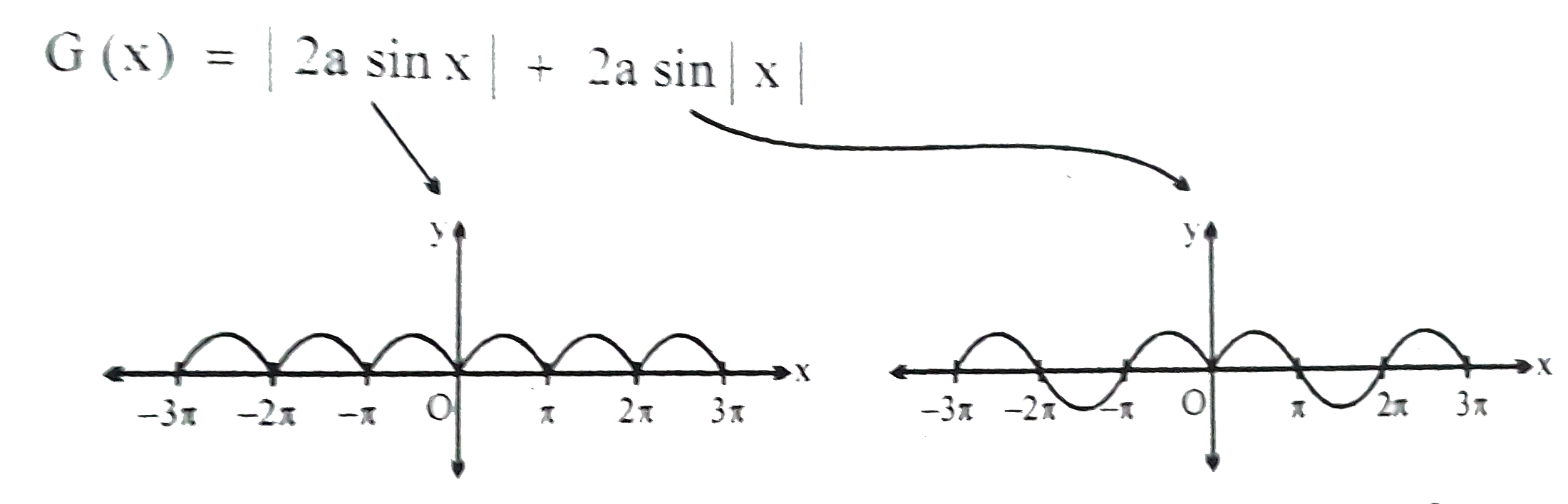 Number of non-differential point of G(x) is `x=-2pi,-pi,0,pi,2pi` separately we can prove that G(x) is non-differentiable at x=0. |
|