

Saved Bookmarks
| 1. |
Consider the following If vec(a) and vec(b) are the vectors forming consecutive sides of a regular hexagon ABCDEF, then 1. vec(CE)=vec(b)-2vec(a) " " 2. vec(AE)=2vec(b)-vec(a) 3. vec(FA)=vec(a)-vec(b) Which of the above are correct? |
|
Answer» 1 and 2 only 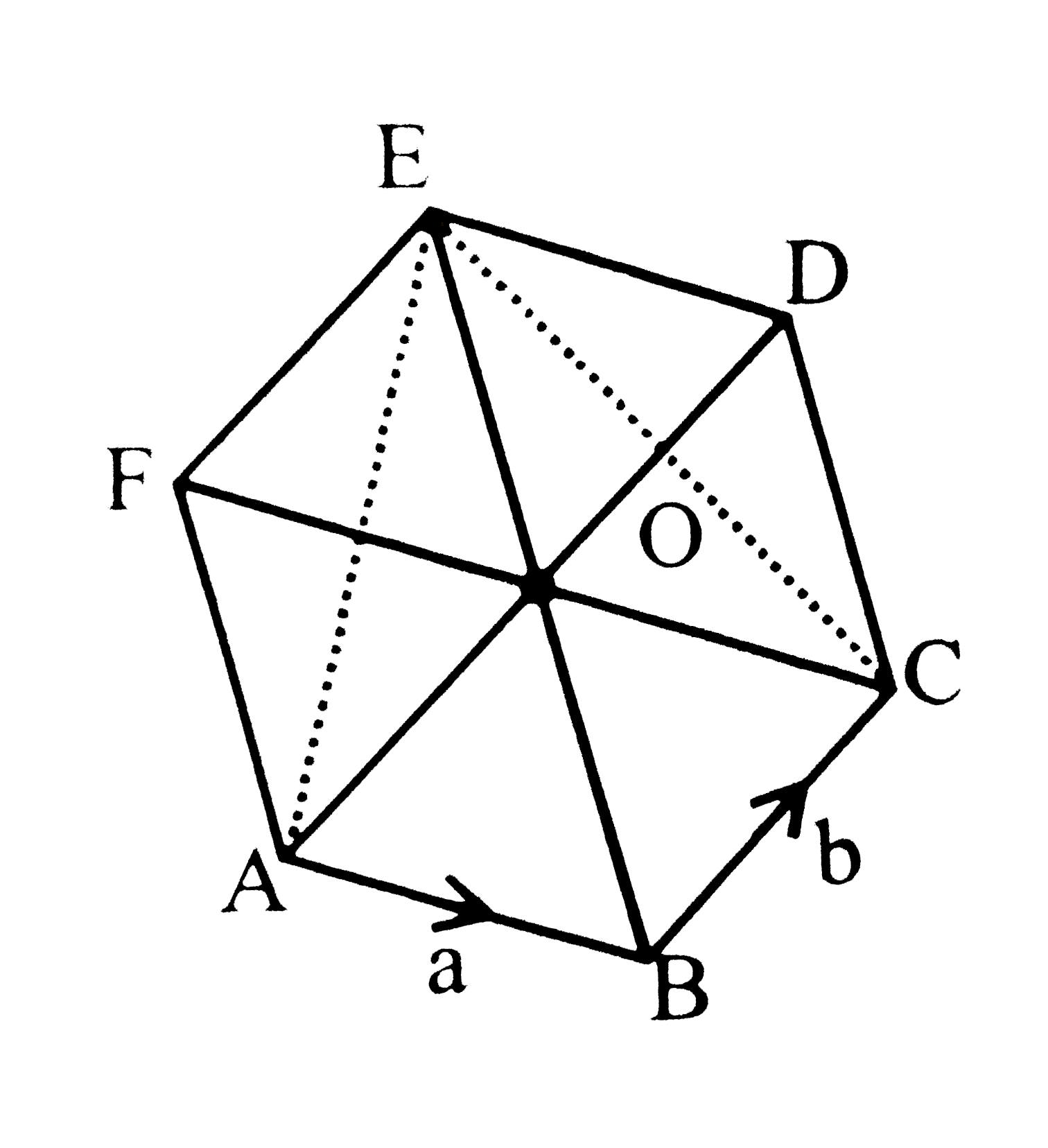 Let `vec(AB)=vec(a)and vec(BC)=vec(b)` JOIN AD, FC and EB. They meet at a common point O, which is the centre of HEXAGON. `AO||BC` so, `vec(AO)=vec(BC)=vec(b)` `OC||AB ` so, `vec(OC)=vec(AB)=vec(a)` OAB forms a triangle, `vec(AB)+vec(BO)=vec(AO)` `rArrvec(BO)=vec(AO)-vec(AB)=vec(b)-vec(a)` BO=OE and they are on the same line, so, `vec(BO)=vec(OE)=vec(b)-vec(a)` In `DeltaOCE, vec(CO) + vec(OE)=vec(CE)` `rArr vec(CE)=-vec(OC)+OE=-vec(a)+vec(b)-vec(a)=vec(b)-vec(2a)` So, (1) is correct. `vec(BE)= 2 vec(OB) ` In `DeltaAEB, vec(AB)+vec(BE)=vec(AE)` `rArr vec(AE) = vec(AB)+2 vec(BO)+vec(a)+2(vec(b)-vec(a))` `rArr vec(AE)=vec(a) + 2 vec(b) - 2 vec (a) = 2 vec(b)-vec(a)` So, (2) is also correct, `FA||OB rArr vec(FA)=-vec(BO)=-(vec(b)-vec(a))=vec(a)-vec(b)` So, (3) is also correct. So, (1) , (2) & (3) are correct. |
|