

Saved Bookmarks
| 1. |
Consider the inequality, 9^(x)-a.3^(x)-a+3 le 0, where 'a' is a real parameter. (a) Find the value of 'a' for which the inequality has at least one negative solution. (b) Find the values of 'a' for which the inequality has at least one positive solution. (c) Find the vlaues of 'a' for which the inequality has at least one real solution. |
|
Answer» Solution :`""9^(X)-a. 3^(x)-a+3 le 0` Let `""t=3^(x)` `RARR""t^(2)-at-a+3 le 0` or `""t^(2)+3 le a(t+1)""` (i) where `""t in R^(+) ` for `AA x in R` 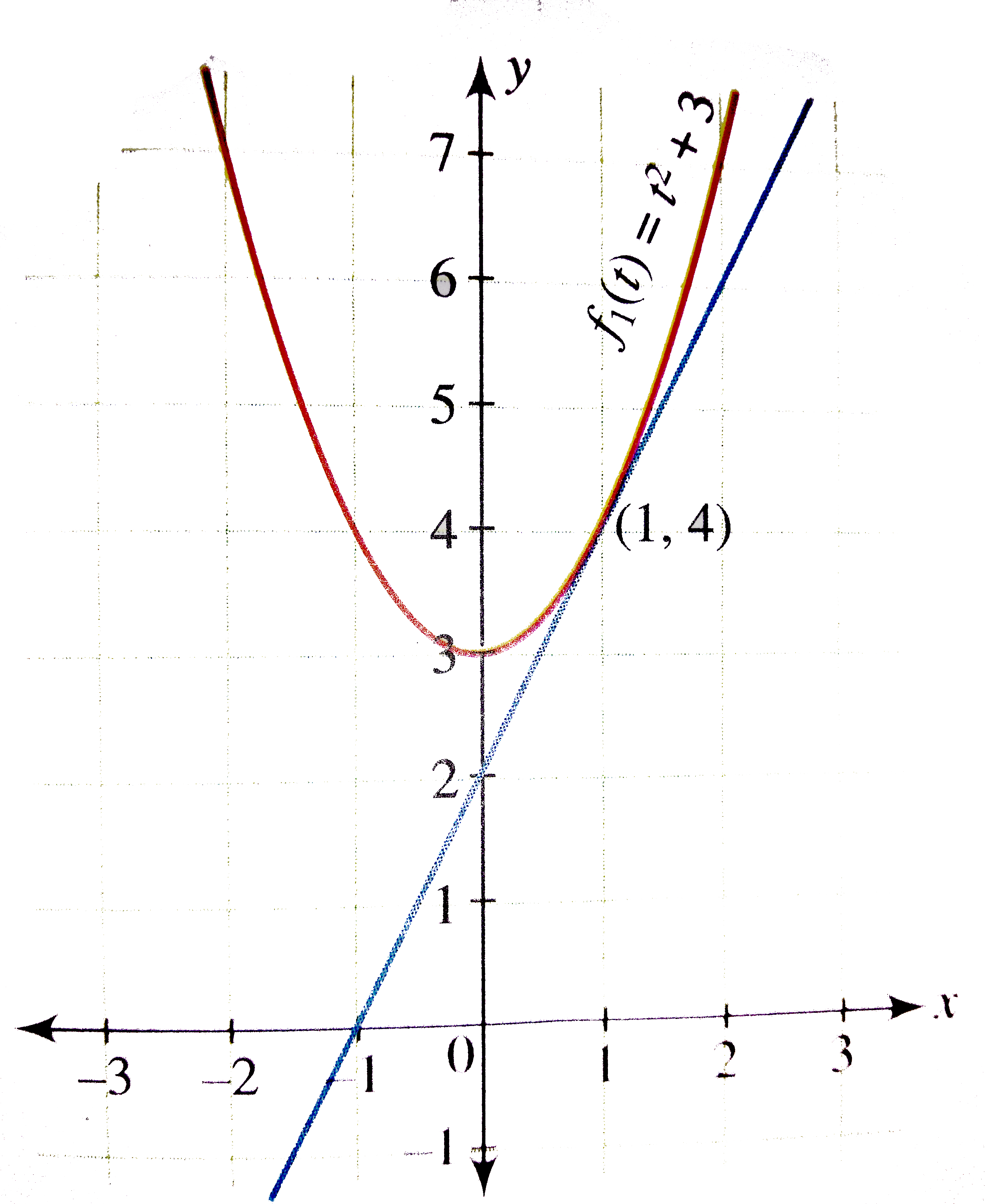 Let `f_(1)(t)=t^(2)+3 and f_(2)(t)= a (t+1)` (a) For `x lt 0, t in (0, 1)`. That means (i) should have at least one solution in `t in (0, 1)`. From (i), it is obvious that `a in R^(+)`. Now `f_(2)(t)= a(t+1)` represents a straight line. It should MEET the curve. `f_(1)(t)=t^(2)+3`, at least once in `t in (0, 1)`. `f_(1)(0)= 3, f_(1)(0) rArr a=3, "if" f_(1)(1)= f_(2)(1)=a =2` Hence REQUIRED `a in (2, 3)`. (b) For at least one positive solution, `t in (1, oo)`. That means the graphs of `f_(1)(t)=t^(2)+3 and f_(2)(t)= a(t+1)` should meet at least once in `t in (1, oo)`. If `a=2`, both curves touch each other at `(1, 4)`. Hence required `a in (2, oo)`. (c) In this CASE, both graphs should meet at least once in `t in (0, oo)`. For `a=2`, both curves touch, hence required `a in [2, oo)`. |
|