

Saved Bookmarks
| 1. |
Define the collections {E_1,E_2,E_3,...} of ellipses and {R_1,R_2,R_3,...} of rectangles as follows : E_1:(x^2)/(9)+(y^2)/(4)=1 R_1: rectangle of largest area, with sides parallel to the axes, inscribed in E_1, R_n-1,ngt1, R_n : rectangle of largest area, with sides parallel to the axes, inscribed in E_ngt1. Then which of the following options is /are correct ? |
|
Answer» the eccentricities of `E_18` and `E_19` are NOT equal. `E_1:(x^2)/(9)+(y^2)/(4)=1` ....(i) Now, let a VERTEX of rectangle of largest area with sides PARALLEL to the axes, incribed in `E_1` be `(3cos theta, 2 sin theta)`. So, area of rectangle `R_1=2(3cos theta)xx2(2sintheta)=12 sin(2theta)` 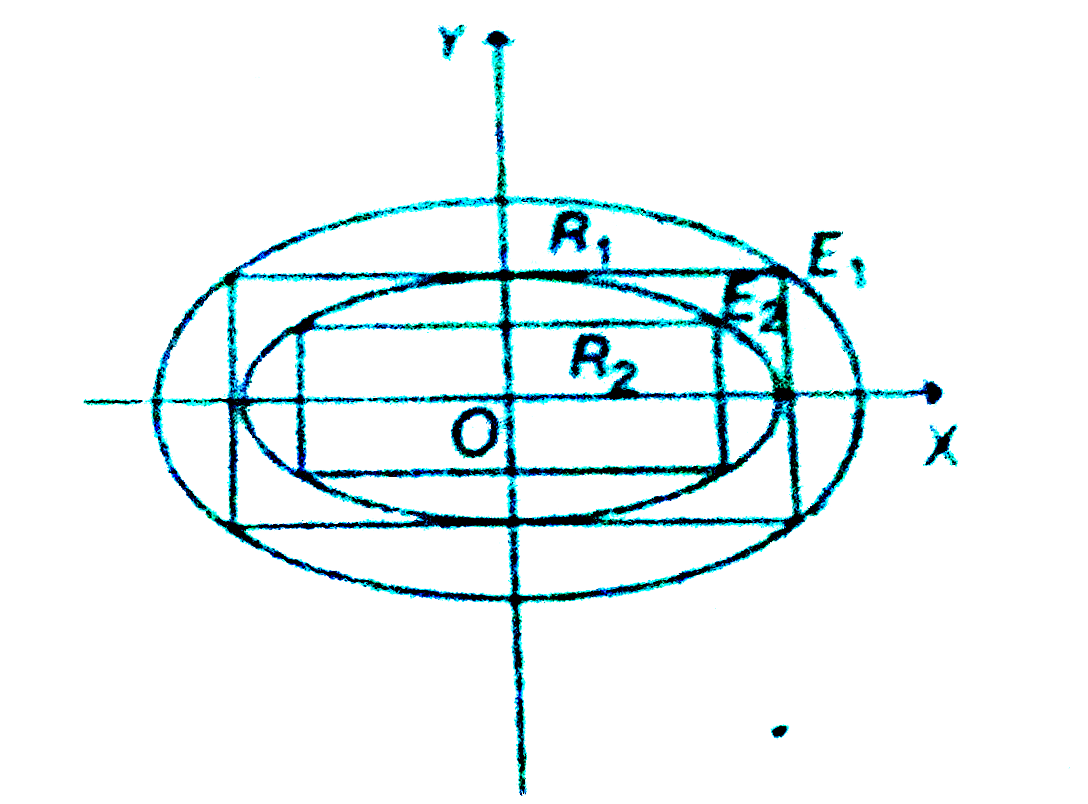 The area of `R_1` will be maximum, if `theta=(pi)/(4)` and maximum area is 12 square units and length of sides of rectangle `R_1` are `2a COS theta =sqrt(2)a=3sqrt(2)=` length of major axis of ellipse `E_1` and `2bsintheta=sqrt(2)b=2sqrt(2)=` length of minor axis of ellipse `E_2`. So, `E_2 : (x^2)/((a)/(sqrt(2)))^2+(y^2)/((b)/(sqrt(2)))^2=1`and maxsimum area of rectangle `R_2=2((a)/(sqrt(2)))((b)/(sqrt(2)))` So, `E_n=(x^2)/(((a)/((sqrt(2))^(n-1)))^2)+(y^2)/(((b)/((sqrt(2))^(n-1)))^2)=1`, and maximum area of rectangle `R_n=2((a)/(sqrt(2))^(n-1))((b)/(sqrt(2))^(n-1))` Now option (a), Since, eccentricity of ellipse `E_n=e_(n)=sqrt(1((b_n)^2)/(a_n)^2)` `sqrt(1-(((b)/((sqrt(2))^(n-1)))^2)/(((a)/((sqrt(2))^(n-1)))^(2)))=sqrt(1-(b^2)/(a^2))=sqrt(1-(4)/(5))=sqrt(5)/(3)` is independent of `pi`,so eccentricity of `E_18 and E_19` are equal. Option (b), Distance between focus and centre of `E_9=e.a_9` `=(a)/((sqrt(2)^8))(2)=(3)/(2^4)xx(sqrt(5))/(3)=(sqrt(5))/(16)"unit"`. Option (c), `because sum_(n=1)^(n)("area of" R_n)lt ("area of" R_1)+("ara of" R_2)+.....oo` `lt 2ab+2(ab)/(2)+2(ab)/(2^2)+......` `lt 2ab (1+(1)/(2)+(1)/(2^2)+......)` `lt 12((1)/(1-1//2))` `rArr sum_(n=1)^(N)("area of"R_n) lt 24`, each of positive integer N. Option (d), Length of latusrectum `E_9=(2b_9^2)/(a_9)=(2b^2)/(a(sqrt(2))^8)` `=(2xx4)/(3xx16)=(1)/(6)" units"`. Hence, option (c) and (d) are correct. |
|