

Saved Bookmarks
| 1. |
Dehydration of 1-butanol or 2-butanol with conc. H_2SO_4 always gives the same mixture of 2-butene (80 %) and 1-butene (20 %) but dehydrohalogenation of 1-bromobutane with alc. KOH gives 1-butene as the major product while that of 2-bromobutane gives 2-butene as the major product . Explain why ? |
Answer» Solution :During dehydration of alcohols , carbocations are the intermediates. In CASE of 1 butanol , first `1^@` carbocation is FORMED which being less stable rearranges to the more stable `2^@` carbocation before losing a proton to form a mixture of 2-butene (80 %) and 1-butene (20%) . 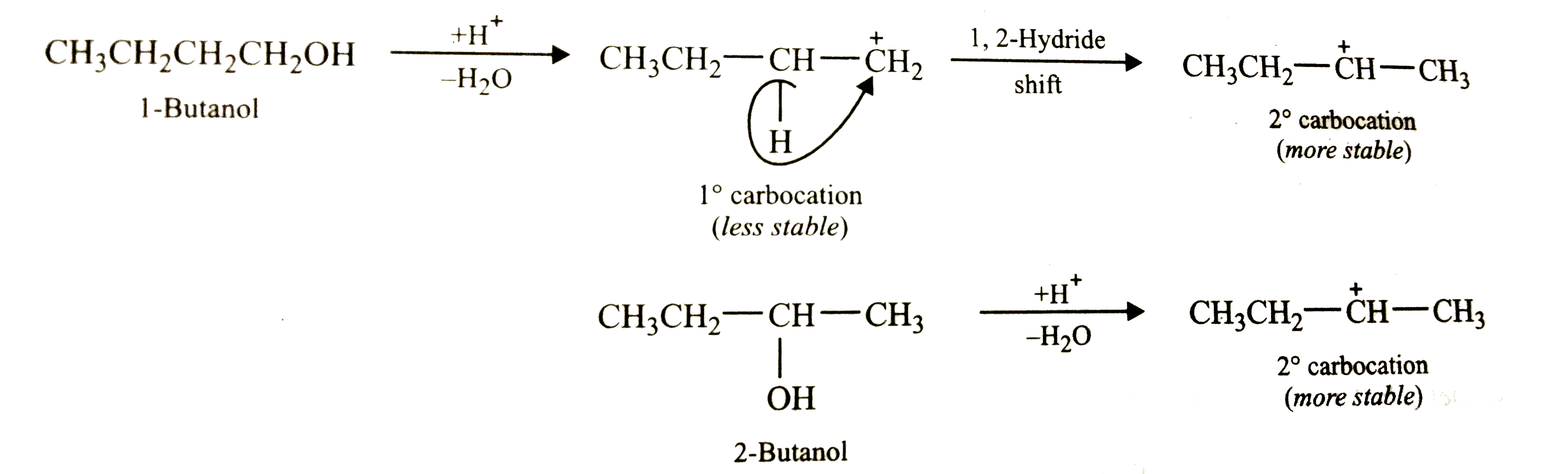 Since 1-butanol and 2-butanol give the same carbocation intermediate, therefore , on losing a proton, both give the same mixture of 2-butene (80%) and 1-butene (20%) in accordance with the Saytzeff's rule. In case of dehydrohalogenation of alkyl halides with alc. KOH , carbocations are not the intermediates. Instead the reaction occurs by a concerted mechanism involving a transition state . Further , since in 1-bromobutane, there is `beta`-H only on left side of `alpha`-carbon carrying the Br atom, therefore , only 1-butene is formed as the major product. however, in 2-bromobutane there are `beta`-H ONE either side of the `alpha`-carbon carrying the Br atom, therefore, elimination of a proton can occur from either `beta`-H leading to the formation of a mixtures of ALKENES . Since according to Saytzeff rule, 2-butene is more stable than 1-butene, therefore, dehydrohalogenation of 2-bromobutane gives 2-butene as the major product. 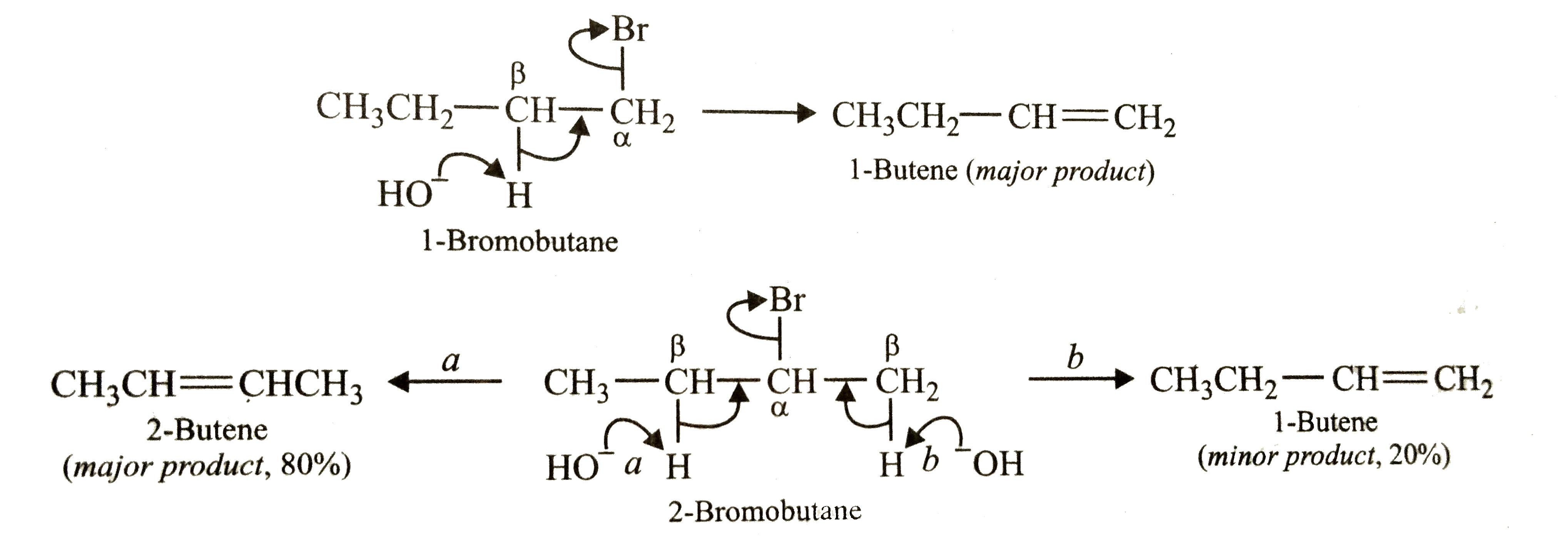 |
|