

Saved Bookmarks
| 1. |
Derive a general expression for the equilibrium constant K_P and K_C for the reaction. 3H_2(g)+ N_2(g) hArr 2NH_3(g) |
|
Answer» Solution :In the formation of ammonia, .a. moles of Nitrogen and .b. moles of hydrogen gas are allowed to react in a CONTAINER of VOLUME of .V.. Let .x. moles of nitrogen react with 3x moles of hydrogen to give 2x molesof ammonia. `N_2(g)+ 3H_2(g)hArr 2NH_3(g)` 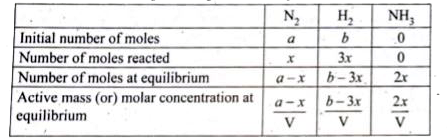 Applying law of mass action `K_C = ([NH_3]^2)/([N_2][H_2]^3) = (((2x)/V)^2)/(((a-x)/V)((b-3x)/(V))^3) = (((4x^2)/(V^2)))/(((a-x)/V)((b-3x)/(V))^3)` `K_C = (4x^2.V^2)/((a-x)(b-3x)^3)` The equilibrium constant `K_P` can be calculated as follow : `K_P = K_C. (RT)^(Deltan_g)` `Deltan_g = n_p - n_r = 2 -4 =-2` `K_P=(4x^2.V^2)/((a-x)(b-3x)^3)(RT)^(-2)` TOTAL number of moles at equilibrium `n = a-x+ b - 3x + 2x = a +b - 2x` `K_P = (4x^2.V^2)/((a-x)(b-3x)^3) xx ((PV)/n)^(-2)` `K_P=(4x^2V^2)/((a-x)(b-3x)^3) xx (n/(PV))^2` `K_P = (4x^2V^2)/((a-x)(b-3x)^3) xx (n/(PV))^2` `K_P = (4x^2V^2)/((a-x)(b-3x)^3) xx ((a+b-2x)/(PV))^2` `K_P = (4x^2 (a + b-2x)^2)/(P^2(a-x)(b-3x)^3)` |
|