

Saved Bookmarks
| 1. |
Discuss the motion of an object under free fall. Neglect air resistance. |
|
Answer» Solution :An object RELEASED near the surface of the Earth is ACCELERATED downward under the influence of the force of gravity. The MAGNITUDE of acceleration due to gravity is represented by g: If air resistance is neglected, the object is said to be in free fall. If the height through which the object falls is small compared to the earth.s radius, g can be taken to be constant, equal to 9.8 `ms^(-2.)` Free fall is THUS a case of motion with uniform acceleration. We assume that the motion is in y-direction, more correctly in - ydirection because we choose upward direction as POSITIVE. Since the acceleration due to gravity is always downward, it is in the negative direction and we have a = - g = - 9.8 `ms^(-2)` The object is released from rest at y = 0. Therefore, `v_(0) = 0` and the equations of motion become : `v =0 - g t =- 9.8 t ms ^(-1)` `y =0 -1/2 g t ^(2) =- 4.9 t ^(2) m` `v ^(2) =0 - 2 gy =- 19.6 ym ^(2)s ^(-2)` These equations give the velcity and the distance travelled as a functino of time and also the variation of velocity with distance. The variation of acceleration, velocity and distance with time have been plotted in (a), (b) and (c) 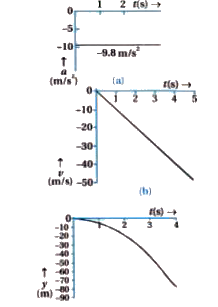
|
|