

Saved Bookmarks
| 1. |
Discuss the properties of scaiar and vector |
|
Answer» Solution :Properties of scalar product are: (i)The product quantity`vec(A), vec(B)`is always a sxalar. It is positive if the angle between the vectors is acule(i.e.,`theta lt 90^(@)`. It is negative if the angle between them is obtuse(i.e.,`90^(@) lt theta lt 180^(@) ` ) (ii)The scalar product obeys commutative law i.e.,`vec(A). vec(B) = vec(B). vec(A)` (iii)The vectors obeys distributive law i.e.,`vec(A) . (vec(B) + vec(C)) = vec(A) . vec(B) + vec(A) . vec(C)` (iv)The angle between the vectors , `theta = cos^(-1)[(vec(A).vec(B))/(AB)]` (v)The scalar product of two vectors will be maximum when`cos theta = 1, i.e. theta = 0^(@),"so"(vec(A) . vec(B))_("max") = AB` (vi)The scalar product of two vectors will be MINIMUM, when ` cos theta = - 1, i.e., theta = 180^(@)` .When the vectors are anti-parallel. `(vec(A). vec(B))_("min") = - AB` (vii)If two vectors`vec(A) and vec(B)`are perpendicular to each other then their scalar product`vec(A) . vec(B) = 0 ` , because`cos 90^(@) = 0`. Then the vectors `vec(A) and vec(B)`are said to be mutually orthogonal . (viii)The scalar product of a vector with itself is termed as self-dot product. ITIS given by`(vec(A))^(2) = vec(A) . vec(A) = A A cos theta = A^(2)` .Here angle`theta = 0^(@)` The magnitude of the vector is given by`vec(A) is|vec(A)| = A = sqrt(A) . vec(A)` (ix)In case of a unit vector , `hat (n)` ` hat (n) . hat(n) = 1 xx 1 xx cos 0 = 1 `. For example,` hat (i) . hat (i) = hat (j) . hat (j)= hat (k) . hat (k) = ` (x)In the case of orthogonal unit vectors`hat (i) . hat (j) and hta(k)` , `hat (i). hat(j) = hat(j) . hat (k) = hat(k) . hat (i) = 1.1 cos 90^(@) = 0 ` (xi)In terms of components the scalar product of ` vec(A) and vec(B)`can be written as `vec(A) . vec(B) = (A, hat (i) + A hat(j) + A, hat(k)).(B, hat(i) + B, hat(j) + B, hat(k))` ` = A_(x) B_(x) + A_(y) B_(y) + A_(z) B_(z)`,With all other terms zero. The magnitude of vector `|vec(A)|`is given by `|vec(A)| = A = sqrt(A_(x)^(z)+A_(y)^(2)+A_(z)^(2))` Properties of vector (cross)product are : (i)The vector product of any two vectors is always another vector whose direction is perpendicular to the piane CONTAINING these two vectors , i.e., orthogonal to both the vectors `vec(A) and vec(B)`. In this case. the vectors `vec(a)and vec(B)`may or may not be mutually othogonal . (ii)The vector of two vectors is not commutative,i.e.,`vec(A) xx vec(B) ne vec(B) xx vec(A) `But .,`vec(A)xx vec(B) = - [ vec(B) xx vec(A)]`. But, `|vec(A) xx vec(B)| = |vec( B) xx vec(A)| = AB sin theta i.e., `in the case of the product vectors`vec(A) xx vec(B) and vec(B) xx vec(A)`, the magnitudes are equal but directions are oppositeto each other . (iii)The vector product of two vectors will have maximum magnitude when sin `theta = 1, i.e., theta =90^(@)`i.e., when the vectors `vec(A) and vec(B)`are orthogonal to each other . `(vec(A) xx vec(B))_("max") = AB hat(n)` (iv)The vector product of two non-zero vectors will be minimum when`|sin theta| = 0,i.e., theta = 0^(@) or 180^(@)` `(vec(A) xx vec(B))_("min") = 0 ` If the vectors are either parallel or anti parallel i.e., then the vector product of twonon-zero vectors vanishes. (v)The self - cross product, i.e., product of a vector with itself is the null vector `vec(A) xx vec(A) = A A sin 0^(@) hat(n) = vec(0)` The null vector `vec(0)`is SIMPLE denoted as zero in physics. (vi)The self-vector products of unit vectors are thus zero . `hat(i) xx hat (i) = hat(j) xx hat (j) = hat (k) xx hat (k) = vec(0)` (vii)In the case of orthogonal unit vectors,`hat(i), hat(j), hat(k)`in accordance with the right hand screw rule `hat (i) xx hat(j) = hat (k), hat(j) xx hat (k) = hat(i) and hat (k) xx hat (i) = hat(j)` Also, since the cross product is not commutative, `hat(j) xx hat(i) = - hat(k), hat(k) xx hat(j) = - hat(i) and hat(i) xx hat(k) = - hat(j)` (viii)In terms of components the vector product of two vectors`vec(A) and vec(B)` is`vec(A) xx vec(B)=|{:(hat(i),hat(j),hat(k)),(A_(x),A_(y),A_(z)),(B_(x),B_(y),B_(z) ):}|` `{{:(hat(i)(A_(y)B_(z)-A_(z)B_(y))),(+hat(j)(A_(z)B_(x)-A_(x)B_(z))),(+hat(k)(A_(x)B_(y)-A_(y)B_(x))):}` Notethat in the `hat(j)^(th)`component the order of multiplicationis different than`hat(i)^(th)andhat(k)^(th)`components . (ix)Iftwo vectors `vec(A) and vec(B)` form adjacent sides in a parallelogram, then the magnitude of `|vec(A) xx vec(B)|`will give the area of the parallelogram as represented GRAPHICALLY in the figure. (x)Since a parallelogram is divided into twoequal triangles as shown in the figure, the area of a triangle with `vec(A) and vec(B)`as sides is`(1)/(2) |vec(A) xx vec(B)|`. 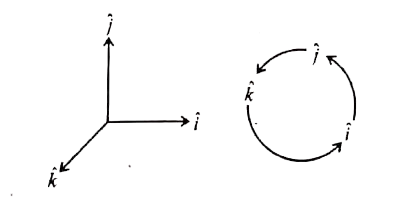 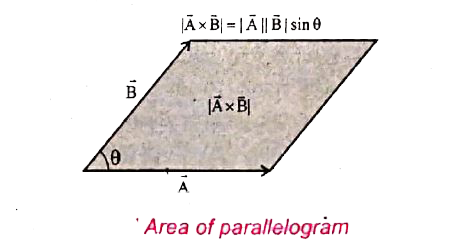 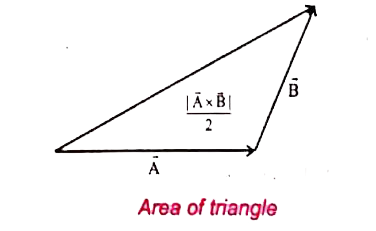
|
|