

Saved Bookmarks
| 1. |
Draw the graph of f(x) = log_(e)(sqrt(1-x^(2))-x) |
|
Answer» Solution :We have `y=f(X)=log_(e)(sqrt(1-x^(2)-x))` `f(x)` is defined if `sqrt(1-x^(2)) - x gt 0` and `1-x^(2) ge0` For `1-x^(2) ge0 , -1 le x le1` `sqrt(1-x^(2))-x gt 0` For (0,1), `1-x^(2)gt x^(2)` or `0 lt x lt 1/sqrt(2)` THUS, the domain of the function is `[-1, 1/sqrt(2)]` `f^(')(x) = ((-x/sqrt(1-x^(2)))-1)/(sqrt(1-x^(2))-x)` `=(-x-sqrt(1-x^(2)))/((sqrt(1-x^(2))sqrt(1-x^(2))-x)` `f^(')(x)=0 therefore -x=sqrt(1-x^(2)` `therefore x=-1/sqrt(2)` `f^(')(x) gt 0` for `x in (-1,-1/sqrt(2))` `f^(')(x) lt 0` for `x in (-1/sqrt(2), 1/sqrt(2))` So `x=-1/sqrt(2)` is the point of maxima. `f(-1) = f(0)=0` `underset(x to 1/sqrt(2))"lim"log_(e)(sqrt(1-x^(2))-x) =- infty (therefore underset(x to 1/sqrt(2))"lim"(sqrt(1-x^(2))-x)=0)` Thus, `x=1/sqrt(2)` is an asymptote. From the above discussion, the GRAPH of the function is as shows in the following FIGURE. 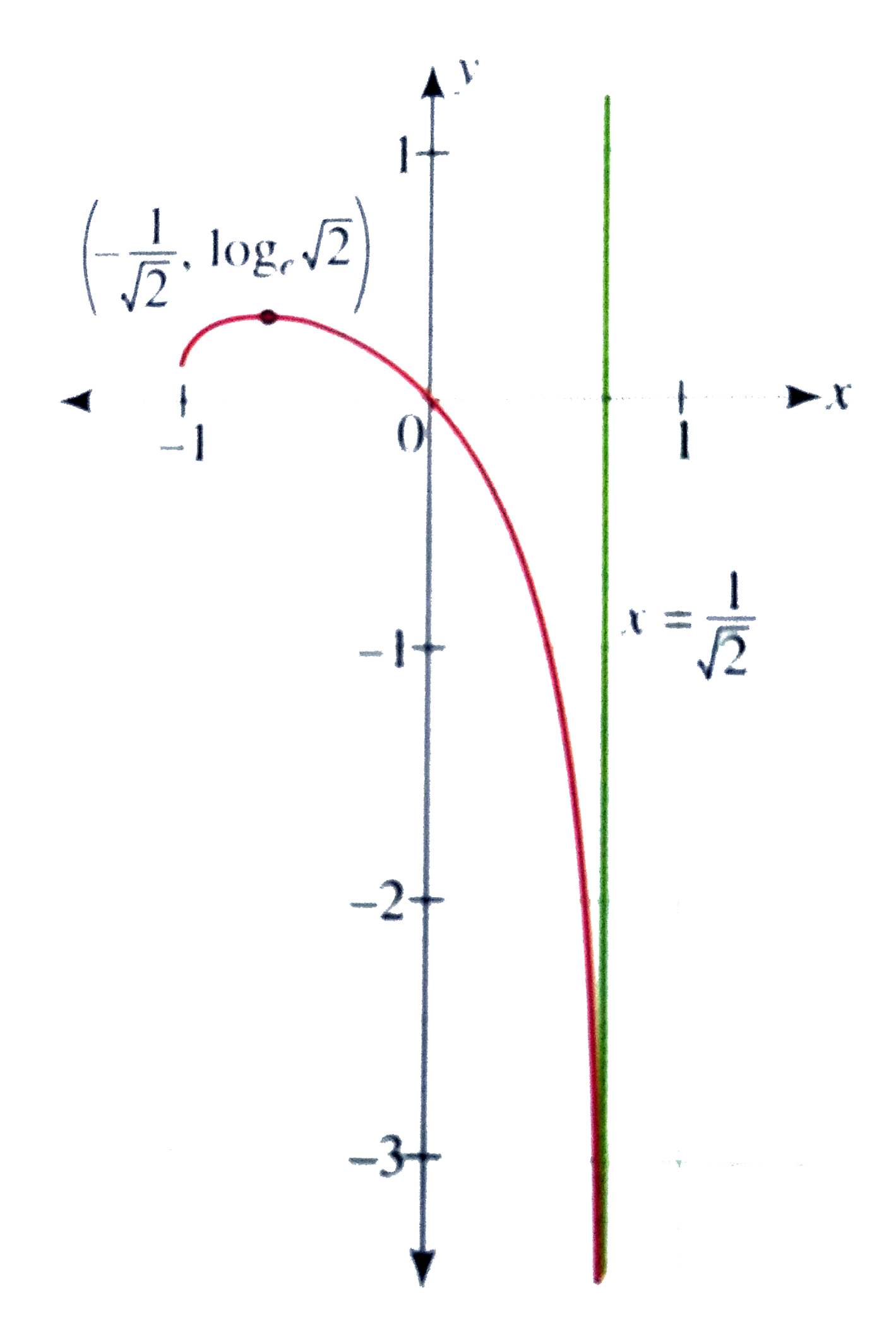
|
|