

Saved Bookmarks
| 1. |
Draw the graph of f(x) = sec x + "cosec " x,x in (0, 2pi) - {pi//2, pi, 3pi//2} Also find the values of 'a' for which the equation sec x + "cosec " x = a has two distinct root and four distinct roots. |
|
Answer» Solution :We have `f(x) = sec x + "cosec " x,x in (0, 2PI) - {pi//2, pi, 3pi//2}` CONSIDER each of the intervals `(0, pi//2), (pi//2, pi), (pi, 3pi//2), (3pi//2, 2pi)` For `x in (0, pi//2)` When `x to 0^(+) or x to pi//2^(-), sec x + "cosec " x to oo` ALSO in the `1^(st)` quadrant, sec x + cosec x gt 0 `f'(x) = sec x TAN x - "cosec " x cot x` `f'(pi//4) = 0,` so `x = pi//4` is clearly a point of minima. `f(pi//4) = 2sqrt(2)` For `x in (pi//2, pi)` When `x to pi//2^(+), sec x + "cosec " x to - oo` When `x to pi^(-), sec x + "cosec " x tooo` Also `f'(x) +sec xtan x - "cosec " x cot x gt 0` Hence f(x) is an increasing function. `f(3pi//4) = 0` For `x in (pi, 3pi//2)` When `x to pi^(+), sec x + "cosec " x to-oo` When `x to 3pi//2^(-), sec x + "cosec " x to-oo` `f'(5pi//4) = 0, " so " x = 5pi//4` is clearly a point of maxima. `f(5pi//4) = -2sqrt(2)` For `x in (3pi//2, 2pi)` When,`x to 3pi//2^(+), sec x + "cosec " x tooo` When `x to 2pi^(-), sec x + "cosec " x to-oo` Also `f'(x) +sec xtan x - "cosec " x cot x lt 0` Hence f(x) is a decreasing function. `f(7pi//4) = 0` From the above discussion, the graph of the function is as shown in the following figure. 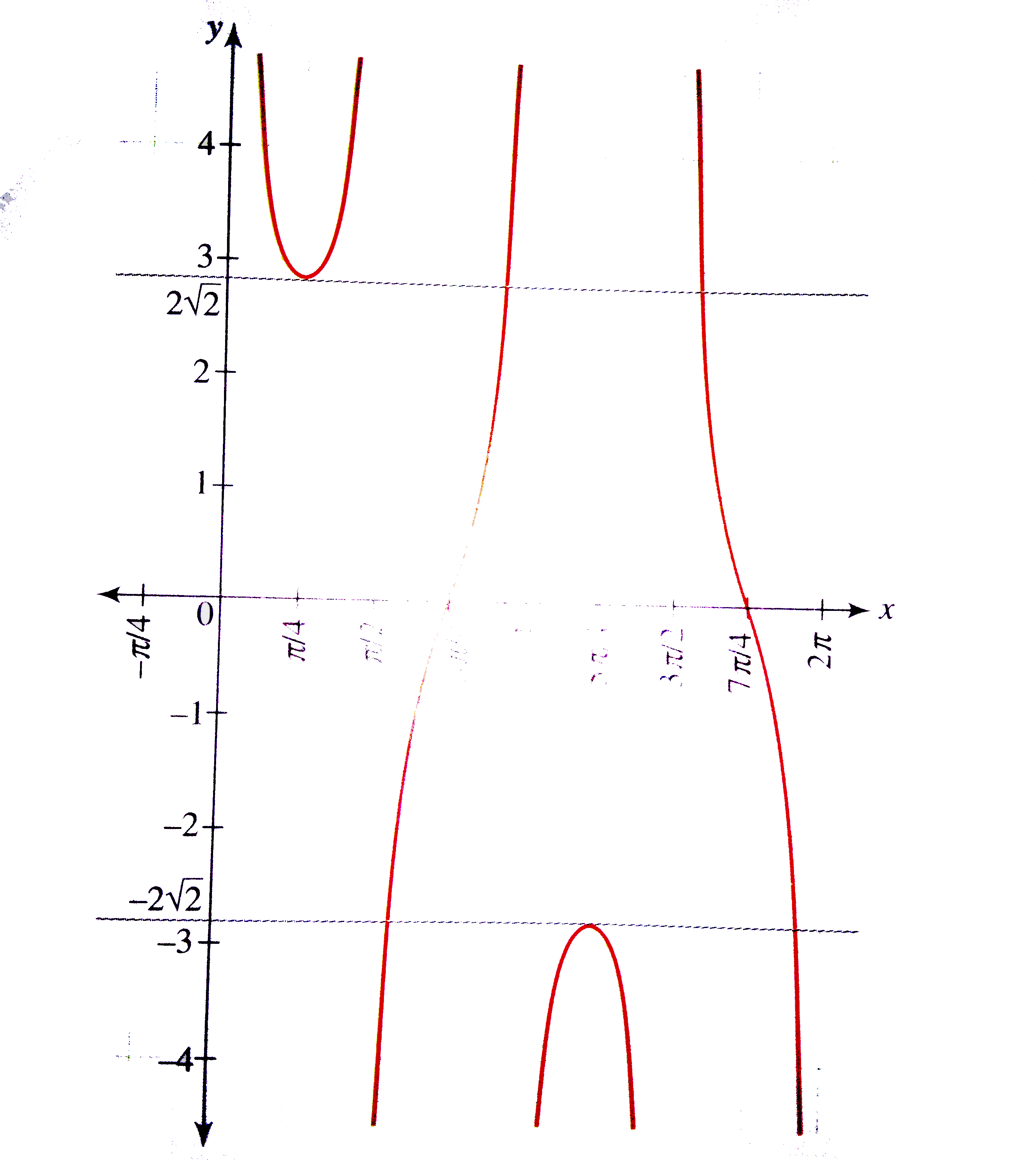
|
|