

Saved Bookmarks
| 1. |
Draw the graph of [y] = sin x, x in [0,2pi] where [*] denotes the greatest integer function |
|
Answer» Solution :We have [y] = sin x This is satisfied by INTERGRAL values of sin x only. So sin x = -1, 0, 1 When `sin x = -1, x = (4n - 1)(pi)/(2), n in Z` And `[y] = -1 therefore - 1 le y lt 0` When `sin x = 1, x (4n + 1)(pi)/(2), n in Z` And `[y] = 1 therefore 1 le y lt 2` When `sin x = 0, x = npi, n in Z` And `[y] = 0 therefore 0 le y lt 1` Hence the graph of the function is as shown in the following figure. 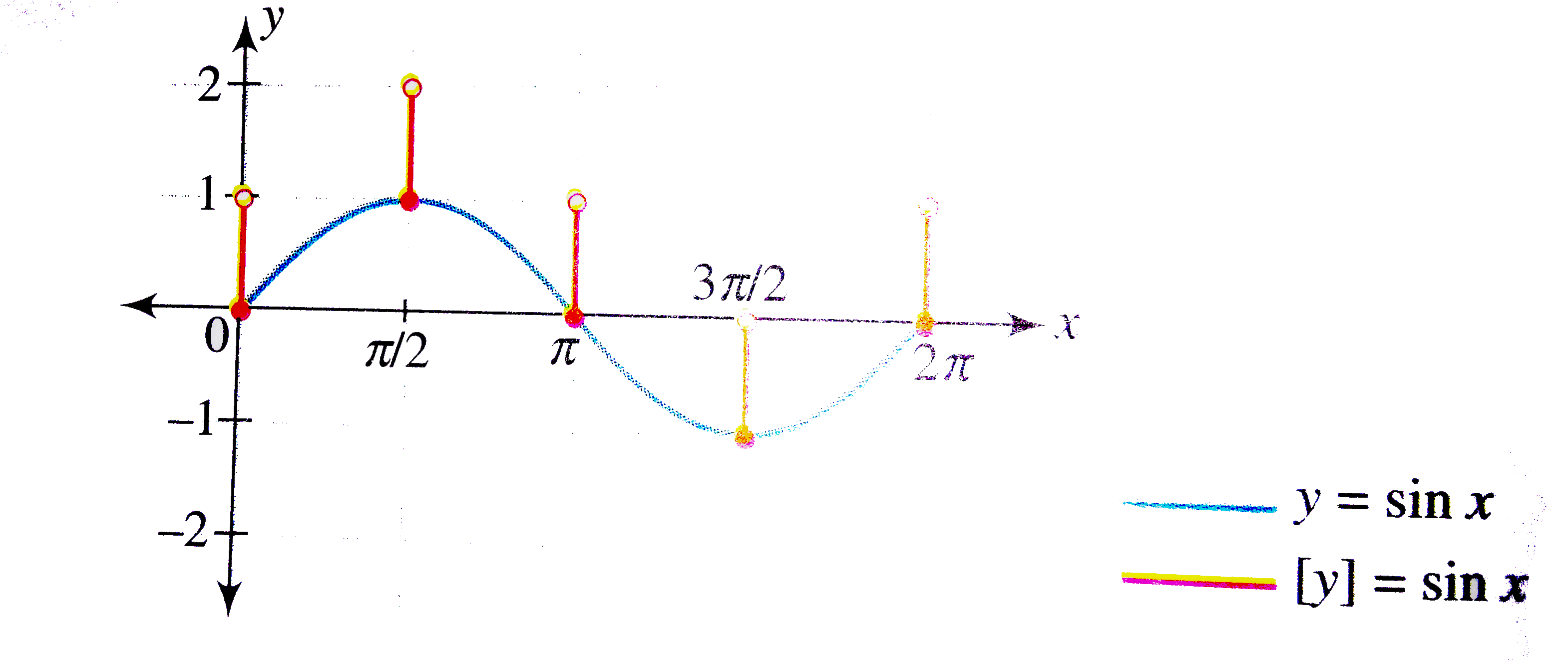 Drawing the graph of `g(x) = f(x) sin x` We have `g(x) = f(x) sin x`. Since `-1 le sin x le 1`, we have `-f(x) le f(x) sin x le f(x)`. Thus the graph of `g(x) = f(x)` sin x lies between th graphs of `y = f(x)` and y = -f(x). So the draw the graph of y = g(x), we first draw the graph of y = f(x) and y = -f(x) and PLOT the points of the graph for quadrant angles, i.e. `x = ... -pi, -pi//2, 0, pi//2, pi, 3pi//2, 2pi...` `g(pi//2) = f(pi//2) " sin " (pi//2) = f(pi//2),` thus the POINT `(pi//2, f(pi//2))` lies on the graph of y = f(x) `g(3pi//2) = f(3pi//2) " sin " (3pi//2) = -f(3pi//2),` thus the point `(3pi//2, - f(3pi//2))` lies on the graph of y = -f(x). Similarly, for `x = 5pi//2, 9pi//2, ...` points of y = g(x) lie on the graph of y = f(x), and for `x = 3pi//2, 7pi//2, ...` points of y = g(x) lie on the graph of y = -f(x). |
|