

Saved Bookmarks
| 1. |
Draw the graph of y=tan^(-1)((3x-x^(3))/(1-3x^(2))). |
|
Answer» Solution :We have `y=f(x)=tan^(-1)((3x-x^(3))/(1-3x^(2)))` Domain of f(x) is `R={-1/SQRT3,1/sqrt3}` Let x `= tan theta, theta in (-pi//2, pi//2)` `rArr""theta=tan^(-1)x` Now `tan^(-1)((3x-x^(3))/(1-3x^(2)))=tan^(-1)((3tantheta-tan^(3)theta)/(1-3tan^(2)theta))` `=tan^(-1)(tan3theta)` `tan^(-1)(tanalpha),"where "ALPHAIN(-3pi//2,3pi//2)` Now consider the graph of `y=tan^(-1)(tan ALPHA)," where "alpha in (-3pi//2,3pi//2)`. 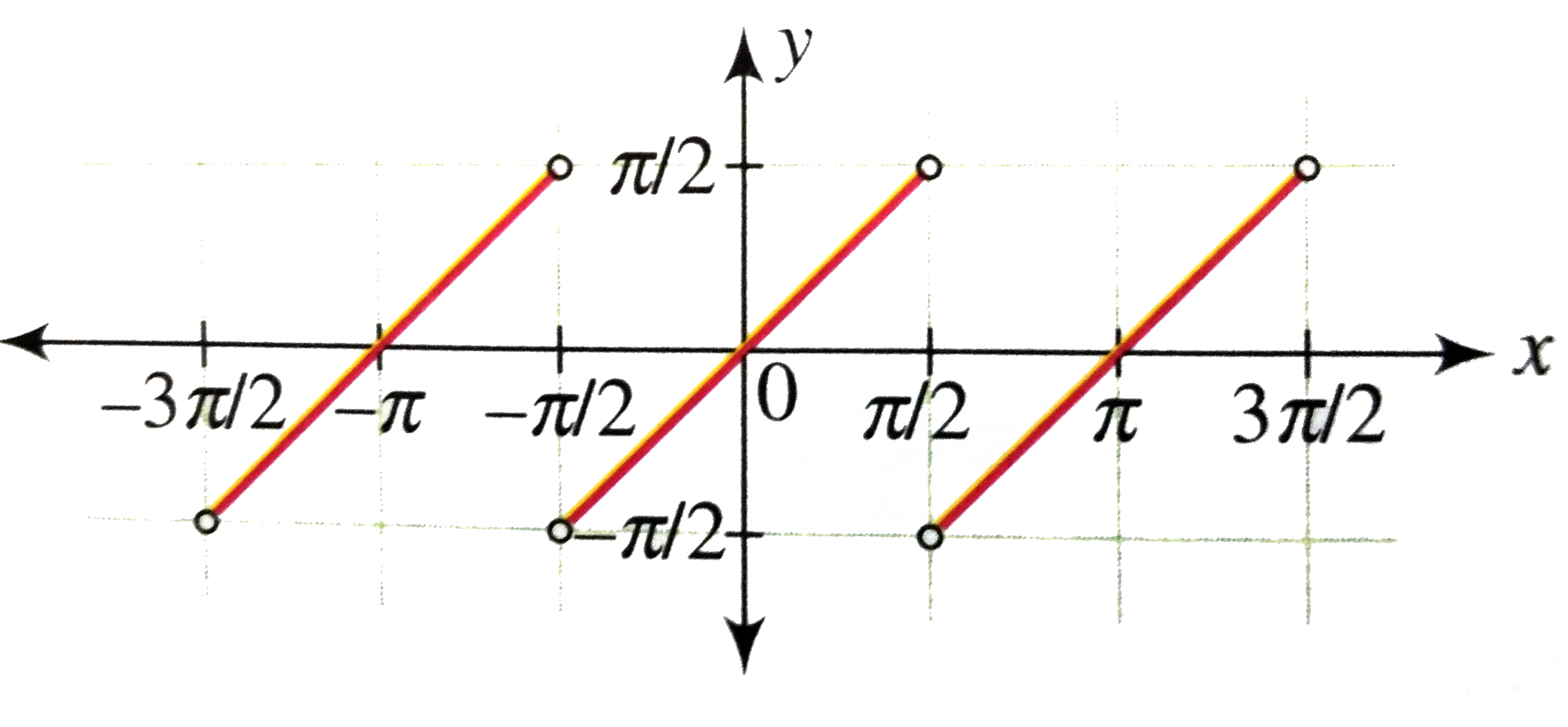 From the graph, `tan^(-1)((3x-x^(3))/(1-3x^(2)))=tan^(-1)(tan alpha)` `={{:(alpha+pi,-3pi//2ltalpha-pi//2),(alpha,-pi//2ltalphaltpi//2),(alpha-pi,pi//2ltalphalt3pi//2):}` `={{:(3 tan^(-1)x+pi,-3pi//2lttan^(-1)xlt-pi//2),(3 tan^(-1)x,-pi//2lt3tan^(-1)xltpi//2),(3tan^(-1)x-pi,pi//2lt3tan^(-1)xlt3pi//2):}` `={{:(3 tan^(-1)x+pi,-pi//2lttan^(-1)xlt-pi//6),(3 tan^(-1)x,-pi//6lttan^(-1)xltpi//6),(3tan^(-1)x-pi,pi//6lttan^(-1)xltpi//2):}` `={{:(3 tan^(-1)x+pi,-ooltxlt-1//2),(3 tan^(-1)x,-1//sqrt3ltxlt1//sqrt3),(3tan^(-1)x-pi,1//sqrt3ltxltoo):}` `tan^(-1)` is an invreasing function for `x in R`. So all brance functions in (i) are increasing functions `underset(xto-oo)(lim)(3 tan^(-1)x+pi)=-pi/2,underset(xto-1/sqrt3)(lim)(3 tan^(-1)x+pi)=pi/2` `3tan^(-1)x+pi=0:.x=-sqrt3` Thus, `tan^(-1)((3x-x^(3))/(1-3x^(2)))" increases from "-pi/2"to"pi/2"when x increases from "-oo"to"pi/2"intersecting the x-axis at x ="-sqrt3` `underset(xtooo)(lim)(3tan^(-1)x-pi)=pi/2,underset(xto1/sqrt3)(lim)(3tan^(-1)x-pi)=-pi/2` `3 tan^(-1)x-pi=0:.x=-sqrt3` Thus `tan^(-1)((3x-x^(2))/(1-3x^(2)))" increases form "-pi/2"to"pi/2" when x increases form "1/sqrt3" to " oo "intersecting the x-axis at x"=sqrt3` From this information, we can draw the graph of `y=tan^(-1)((3x-x^(2))/(1-3x^(2)))` can be DRAWN as follows. 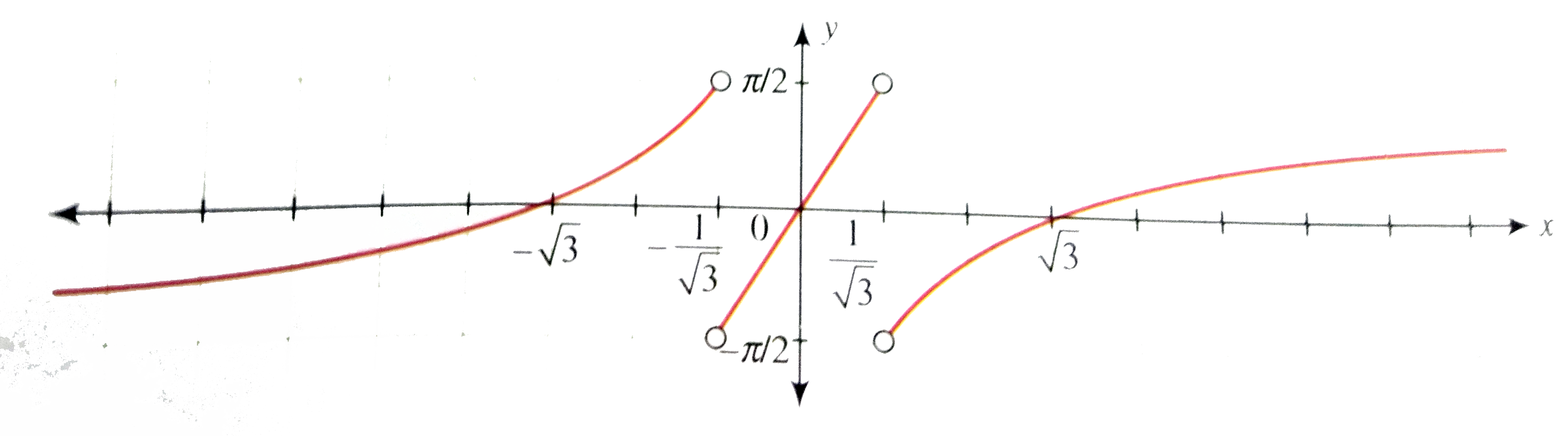
|
|