

Saved Bookmarks
| 1. |
Each side of a square has length 4 units and its center is at (3,4). If one of the diagonals is parallel to the line y=x, then anser the following questions. ,brgt The radius of the circle inscribed in the triangle formed by any two vertices of the square and the center is |
|
Answer» `2(sqrt(2)-1)` Also, the length of the DIAGONAL of the square is `4 sqrt(2)` Hence, the equation of one of the diagonals is `(x-3)/(1//sqrt(2))=(y-4)/(1//sqrt(2))=r = +-2 sqrt(2)` Hence, `x-3= y-4= +- 2` or `x=5,1` and `y=6,2` Hence, two of the VERTICES are `(1,2)` and `(5,6)` The other diagonal is parallel to the line `y= -x` , so that its equation is `(x-3)/(-1//sqrt(2))=(y-4)/(1 //sqrt(2))=r = +- 2 sqrt(2)` Hence, the two vertices on this diagonal are (1,6) and (5,2) 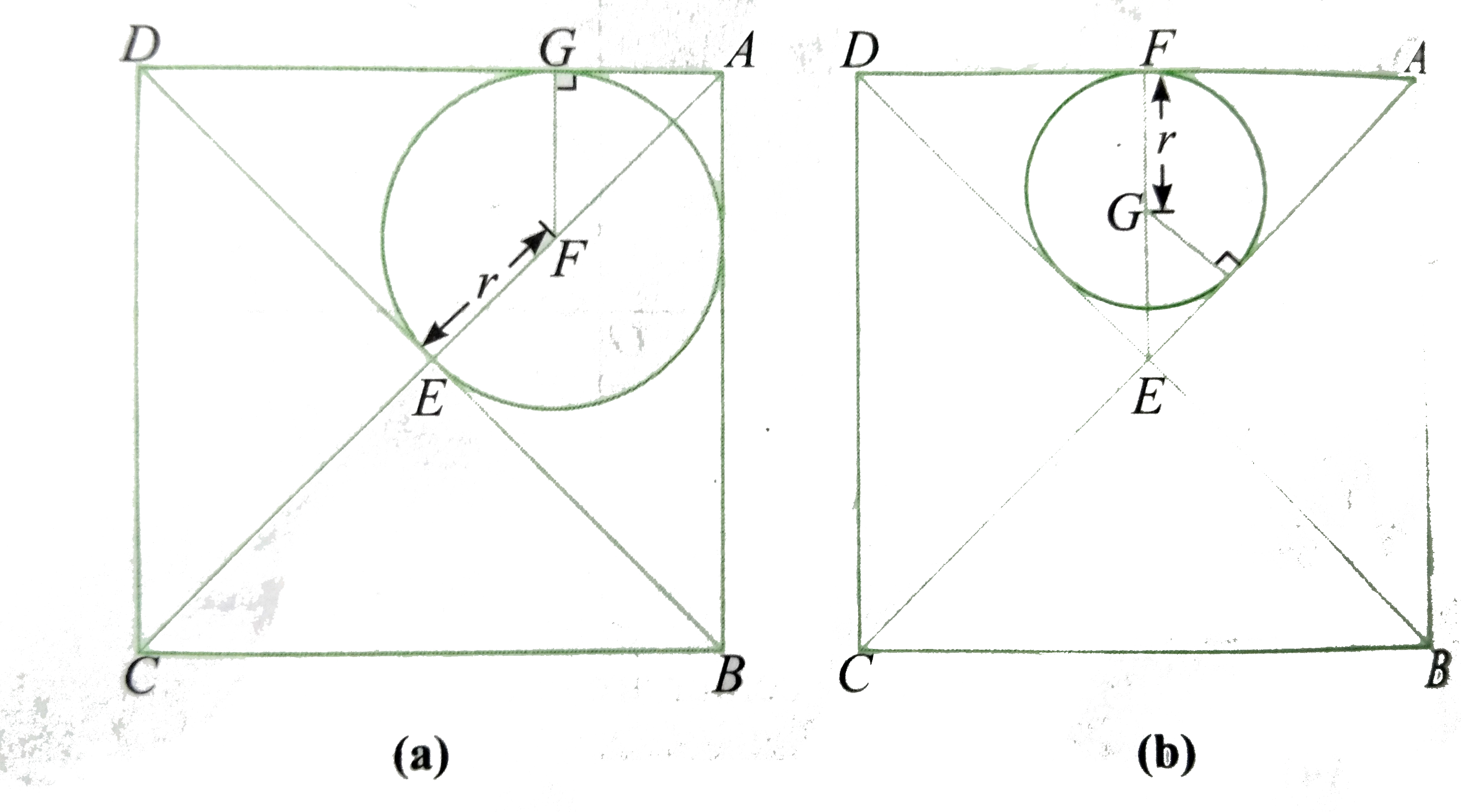 `AB =4, AC= 4 sqrt(2)` `:. AE =2 sqrt(2)` In first figure, `EF+FA = AE` or `r +sqrt(2) r = 2 sqrt(2)` or `r= (2sqrt(2))/( sqrt(2)+1)=2sqrt(2)(sqrt(2)-1)` In second figure, `EG +FG =EF` or `sqrt(2)r +r=2` or `r= (2)/(sqrt(2)+1)=2(sqrt(2)-1)` |
|