

Saved Bookmarks
| 1. |
Eleven identical rods are arranged as shown in Fig. Each rod has length l, cross sectional area A and thermal conductivity of material L. Ends A and F are maintained at temperatures T_1 and T_2(ltT_1), respectively. If lateral surface of each rod is thermally insulated, the rate of heat transfer ((dQ)/(dt)) in each rod is |
|
Answer» `((DQ)/(dt))_(AB)=((dQ)/(dt))_(CD)` 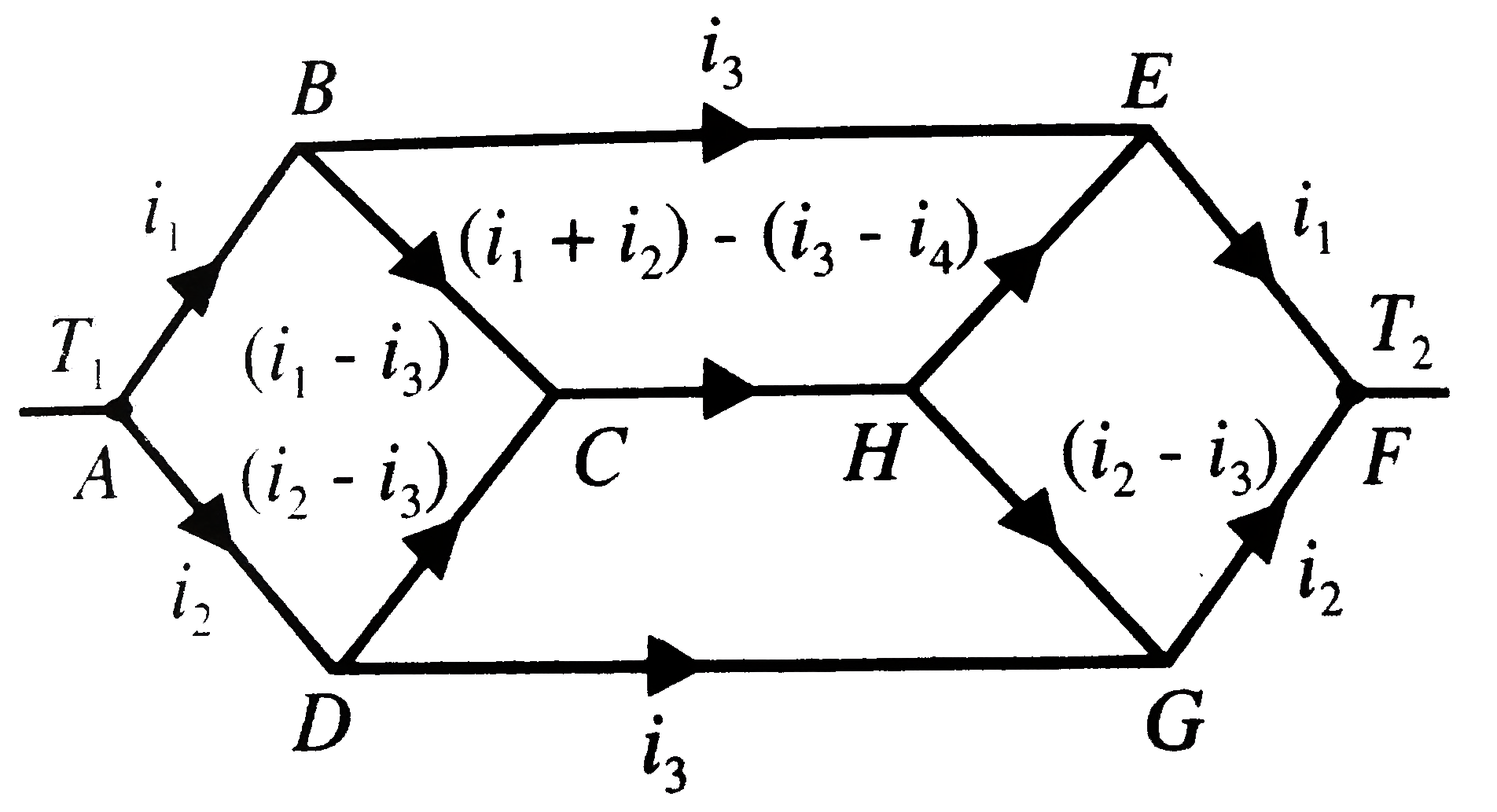 Resistance of each ROD `R=(l)/(kA)` In STEADY state `T_B=T_D` `T_E=T_G` Thermal current `((dQ)/(dt))=i` `i_1R+i_3R+i_1R=(T_1-T_2)` `2i_1+i_3=((T_1-T_2))/(R )` ..(i) `2i_1+i_3=(T_1-T_2)/( R)`.(ii) `i_1=i_2` For the path ABCHGF `i_1R+(i_1-i_3)R+2(i_1+i_3)R+(i_1-i_3)R+i_1R=(T_1-T_2)` `6i_i-4i_3=((T_1-T_2))/(R )=2i_i+i_3`.(iv) `4i_i=5i_3impliesi_3=(4)/(5)i_i`.(v) From eqs (ii) and (v) `2i_i+(4)/(5)i_1=((T_1-T_2))/(R )` `(14i_i)/(5)=((T_1-T_2))/(R )` Equivalent thermal resistance `((T_1-T_2))/(2i_i)=(7)/(5)R` `((dQ)/(dt))_(AB)=i_1=(5(T_1-T_2)KA)/(14l)` `((dQ)/(dt))_(BE)=(2)/(7)((T_1-T_2)KA)/(l)` `((dQ)/(dt))_(BC)=((T_1-T_2)KA)/(14l)` `((dQ)/(dt))_(CH)=((T_1-T_2)KA)/(7l)` 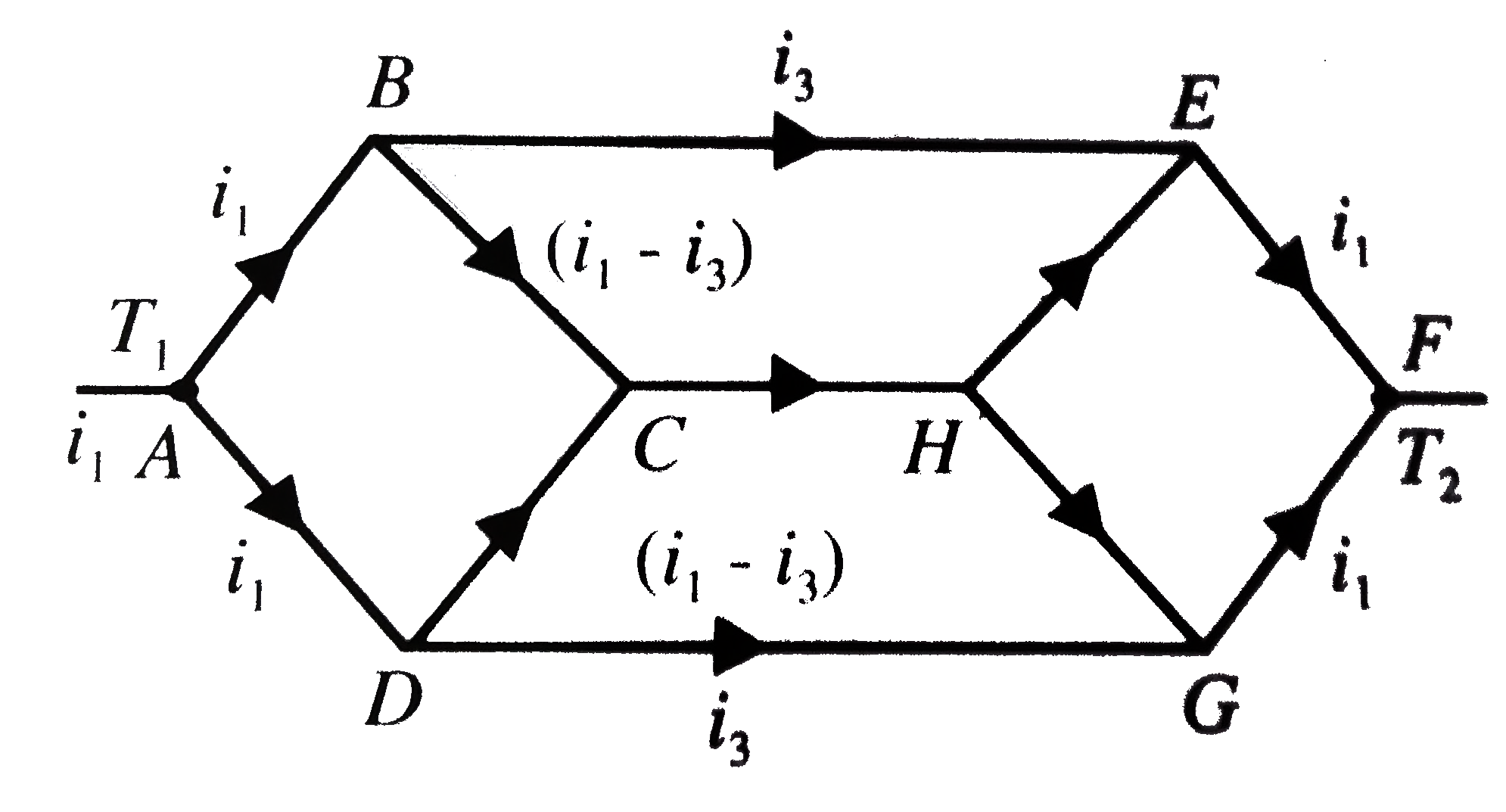
|
|